SlideServe
Menu
Préférences
© SlideServe · v2026

Understanding Preference Reversal in Behavioral Economics: Framing, Context, and Choice Dynamics

harper avatar
14 diapositives · 304 Views · Aug 02, 2014

This lecture explores preference reversal, a phenomenon where individuals prefer one option in a given context but assign it a lower value in another. It examines how framing, dual systems of thinking, and contextual influences dictate choices. Key concepts discussed include payoffs vs. probabilities, trade contrast, and extremeness aversion. Through experiments, it demonstrates how backgrounds shape perceptions and decisions, leading to inconsistencies in moral intuitions and value assessments. Readings from Kahneman, Tversky, and Simonson deepen understanding of these behavioral dynamics.
Understanding Preference Reversal in Behavioral Economics: Framing, Context, and Choice Dynamics - slide 1
01 / 14Understanding Preference Reversal in Behavioral Economics: Framing, Context, and Choice Dynamics
1 / 17

Télécharger la présentation

Understanding Preference Reversal in Behavioral Economics: Framing, Context, and Choice Dynamics
Une image / un lien ci-dessous est fourni (tel quel) pour télécharger la présentation

Politique de téléchargement : le contenu du site vous est fourni TEL QUEL pour votre information et votre usage personnel ; il ne peut être vendu, concédé sous licence ni partagé sur d’autres sites sans l’accord de son auteur.Le contenu vous est fourni TEL QUEL, pour votre information et votre usage personnel uniquement. Téléchargez la présentation en cliquant sur ce lien. Lors du téléchargement, si vous ne parvenez pas à télécharger une présentation, l’éditeur a peut-être supprimé le fichier de son serveur.Pendant le téléchargement, si vous ne parvenez pas à obtenir une présentation, le fichier a peut-être été supprimé par l’éditeur.

F I N

Plus de contenu associé

Transcription de la présentation
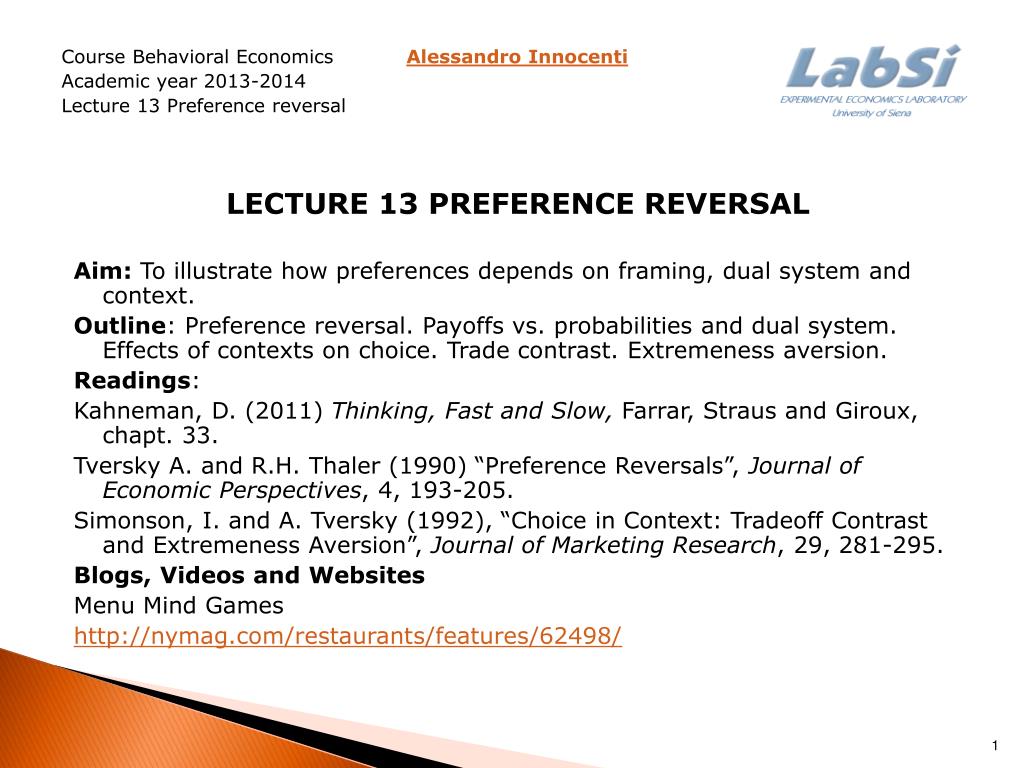
  1. Course Behavioral Economics Alessandro Innocenti Academic year 2013-2014 Lecture 13 Preference reversal Lecture 13 Preference Reversal Aim: To illustrate how preferences depends on framing, dual system and context. Outline: Preference reversal. Payoffs vs. probabilities and dual system. Effects of contexts on choice. Trade contrast. Extremeness aversion. Readings: Kahneman, D. (2011) Thinking, Fast and Slow, Farrar, Straus and Giroux, chapt. 33. Tversky A. and R.H. Thaler (1990) “Preference Reversals”, Journal of Economic Perspectives, 4, 193-205. Simonson, I. and A. Tversky (1992), “Choice in Context: Tradeoff Contrast and Extremeness Aversion”, Journal of Marketing Research, 29, 281-295. Blogs, Videos and Websites Menu Mind Games http://nymag.com/restaurants/features/62498/

  2. Crime victims compensation • Setting compensations for victims of violent crimes • A man lost the use of his arm as for a gunshot • He was shot when walking in a store in his neighborhood Two stores were located near the victim’s home, one of which he frequented more regularly than the other. Consider two scenarios: • The burglary happened in the man’s regular store. • The man’s regular store was closed for a funeral, so he did his shopping in the other store, where he was shot Should the store in which the man was shot make a difference to his compensation? Most people agrees on equal compensation in both situations System 2 explicitly compares the two scenarios and concludes that location is not relevant for compensation

  3. Crime Compensation Experiment Miller – Mc Farland (1986) Between-subjects experiment Each subject sees only one scenario and asked to assign a monetary value to compensation Result: Victim was awarded a larger sum if he was shot in scenario 2 (store rarely visited) Regret as conterfactual feeling: “ if only he had shopped at his regular store..:” which triggers System 1’s associative mechanism based on WYSIATI Moral intuitions are not necessarily internally consistent

  4. PREFERENCE REVERSAL When facing a choice between gambles of nearly equal expected values in certain circumstances, to prefer one gamble but to place a higher monetary value on the other. One gamble offers a High probability of winning a small prize (safer) and the other offers a Low probability of winning a large prize (riskier). BetH: 8/9 towin $4 BetL: 1/9 towin $40 Most people preferBet H toBet L Butmost people put a highervalue on L whenaskedto state the lowest price at whichtheywouldbuyitforcash.

  5. Payoffs vs. probabilities or Dual System Lichtenstein - Slovic (1971) preferencesforgambles (and ratingsoftheirattractiveness) are more highlycorrelatedwithprobabilitiesofwinningthanwithpayoffsizes buying and sellingpricesofgambles are more highlycorrelatedwithpayoffsizesthanwithprobabilitiesofwinning. Kahneman 2011 Emotionalreactionsof system 1 determine single evaluation (H > L) Comparisonthatoccurs in joint evaluation (System 2) involves a mroecareful and effortfulassessment (L < H)

  6. Effect of contexts on choice Trade contrast the same product may appear attractive on the background of less attractive alternatives and unattractive on the background of more attractive alternatives Ex: x is of higher quality and y has a better price The choice between x and y is influenced by other implied tradeoffs in the set of options under consideration 2 pc x 960k memory - cost $1200 y 640k memory - cost $1000 x is chosen if the choice set includes pairs of options for which the cost of additional memory is greater than 320k memory for a cost of $200

  7. Effect of contexts on choice Extremeness aversion An option is more attractive to the respondent if it is an intermediate option in a choice set Attractiveness is lower for extreme options Based on Principle of Loss Aversion: losses loom larger than gains Alternatives are evaluated in terms of their advantages and disadvantages relative to other options; disadvantages are weighted more heavily than advantages 3 VCR x highest quality and price z lowest quality and price y intermediate on both attributes Y is preferred because it has small advantages in relation to the other options

  8. Trade contrast - BACKGROUND EFFECTS Background effects: relevant alternatives encountered in the past Local effects : offered set of alternatives Experimental design three choices between options in the background set followed by two choices between options in the target set Choices among 2 or 3 PC with two attributes, memory and cost Exchange rate for the Background set (B) B1) $4 per 1K memory B2) $0.5 per 1K memory Exchange rate for Target set (T) $2 per 1K memory Results: Subjects exposed to B1 were more likely to select PC with bigger memory in T (52% vs. 18%) People’s choices appear to be influenced by the background, whether or not it provides pertinent information about the quality of options

  9. Trade contrast - LOCAL EFFECTS Local effects: offered set of alternatives If y is clearly superior to z but x is not, the addition of z to the set (x,y) will increase the attractiveness of y relative to x Contrary to standard economics, the popularity of an option can be increased by enlarging the offered set Failures of this axiom “irrelevant alternatives independency “represent a violation of value maximization Design 5 microwave ovens on catalog Subjects asked to examine all the five products carefully Then they were asked to choose between two or three out of five The addition of the less attractive oven increased the market share of the more attractive

  10. Trade contrast - LOCAL EFFECTS Cash versus goods All subjects were informed that some of them – selected randomly -would received $6 They were informed that the winners would have the option of the trading the $6 for a pen They were asked to indicate whether they would like to trade the $6 for a pen Later 10% of the participants received either $6 or the pen they had chosen Two treatments • elegant Cross pen • elegant Cross pen and a lesser known name selected for its unattractiveness The inclusion in the offered set of the less attractive pen increased the percentage of respondents who preferred the more attractive Cross pen from 36% to 46%

  11. Extremeness aversion Two forms of extremeness aversion Compromise and Polarization Px (y,z) > P(y,z) Pz (x,z) > P(y,x) Compromise The addition of x to (y,z) increase the share of y relative to z and the addition of z to (x,y) increases the share of y relative to x Disadvantages loom larger than advantages in both attributes Polarization Only one of the inequalities above holds Disadvantages loom larger than advantages on one dimension but not on the other

  12. Extremeness aversion - COMPROMISE Compromise test Set 1) Two Minolta cameras ($170 - $240) Set 2) Three Minolta cameras ($170 - $240 - $470) In set 1 both cameras were equally popular (50%/50%) In set 2 the addition of a more expensive camera increased the popularity of y relative to x from 50% to 72% The same compromise effect was also demonstrated when the added extreme alternative was not available for choice but only shown

  13. Extremeness aversion – POLARIZATION Polarization occurs when disadvantages loom larger than advantages on one dimension but not on the other For example extremes aversion for quality but little or no extremes aversion for price Ex. AM/FM cassette recorder, personal computer, binoculars, dental insurance As if quality may be perceived more important than price and consumers find the lowest quality more aversive than the highest price Different results for CD players and bets in which, respectively, sound quality and probability of winning are considered more important than price

  14. CONTEXT EFFECTS • During perception of any kind people generally use either sensory data (bottom-up design) or prior knowledge of the stimulus (top-down design) when analyzing the stimulus. We generally use both types of processing to examine stimuli.  • When context effects occur we are using environmental cues perceived while examining the stimuli in order to help analyze it. • When designing a new product managers should consider not only its attribute values but also its likely position in the relevant choice set. • The introduction of a middle option between a high price, high quality brand and a low price, low quality brand will hurt the latter more than the former • A new product positioned as clearly superior to another brand is likely to benefit from the extremeness effect