Overview of Low-Grade Kimberlite Pipes and Their High-Value Diamond Production
The resources within the Main and Satellite kimberlite pipes showcase a unique combination of low diamond grade but high value, reminiscent of alluvial deposits. All indicated resources are classified as probable reserves, while inferred resources remain unconverted due to cost constraints. The open pit mining method anticipates a 33-year mine life, producing significant diamonds over 100 carats, including the 603-carat Lesotho Promise. The mining employs traditional open-pit techniques, with ore treatment commenced in March 2008, leveraging the intrinsic properties of diamonds for efficient recovery.

Overview of Low-Grade Kimberlite Pipes and Their High-Value Diamond Production
E N D
Presentation Transcript
1. Resources The two kimberlite pipes (Main and Satellite) that form the resources are low diamond grade, high diamond value. This is unique for kimberlite deposits and is more characteristic of an alluvial deposit
All indicated resources have been converted to probable reserves (SAMREC)
Inferred resources, although significant, will not be converted due to the cost implications
Total resources that will be mined by open pit method indicate a 33 year mine life. This is based on the present plant throughput of the indicated and inferred resources
Production is characterised by regular production of large diamonds over 100 carats, including the Lesotho Promise which at a mass of 603 ct is the fifteenth largest diamond mined in the world and the Letseng Legacy at 494ct
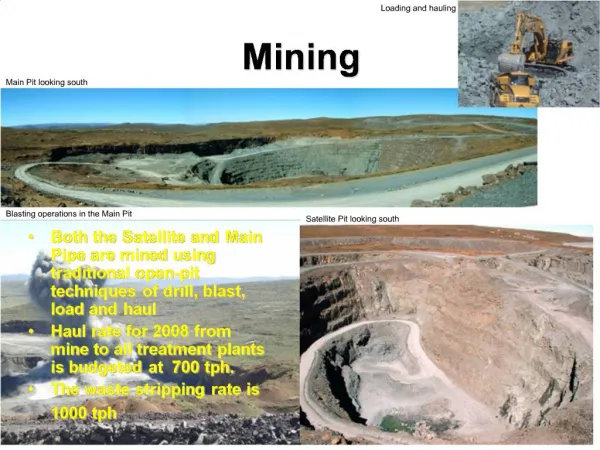
2. Mining Both the Satellite and Main Pipe are mined using traditional open-pit techniques of drill, blast, load and haul
Haul rate for 2008 from mine to all treatment plants is budgeted at 700 tph.
The waste stripping rate is 1000 tph
3. Treatment
4. Treatment First ore treated through No 2 plant on 23 March 2008
Commissioning and full production (350 tph) on target for end of 2nd quarter.
5. Treatment Processing Schematic.
6. Recovery Some diamonds fluoresce when exposed to x-ray and this property aids with the sorting process
7. Recovery A small example of the final products