Understanding the Wilcoxon Signed-Rank Statistic for Paired Data Analysis
The Wilcoxon signed-rank statistic is a crucial method for analyzing paired data. This technique involves calculating the differences (Di) between pairs, ranking their absolute values, and assigning signs based on the original differences. By summing the positive ranks, denoted by SR+, you can use this statistic to test for differences in treatments. The method allows for consideration of ties and can leverage critical values from tables or normal approximations for larger samples. Apply this analysis using R with practical examples for enhanced understanding.

Understanding the Wilcoxon Signed-Rank Statistic for Paired Data Analysis
E N D
Presentation Transcript
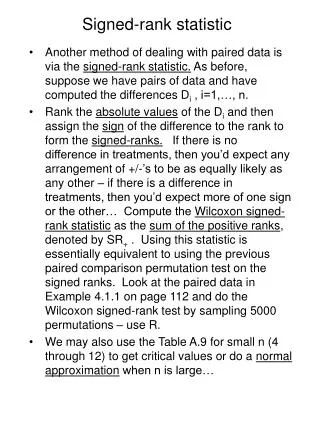
Signed-rank statistic • Another method of dealing with paired data is via the signed-rank statistic. As before, suppose we have pairs of data and have computed the differences Di , i=1,…, n. • Rank the absolute values of the Di and then assign the sign of the difference to the rank to form the signed-ranks. If there is no difference in treatments, then you’d expect any arrangement of +/-’s to be as equally likely as any other – if there is a difference in treatments, then you’d expect more of one sign or the other… Compute the Wilcoxon signed-rank statistic as the sum of the positive ranks, denoted by SR+ . Using this statistic is essentially equivalent to using the previous paired comparison permutation test on the signed ranks. Look at the paired data in Example 4.1.1 on page 112 and do the Wilcoxon signed-rank test by sampling 5000 permutations – use R. • We may also use the Table A.9 for small n (4 through 12) to get critical values or do a normal approximation when n is large…
Under the null hyp. of no diff. in trts, we’ll write • Now show that for large samples the signed-rank statistic is approximately normal: • HW for Tuesday: Show the formulas above for expected value and variance are true using the usual formulas for • Now let’s use the Wilcoxon signed-rank statistic on the cholesterol-reducing twin data (Ex. 4.1.1, p. 112) – use both the wilcox.test function in R and an explicit computation of SR+ .
There are two types of ties that are possible when we work with paired data: • ties when the two values in a pair are equal (giving a difference of 0) • ties of the absolute values of the differences (requiring mid-ranks) • We must decide what to do with the zeros that occur when the two values in a pair are equal… • the first method says to ignore the zeros and do the ranking based on the non-zeros • the second method says to include the zeros and do the ranking; but when it comes to assigning the signs to the ranks, give pluses to the positive differences, minuses to the negative differences, and 0 to the zero differences. • see Tables 4.2.3 (Ranking With Zeros) and 4.2.4 (Ranking w/out Zeros) on page 121 • check out SAS and R to see which of these methods is used in these languages…