Understanding the Legislative Process and Presidential Roles in U.S. Government
This comprehensive overview explores the critical steps of how a bill becomes a law, emphasizing the importance of popular sovereignty in holding representatives accountable for protecting citizens' rights. It details the limitations of the Legislative Branch as defined by our Constitutional Democracy and highlights key aspects of the Executive Branch, including presidential qualifications, election processes, and succession. Additionally, it outlines the president's roles and powers, including veto authority, executive orders, and the implications of the 25th Amendment, while reflecting on U.S. foreign policy goals.

Understanding the Legislative Process and Presidential Roles in U.S. Government
E N D
Presentation Transcript
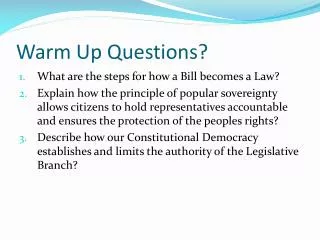
Warm Up Questions? • What are the steps for how a Bill becomes a Law? • Explain how the principle of popular sovereignty allows citizens to hold representatives accountable and ensures the protection of the peoples rights? • Describe how our Constitutional Democracy establishes and limits the authority of the Legislative Branch?
Terms • Executive Branch • Electoral College • Presidential Succession • Impeachment
Executive Branch Article II
Qualifications • Must be 35 yrs old • Live in USA for 14 yrs • Native Born
Election • Every 4 yrs in November on a Tuesday • Electoral College (need 270/538) The 538 equals all representatives in Congress + DC’s 3 • Winner take all system • Whoever wins the majority in state gets all electoral votes
Presidential Succession • 25th amendment deals with succession: • VP • Speaker of the House • Prez Pro Tempore • Secretary of State (Hillary Clinton-deals with diplomatic matters)
Term in office • 4 yrs = 1 term • Originally, there was no limit to how many terms a president could serve. In 1951, after FDR was elected 4 times the 22nd amendment was created and limited presidents to 2 terms.
Other Powers • Veto Power – rejecting bills from Congress • Executive Order – Directing to take certain actions • Pardons – Excuse a person from being punished for a criminal offense • Commute Sentences – Shorten the time someone spends in prison • Reprieves – Delay the implementation of a sentence • State of the Union – President reports to Congress on the state of the union and what he wants Congress to do in the coming year.
Limitations • Checks and Balances • Threat of Impeachment • The removal of the president if he/she violates the constitution. • Only House of Rep can impeach. • If a president is impeached they must still be convicted by the senate in order to be removed
Foreign Policy • What is foreign policy? • Nations overall plan for dealing with other countries • 4 Goals of US Foreign Policy • National Security – keep country safe • World Peace • Promoting democracy • International Trade
Reflection • Describe what roles does the president fulfill, and what authority come from such roles? • Explain what limitations are placed on the president by the Constitution? • What are the goals of American Foreign Policy? • What roles does the president fulfill in regard to American Foreign Policy? • What role does the Executive Branch play in the law making process? • What are some things the government can constitutionally do to ensure the safety of citizens?