Download
1 / 9
90 likes | 201 Vues
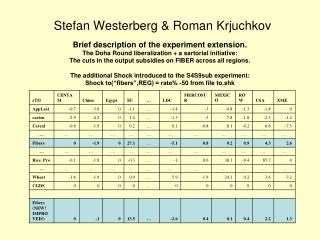
This experiment investigates the impact of reducing output subsidies for fiber across all regions as part of the Doha Round liberalization. Specifically, an additional shock is introduced to the S4S9sub experiment, applying a 50% reduction in subsidies for fibers (REG). The welfare implications are analyzed through a decomposition approach that evaluates the effectiveness of these cuts. The results aim to inform policy discussions regarding agricultural subsidies and their economic ramifications in various regions.

E N D
Stefan Westerberg & Roman Krjuchkov Brief description of the experiment extension. The Doha Round liberalization + a sartorial initiative: The cuts in the output subsidies on FIBER across all regions. The additional Shock introduced to the S4S9sub experiment: Shock to(“fibers”,REG) = rate% -50 from file to.shk
CNTendwir(i,r) = [0.01 * EVSCALFACT(r)] * [VOA(i,r) * [qo(i,r) - pop(r)]] qo(i,r) = sum(j,PROD_COMM, SHREM(i,j,r) * qfe(i,j,r)) + endwslack(i,r)