Understanding Common Logarithms: Characteristics and Evaluation Methods
Common logarithms, with base 10, are essential in mathematics, particularly for evaluating integral powers of 10. A common logarithm consists of two parts: the characteristic, which is the exponent of 10, and the mantissa, the common logarithm of a number between 1 and 10. This guide covers how to evaluate common logarithms using the change of base formula and provides examples including the calculations for logarithms of 50,000 and 0.005. Additionally, the antilogarithm concept is explained as a means to solve for x.

Understanding Common Logarithms: Characteristics and Evaluation Methods
E N D
Presentation Transcript
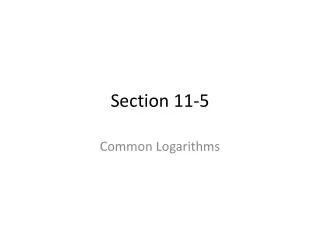
Section 11-5 Common Logarithms
Logarithms with base 10 are called common logarithms. You can easily find the common logarithms of integral powers of 10.
A common logarithm is made up of two parts. • Common Logarithm – logarithms that use ten as the base • Characteristic – the exponent of 10 that is used to write the number in scientific notation • Mantissa –the common logarithm of a number between 1 and 10
Mantissa Characteristic Is 6
Given that log 5 = 0.6990, evaluate each logarithm. a. log 50,000 b. log 0.005
Antilogarithm – written antilog a log x = 1.95 Use antilog to solve for x