Vasculitis
Vasculitis. Dr. Müge Bıçakçıgil Kalaycı. Vasculitis. A heterogenous group of clinical syndromes characterized by inflammation of blood vessels The clinical picture is essentially dependent on the size and extent of vessel involvement. Vasculitis. Ambiguity of clinical presentations

Vasculitis
E N D
Presentation Transcript
Vasculitis Dr. Müge Bıçakçıgil Kalaycı
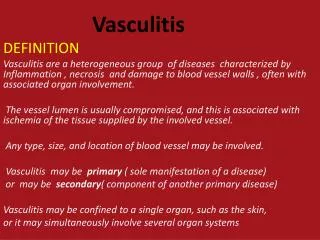
Vasculitis • A heterogenous group of clinical syndromes characterized by inflammation of blood vessels • The clinical picture is essentiallydependent on the size and extent of vessel involvement
Vasculitis • Ambiguity of clinical presentations • Limited diagnostic tests • Difficulty in obtaining diagnostic tissue • Therefore, difficult to diagnose • AND classify
Incidence of Vasculitis • Variable because of definitions • Kawasaki seen almost exclusively in pediatric population • Most other vasculitides in the fifth decade of life
All blood vessels can be affected from the largest (Aorta) to the smallest blood vessels in the skin (capillaries) • Blood Vessel Injury • Increased permeability • Weakening (Aneurysm +/-Hemorrhage) • Intimal proliferation and thrombosis, obstruction and local ischemia
Classification of Vasculitis • Vasculitis may be classified by: • The size and type of vessel involvement • The histopathologic features (leukocytoclastic, granulomatous vasculitis, etc.) • The pattern of clinical features
Classification of Vasculitis • Important to classify the vasculitis since some types may be self-limited while others may be chronic • However, initially it is important to determine the amount and extent of organ system involvement
CLASSIFICATION TREE Vasculitis Small Blood Vessel • Medium Blood Vessel • Polyarteritis Nodosa • Kawasaki’s Disease • Large Blood Vessel • Temporal Arteritis • Takayasu Arteritis Non-ANCA Associated • ANCA Associated • Wegener’s Granulomatosis • Churg-Strauss Vasculitis • Microscopic Polyangiitis • Drug Induced • Immune Complex • Hypersensitivity Vasculitis • Cryoglobulinemic Vasculitis • CTD related Vasculitis • Henoch Schonlein Purpura • Behcet’s • Miscellaneous • Paraneoplastic Vasculitis • Inflammatory Bowel Disease
LARGE VESSEL VASCULITIS • Giant Cell Arteritis (Temporal Arteritis) • Takayasu’s Arteritis
Temporal (Giant-Cell) Arteritis • Chronic granulomatousvasculitis affecting large arteries in older people • Inflammation of the walls of large arteries • Cranial arteritis(most common): • Temporal, occipital, ophthalmic • Subclavian, iliac/femoral • Aorta
Temporal (Giant-Cell) Arteritis • Most are >50 years of age (average 72) • Women>men • Females 70% • Gradual onset 64% • Prevalence high in Scandinavian countries • VERY rare in Blacks and Hispanics
Fever/wastingsyndrome • Feverandchills • Can sometimes present with Fever of Unknown Origin (FUO) • Anorexia, weightloss • Nightsweats • Weakness • Depression • Pain & Stiffness: • Around shoulders and hips (polymyalgiarheumatica) – 15%
CranialArteries – mostcommon • Headaches…….severe • Scalptenderness +/- thickenedvessels • Ischemicopticneuropathy • Loss of vision-diplopia • Jawclaudication in 50% • Tongueclaudication • CNS ischemia • Strokes
Large-vessel GCA/aortitis 10-15% • Arm claudication…femoral is rare • Pulselessness • Raynaud’sphenomenon • Aorticaneurysm • Aorticinsufficiency • PMR • Often lack cranial involvement
Scalp necrosis • Tongue gangrene • Cranial and peripheral neuropathies • Rare, isolated organ involvement
Temporal (Giant-Cell) Arteritis • Physical Examination • Very tender over temples • Swollen, rope like temporal artery • Optic disc swelling due to ischemia
Temporal (Giant-Cell) Arteritis • Investigations • Complete Blood Count (CBC) • Normochromic, normocytic anemia • Reactive thrombocytosis • WBC is usually normal • Erythrocyte Sedimentation Rate (ESR) • Significantly elevated • C-Reactive Protein (CRP) • Significantly elevated
Diagnosis • Biopsy in Temporal arteritis • Biopsy abnormal site • 4-6 cm. if not obviously abnormal • If strong suspicion and normal biopsy, then biopsy opposite side. • Doppler guidance?
Temporal Artery Biopsy Inflammation Multi-Nucleated Giant Cell
Three of thefollowingfivecriteriamust be met todiagnosis GCA. • 1-Age greater than 50 years • 2-new headaches • 3-abnormal temporal artery • 4-ESR≥50mm/h and • 5- positive temporal artery biopsy results for vasculitis
Therapy • Relative EMERGENCY as patient can lose vision • Urgent temporal artery biopsy (get the tissue) to confirm the diagnosis • Initiate high-dose corticosteroids (40-60 mg per day) • Relief DRAMATIC • Taper by 10% per 2 weeks • Duration – 9-12 months • Steoridsparingdrugs- MTX 10 mg/wk - maybe • Low dose ASA can be considered
PolymyalgiaRheumatica • A clinical syndrome of the middle aged and elderly characterized by pain and stiffness in the neck, shoulder and pelvic girdles,often accompanied by constitutional symptoms. • The clinical response to small doses of corticosteroids can be dramatic.
PolymyalgiaRheumatica: • Clinical features • The musculoskeletal symptoms are usually bilateral and symmetrical. • Morning Stiffness is the predominant feature • Muscular pain is often diffuse and is accentuated by movement; pain at night is common.
PolymyalgiaRheumatica: • Clinical features • Systemic features include low-grade fever,fatigue, weight loss and an elevated ESR. • Corticosteroid treatment is usually required for at least 2 years. • .
Increased ESR AND CRP • NO pathognomonic test • No myopathy
All of thefollowingcriteriamust be met todiagnose PMR: • 1- Agegreaterthan 50 years • 2-achingandstiffnessfor at least 1 month,affecting at leasttwo of thethreeabovementionedareas(ie,shoulders,neck, andpelvicgirdle) • 3-morningstiffnesslasting at least 1 hour • 4-ESR>40 mm/h • 5-exclusion of otherdiseasesexcept GCA and • 6-rapidresponsetoprednisone(<20 mgd)
Treatment of PMR • Prednisone 15 mg • Slow taper over 12 to 18 months • Possible mtx use as 2nd line agent • Look for temporal arteritis • Concept of benign outcome
Takayasu’s arteritis • Takayasu’s arteritis is a chronicinflammatory disorder of unknown etiologyprimarily affecting the aorta and its major branches. • Occurs most commonly in females under 40 years of age.
Takayasu’s Arteritis • Pathophysiology • Giant cells are seen invading the media & adventitia of affected vessels • Bw52 or DR12 • Immunogenetics of TA are less well defined • Exposure to an unknown antigen precipitates an uncontrolled,inflammatory immune response that primarily targets large vessels
Takayasu’s Arteritis • Clinical Picture • TA had a triphasic course: • 1. Early systemic complaints • 2. Followed by symptoms related to vascular inflammation • 3. Finally sequelae of vascular stenosis
Systemic phase: • malaise, fever, night sweats and fatigue. • Occlusive phase: upper limb claudication, headaches, postural dizziness and visual disturbances. • Reduced or absent upper limb pulses. • Arterial bruits over the carotid, abdominal and subclavian vessels
80% of patients had bruits most in the carotid arteries • Elevated blood pressure occurred in 33% • Diminished or absent extremity pulse occur over half of the patients with TA • Nervous system symptoms occurred , in over half experienced dizziness • Visual disturbance affected 1/3 of the patients, always bilateral
Takayasu’s Arteritis • Evaluation • ESR > 20mm/hr • Ultrasonography and MRI have been used • Angiography is considered the diagnostic goldstandard • Long stenotic lesions were seen in 98% of patients. • Aneurysms were seen in 27%
Diagnosis - 3 of 6 criteria 1. onset age < 40 years 2. Limb claudication 3. decreased brachial artery pulse 4.unequal arm BP(>10 mmHg) 5.subclavian and artic bruit 6.Angiographic evidence of narrowing or occlusion of aorta
Takayasu’s Arteritis • Management • Glucocorticoids are the mainstay of therapy • Other immunosuppressive therapies are used for patients who fail to respond to steroid therapy • Azathioprine and Methotrexate are frequently used & cyclophosphamide has been used with some
Beta-adrenergic blockers and angiotensin-converting enzyme (ACE) inhibitors can be used to treat hypertension • Percutaneous coronary transluminal angioplasty (PCTA) successfullyrestores patency in as many as 80% of these patients • Bypass surgery can be done.
Takayasu’s Arteritis • Prognosis • 5-10 years survival rates are in the range of 80-97% • Myocardial infarction, stroke, cardiac failure, aneurismal rupture are causes of death
Medium-sized Vessels • Polyarteritis Nodosa • Kawasaki’s Disease
Polyarteritis Nodosa (PAN) • Necrotizing arteritis of mediumsized muscular arteries • Pathology: “fibrinoid necrosis”
Hepatitis B Virus Association • Usually occurs during the first 6 months after infection • Usually positive for HBAgs and e antigen
Epidemiology of Polyarteritis Nodosa • Age: 20-70 years-old • No racial or ethnic predilection • Incidence • 2-4/1,000,000 annual incidence • 70-80/1,000,000/ in regions which • are endemic for Hepatitis B