'Understanding CPU Scheduling Fundamentals'
CPU scheduling is crucial in multiprogrammed systems, improving computer productivity by switching among processes efficiently. Learn about CPU bursts, schedulers, dispatchers, scheduling criteria, and popular algorithms including First-Come, First-Served, Shortest-Job-First, and Priority.

'Understanding CPU Scheduling Fundamentals'
E N D
Presentation Transcript
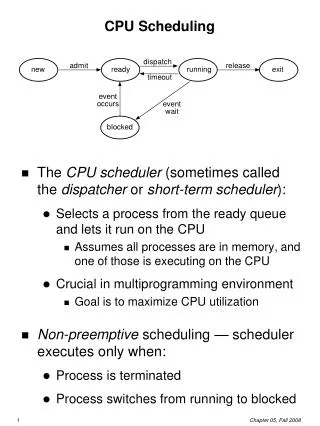
INTRODUCTION CPU scheduling is the basis of multiprogrammed operating system. By switching the CPU among processes, the operating system can make the computer more productive
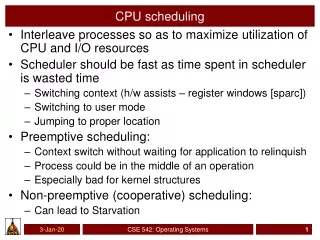
CPU – I/O Burst Cycle CPU Scheduler Preemptive / Nonpreemptive Scheduling
DISPATCHER • Switching context • Switching to user mode • Jumping to the proper location in the user program to restart that program
Scheduling Criteria • CPU utilization • Throughput • Turnaround time • Waiting time • Response time
SCHEDULING ALGORITHMS • First-Come , First-Served Scheduling Gantt chart: 24 27 30 0 Average waiting time: (0+24+27)/3 =17
Shortest-Job-First Scheduling Gantt chart: 0 3 9 16 24 Average waiting time: (3+16+9+0) / 4 = 7
Priority Scheduling Gantt chart: 0 1 6 16 18 19
Waiting Time: P1 = 6 P2 = 0 P3 = 16 P4 = 18 P5 = 1 Average waiting time: 8.2 milliseconds