Managing Milk CONCURRENCY in Roommates: A CS Theory Exploration
This document explores a concurrency problem faced by two roommates dealing with milk purchases, specifically analyzing scenarios where insufficient milk triggers a race condition between concurrent threads. It outlines the sequence of events where both roommates independently check for milk and execute a purchase function while managing shared state through notes. Various attempts at implementing thread safety in their milk-buying logic demonstrate the challenges and solutions in ensuring that only one roommate buys milk at a time, preventing oversupply.

Managing Milk CONCURRENCY in Roommates: A CS Theory Exploration
E N D
Presentation Transcript
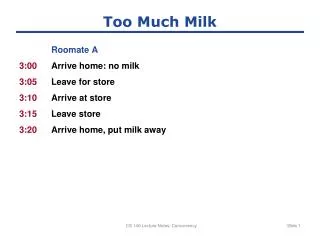
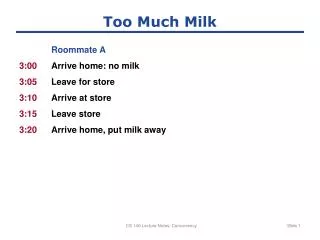
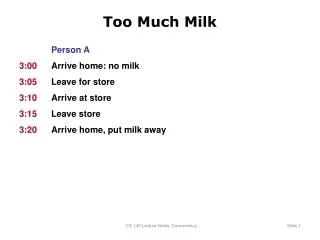
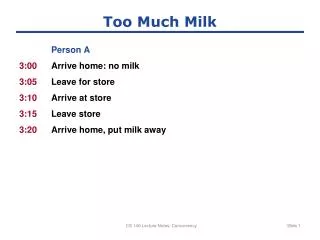
Too Much Milk Person A 3:00 Arrive home: no milk 3:05 Leave for store 3:10 Arrive at store 3:15 Leave store 3:20 Arrive home, put milk away CS 140 Lecture Notes: Concurrency
Too Much Milk Roomate ARoomate B 3:00 Arrive home: no milk 3:05 Leave for store 3:10 Arrive at store Arrive home: no milk 3:15 Leave store Leave for store 3:20 Arrive home, put milk away Arrive at store 3:25 Leave store 3:30 Arrive home: too much milk! CS 140 Lecture Notes: Concurrency
Computerized Milk Purchase if (milk == 0) { if (note == 0) { note = 1; buyMilk(); note = 0; } } CS 140 Lecture Notes: Concurrency
Still Too Much Milk Thread A:Thread B: if (milk == 0) { if (note == 0) { if (milk == 0) { if (note == 0) { note = 1; buyMilk(); note = 0; } } note = 1; buyMilk(); note = 0; } } CS 140 Lecture Notes: Concurrency
Thread A: if (note == 0) { if (milk == 0) { buyMilk(); } note = 1; } Thread B: if (note == 1) { if (milk == 0) { buyMilk(); } note = 0; } Second Attempt CS 140 Lecture Notes: Concurrency
Thread A: 1noteA = 1; 2 if (noteB == 0) { 3 if (milk == 0) { 4buyMilk(); 5 } 6 } 7noteA = 0; Thread B: 1noteB = 1; 2 if (noteA == 0) { 3 if (milk == 0) { 4buyMilk(); 5 } 6 } 7noteB = 0; Third Attempt CS 140 Lecture Notes: Concurrency
Thread A: 1noteA = 1; 2 if (noteB == 0) { 3 if (milk == 0) { 4buyMilk(); 5 } 6 } 7noteA = 0; Thread B: 1noteB = 1; 2 while (noteA == 1) { 3// do nothing 4 } 5 if (milk == 0) { 6buyMilk(); 7 } 8noteB = 0; Fourth Attempt CS 140 Lecture Notes: Concurrency