Concurrency Challenges: The Milk Dilemma in Roommate Dynamics
In a humorous exploration of concurrency issues, two roommates, A and B, face the familiar struggle of managing milk supplies. Both arrive home to find an empty fridge, leading them to embark on a synchronized mission to buy milk. As they navigate the complexities of threading, notes, and the frustrating "too much milk" scenario, their attempts to avoid duplicate purchases create chaotic yet comedic outcomes. This situation serves as a playful metaphor for cooperation and resource management within concurrent systems, a core concept in computer science.

Concurrency Challenges: The Milk Dilemma in Roommate Dynamics
E N D
Presentation Transcript
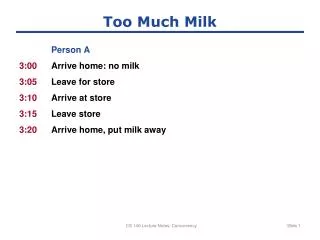
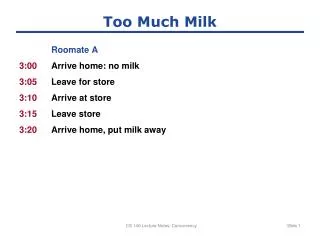
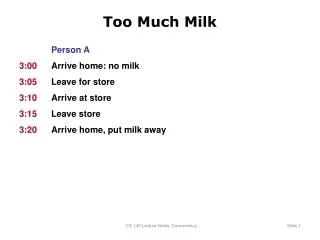
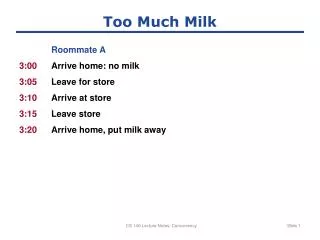
Too Much Milk Roommate A 3:00 Arrive home: no milk 3:05 Leave for store 3:10 Arrive at store 3:15 Leave store 3:20 Arrive home, put milk away CS 140 Lecture Notes: Concurrency
Too Much Milk Roommate ARoommate B 3:00 Arrive home: no milk 3:05 Leave for store 3:10 Arrive at store Arrive home: no milk 3:15 Leave store Leave for store 3:20 Arrive home, put milk away Arrive at store 3:25 Leave store 3:30 Arrive home: too much milk! CS 140 Lecture Notes: Concurrency
Computerized Milk Purchase 1 if (milk == 0) { 2if (note == 0) { 3 note = 1; 4buy_milk(); 5 note = 0; 6} 7 } CS 140 Lecture Notes: Concurrency
Still Too Much Milk Thread A:Thread B: 1 if (milk == 0) { 2if (note == 0) { 3 if (milk == 0) { 4 if (note == 0) {5 note = 1; 6buy_milk(); 7note = 0; 8 } 9 } 10 note = 1; 11buy_milk(); 12 note = 0; 13} 14 } CS 140 Lecture Notes: Concurrency
Thread A: 1 if (note == 0) { 2if (milk == 0) { 3buy_milk(); 4} 5 note = 1; 6 } Thread B: 1 if (note == 1) { 2if (milk == 0) { 3buy_milk(); 4} 5 note = 0; 6 } Second Attempt CS 140 Lecture Notes: Concurrency
Thread A: 1noteA = 1; 2 if (noteB == 0) { 3 if (milk == 0) { 4buy_milk(); 5 } 6 } 7noteA = 0; Thread B: 1noteB = 1; 2 if (noteA == 0) { 3 if (milk == 0) { 4buy_milk(); 5 } 6 } 7noteB = 0; Third Attempt CS 140 Lecture Notes: Concurrency
Thread A: 1noteA = 1; 2 if (noteB == 0) { 3 if (milk == 0) { 4buy_milk(); 5 } 6 } 7noteA = 0; Thread B: 1noteB = 1; 2 while (noteA == 1) { 3// do nothing 4 } 5 if (milk == 0) { 6buy_milk(); 7 } 8noteB = 0; Fourth Attempt CS 140 Lecture Notes: Concurrency