Parallel Hill Climbing Algorithm for Optimizing Data Access in Client-Provider Systems
130 likes | 261 Vues
This research presents a parallel hill climbing algorithm designed to optimize data access times in client-provider-server architectures. By generating permutations of file access orders based on AND, OR, and IMPLY dependencies, the algorithm minimizes the expected access time of clients, as shown through rigorous experimental comparisons against traditional random permutations. The findings indicate that parallel hill climbing can significantly outperform random methods, being 2 to 3 times faster while still attaining high-quality solutions. This advancement highlights the algorithm's potential application in efficient data broadcasting systems and client-server interactions.


Parallel Hill Climbing Algorithm for Optimizing Data Access in Client-Provider Systems
E N D
Presentation Transcript
Universidad Nacional Autónoma de México A parallel hill climbing algorithm for pushing dependent data in clients-providers-servers systems Francisco Javier Ovalle Martínez Julio Solano Gonzalez Ivan Stojmenovic Ivan@site.uottawa.ca www.site.uottawa.ca/~ivan
Data broadcast • -Server (satellite) broadcasts data files from providers in round-robin manner. • Clients may access two files in any order (AND), one out of two files (OR), and second file only after accessing first (IMPLY). • Order the files to minimize the access time of the clients given probabilities for desiring file pairs in AND-OR-IMPLY-AOI cases. Bar-Noy, Naor and Schieber MOBICOM 2000
Probabilities • F={F0, F1, ..., Fn-1}: n files of equal size. • AND, probability to access Fi and Fj is a(i,j). • OR, probability to access Fi or Fj is b(i,j). • IMPLY, probability to access Fi after Fj is c(i,j). • AOI, probabilities for AND(a), OR(b), IMPLY() user, a+b+=1 • Probability to access Fi-Fj pair in one of four given cases is x(i,j).
File permutation and expected access time • p = (p(0), p(1), ..., p(n-1)). • d(i,j) shorter cycle distance Fi - Fj • dd(i,j) directed distance Fi – Fj • A(p), B(p), C(p), E(p), X(p) • =expected access times for • AND-OR-IMPLY-AOI-any
Problem statement • Input: • n, a(i,j) / b(i,j) / c(i,j), AND/OR/IMPLY/AOI Compute distances for candidate : s = p-1,s(p(i)) = i d(i,j)=min{ ((s(i) - s(j)) mod n), ((s(j) - s(i)) mod n)} dd(i,j)= ((s(j) - s(i)) mod n) Output: Permutation that minimizes X(), X = A / B / C / E
Existing solution to minimize X() Bar-Noy, Naor and Schieber MOBICOM 2000 • Generate m random permutations, evaluate each in O(n2) time, choose the best one. • 2. Test m deterministically chosen permutations, choose the best one, not better than with random selection
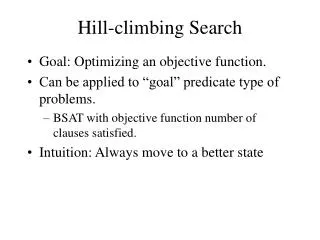
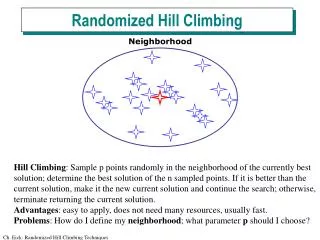
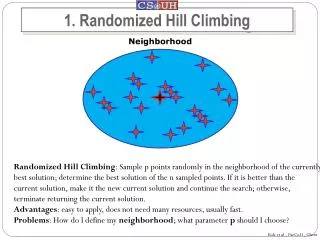
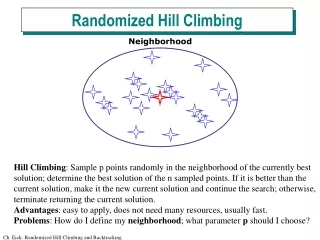
Hill climbing solution • Generate initial permutation p at random • Repeat • swap two bits of p at random to obtain p’ • If p’ is better then p=p’ • Until no improvement in max consecutive attempts • Parallel hill climbing: • Call hill climbing t times, choose best overall p
Why is (parallel) hill climbing faster • Calculation of X(neighbor(p) from X(p) can be done in O(n) time instead of O(n2) time in random permutation solution • Expected speed up is n times • Impact on quality of solution to be determined
Experiments – generating probabilities • Groups of files, e.g. sports, science, news • High probability for two files from the same group • Low probability for two files from different groups • t permutations of size n,t=15-75, n=5, 25 • Apply hill climbing on each, count total number of evaluated permutations • Generate the same number of random permutations for comparison • Experiment 2: run both algorithm for the same time
Experimental results • hill climbing algorithm is 2n-3n times faster that random permutations method, both in terms of • time needed to evaluate the same number of permutations, and • time needed to provide a high quality solution. Random permutation method produces high quality permutations, but requires extremely significant time to do so MATLAB used for experiments
Conclusions • Parallel hill climbing is superior to random permutation method in running time • Evolutionary computation, simulated annealing, tabu search, neural networks ... are not expected to furher improve significantly • Three or more files dependance can be studied • Some files could be repeated in cycle, providers with different file supplies, permutations with repetitions