Collaborative Songwriting Process: From Chords to Recording
This guide outlines a structured process for writing a song in a collaborative group setting. Over six weeks, participants will engage in various roles to create a cohesive piece of music. Begin by converting Roman numerals into chord sequences and experimenting with different arrangements. Utilize improvisation techniques to craft melodies and lyrics that fit the tune. After peer reviews and revisions, you'll finalize your song for recording. Key tips emphasize simplicity, rhythmic variation, and collaborative input from all musicians involved.

Collaborative Songwriting Process: From Chords to Recording
E N D
Presentation Transcript
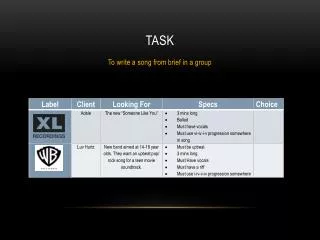
task To write a song from brief in a group
In your Group You Will Need A singer Someone to play the chords Someone to play the bass line Someone to play either percussion or riffs
Schedule • Week Two: Write song • Week Three: Recording 1 • Week Four: Peer review • Week Five: Improve song • Week Six: Recording 2 and assessments
How do I start? • Step 1: Translate the roman numerals to actual chord sequences (e.g. vi- IV- I- V will become Am- F- C- G)using the Song Writing Tools sheet. • Step 2: Experiment and try different chord sequences to see which ones you like. Choose one for the verse and one for the chorus. Whoever is playing chords will need to loop this. • Step 3: Using the relevant major/ minor scale, try improvising a short phrase over the chord sequence. (If unsure how, use Creating Phrasesto help you). Keep repeating until section is complete! KEY POINT: Make sure you use the words when you are doing this, the tune must fit the words and vice versa! • Step 4: Repeat for another section of music, until you’ve got complete phrases for verse, chorus and middle 8. • Step 5: Practice putting them together and playing the whole song. • Step 6: What works? What doesn’t? Go back and make changes, and then test again.
Top Tips • Singers: Keep the phrases simple. Real life songs are only based on a few repeated notes in each section. • Singers: Remember you need to breathe. Leave space, don’t clutter it with notes. • Chord players: Find interesting ways to play your chords: remember you can change the rhythm and completely change the sound. • Bass players: Start with just the root notes that the chord player plays, then build it up as you go. Roots and 5ths always sound great!