Developing Your Leadership Competencies
290 likes | 402 Vues
This seminar, led by Roy Romero, CPA, and Stan Payton, aims to explore essential leadership competencies that can enhance leadership abilities. Participants will learn how to create new leadership behaviors through affirmations and utilize tools that develop a personalized leadership roadmap. Engaging activities such as Leadership Autograph Seeker Bingo will foster networking and sharing experiences among participants. By understanding the components of competency frameworks, including values, cognitive skills, and diversity, attendees will embark on a transformative journey towards improved leadership capabilities.


Developing Your Leadership Competencies
E N D
Presentation Transcript
Developing Your Leadership Competencies Roy Romero, CPA Inside Results Stan Payton SPACS.com
I Am Who I Am • Why am I here? • What do I expect to learn? • If I rate this seminar from 1-10 (ten being the highest possible rating), what rating do I expect to give?
OBJECTIVES • Understand Leadership Competencies • Understand how competencies can be used to improve Leadership abilities. • How Affirmations create new leadership behaviors • Tools that help your determine your leadership roadmap. • Begin your path towards leadership development
Leadership Autograph Seeker Bingo • Obtain signature from fellow participants in boxes that identify with their experiences. • First person to black out card call out “BINGO” • Prize for the winner.
Traits and Components Commonly Found in Leadership Competency Models • Values • Cognitive Skills • Interpersonal Skills • Diversity Components • Change Orientation A competency model is a roadmap to individual and group leadership success.
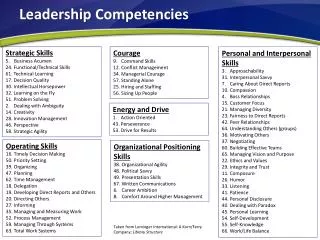
Components of Competency Frameworks • Competencies are labels that describe how they relate to leadership and behavior • Competencies are often written as definitions that describe observable behaviors • Various types of frameworks used, many similarities, many differences • Army – Field Manual 22-100 • ECQ’s – 5 Areas, 27 competencies • Marines -11 Principles, 14 Traits • IRS - 5 Core Responsibilities, 21 competencies • Others?
Values Values are our core beliefs that we feel most passionate about. There are individual, family, community, cultural and work values. For example: • Family • Spiritual • Learning • Integrity • Honesty • Self Awareness
Cognitive Skills • Decisiveness • Problem Solving • Political Savvy • Strategic Thinking • Entrepreneurship • Analytical Thinking • Technical Knowledge Cognitive skills represents knowledge acquired through perception, reasoning, and intuition. (i.e. analytical skills, learned processes like problem solving, planning and monitoring)
Interpersonal Skills • Oral Communication • Written Communication • Influencing & Negotiating • Developing Others • Coaching • Mentoring • Partnering Interpersonal skills pertain to interactions between individuals.
Diversity Components • Cultural Awareness • Diversity Awareness • Teamwork • Customer Focus Diversity encompasses the understanding, respect and acceptance of the various differences and uniqueness of individuals.
Change Orientation Change orientation is a systematic approach to achieving change at individual and organizational levels. • Leading Transformation • Risk taking • Achievement Orientation • Change Management • Creativity • Innovation • Adaptability • Flexibility • Resilience
Exercise • Break into groups of four • Discuss various types of models from your respective organizations • What categories are emphasized most? • Values • Cognitive • Interpersonal • Diversity • Change
What is Leadership? • Influencing, motivating and inspiring others through direct or indirect means to accomplish organizational goals. • John Maxwell: Influence, nothing more and nothing less. • What aspects come to your mind when you think about leadership?
Interesting Facts About Leaders and Leadership Development • Leadership skills are developed • Leaders are viewed through their strengths • As you develop your strengths, perceptions of your other skills improves (halo effect) • Don’t concentrate on weaknesses unless they are profound
What are Leadership Characteristics? • Flipchart
Developmental Process Projected Goal Self-Image Comfort Zone
What is Your Self-Image About Your Personal Leadership Capabilities? • I am a great leader. • I have many leadership skills. • I have leadership gaps. • I am not a leader. • I don’t know how leadership skills impact me. • I don’t really understand leadership. • I prefer to follow than to lead
Your Current Reality about Leadership is Your Comfort Zone • Your current reality is “your truth” and is the area in which you are comfortable. • To develop your leadership skills you must be willing to move out of your comfort zone.
Developing Your Leadership Capabilities Projected Goal ____ “Creates Tension” Self-Image Comfort Zone
Leadership Picture Summary • Current reality (Where you are now) • Your comfort zone (Where you feel comfortable now) • Affirmation creates picture of projected reality • Repeated affirmations make picture clearer • Creates tension (creative tension) • You begin moving towards the projected reality • Learning opportunities take place • Resources become available • Your projected reality becomes your new current reality
Affirmations • We make them all of the time. • They can be positive or negative. • When an affirmation takes us out of our current reality (and comfort zone), we have a natural tendency to move back within our comfort zone. • Repeating Affirmations helps us to see a new reality with more clarity and helps us to create a new “comfort zone” • It is through this learning process that we can begin to extend and develop our leadership skills
Affirmations Influence Leadership Development • What is an affirmation? • Self Talk • Talk to others
Guidelines for Writing Affirmations • Personal • Positive • Present tense • Indicate achievement • No comparison • Action words • Emotion words • Accuracy • Balance • Realistic • Confidential
Affirmation Statements • I easily earn respect with my team by sharing power and control. • I eagerly invest in and develop my team members, readying them for full empowerment. • I easily collaborate with my team, sharing authority, control, responsibility and rewards. • I am easily trusting of others when we meet. • I value ideas and input others have to offer. • I respect and value others opinions even when I don’t agree. • It is just like me to consistently show respect for all employees and help them transfer that respect to our customers. • My actions reveal high self-confidence in what I do and how I do it – and I take actions that instills self-confidence in others. • I am fully aware of attitudes and behaviors that reveal my “best self” day in and day out.
Leadership Development Cycle • Assessment and Alignment • Individual Learning • Social Application • Sustain and Reinforce • Measure and repeat process
Profound Leadership Assessment Tool Stan Payton Computer Guru
Path to Leadership Development • Affirmations • Assessment tools • Action Plan • Reading • Observing behavior • Formal program • Community leadership activities • Other
Exercise • Write three affirmation statements that improve your leadership capabilities • Write three affirmation statements pertaining to your personal development • Begin to explore the paths that will make your affirmations Your Reality
Conclusion • Why was I here? • What did I learn? • I rate this seminar from 1-10 (ten being the highest possible rating)