Engineering Streptavidin in E. coli: Overcoming Toxicity and Enhancing Functionality
This project aims to create a fusion protein expressing streptavidin on the surface of E. coli for biotin binding. Streptavidin, a tetrameric protein from *Streptomyces avidinii*, binds biotin with high affinity. However, issues such as toxicity and solubility must be addressed. Strategies include using the T7 promoter for controlled expression and engineering mutations to favor monomer formation. The experimental agenda involves designing primers, PCR amplification, and testing functionality. Ultimately, this system could enable versatile biotinylated compound bindings.

Engineering Streptavidin in E. coli: Overcoming Toxicity and Enhancing Functionality
E N D
Presentation Transcript
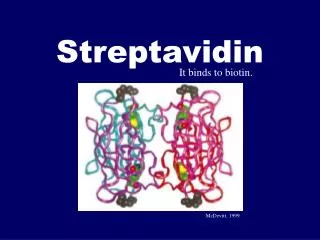
It binds to biotin. Streptavidin McDevitt, 1999
Streptavidinfo • Found in bacteria Streptomyces avidinii • Full-length ~160 aa’s, core ~ 140 aa’s • Binds to biotin (vitamin H or B7) • Kd ~ 10-15 M (Chaiet, 1964) • Forms tetramers • Strong monomer-monomer interactions • Weak dimer-dimer interactions (Sano, 1997) • Biotin binding relies heavily (10-7) on Trp-120 of neighboring subunit (Sano, 1995) • No cysteines, no carbohydrates, no charge, no problem
The goal • To create a fusion protein in E. coli expressing streptavidin on the surface • Can bind anything biotinylated • Peptides • DNA • Antibodies
Problems • Toxicity • Tetramer vs. monomer • Solubility
Toxicity • Biotin is important for many of E.coli’s metabolic pathways. • Streptavidin binds biotin and makes it unavailable. • Solution: T7 promoter/RNA polymerase • This was for one-time expression/harvesting (~35% of total protein in Sano, 1990).
Engineering by mutation • Introduce amino acid mutations to disrupt tetramer formation and to improve solubility • Sano, 1997: H127D to form dimers; delete G113-W120 loop to increase solubility • Qureshi, 2001: S45A, T90A, D128A to form soluble, functional monomers, Kd = 1.7x10⁻⁶ M • Qureshi, 2002: T90A, D128A, Kd = 1.3x10⁻⁸ • Wu, 2005: T76R, V125R (monomer) V55T, L109T (soluble), reported better solubility than Qureshi 2002, Kd = 2.2x10⁻⁷
Looser biotin affinity • Reversibility • Purification • Recyclable • Non-toxicity (Wu, 2006) • Still good binding
Concerns for this project • Toxicity may not be an issue when expressed on the surface. • We don’t “need” monomers. • We do need solubility ~ hydrophilicity.
In other news • A bifunctional chimeric protein • Streptavidin + MMP inhibitor (Farlow, 2002) • Cell recognition peptides • RGD adhesion sequence to rat aortic endothelial and human melanoma cells (McDevitt, 1999) • Streptavidin-based containment systems • 99.9% culture suicide in 8 hr, induced by absence of hydrocarbon substrate (Kaplan, 1999)
Agenda • Design and order primers, obtain streptavidin and membrane protein genes/constructs 1 wk • PCR into BioBricks; mutagenesis; sequencing. 3 wks • Assembly and cloning. 2 wks • Test functionality. 2 wks • 3-4 people.