Download
1 / 8
80 likes | 204 Vues
This overview of the nervous system elaborates on its two main divisions: the Central Nervous System (CNS) comprising the brain and spinal cord, and the Peripheral Nervous System (PNS) which includes somatic and autonomic systems. Key features such as neurons, synaptic transmission, and the role of various brain regions like the cerebellum, limbic system, and basal ganglia in functions like memory, emotion, and motor control are discussed. Understanding these components provides insights into neural processes essential for human behavior and physiology.

E N D
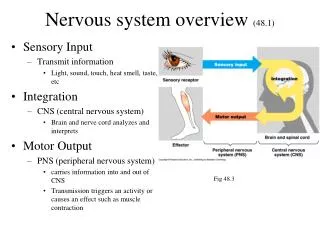
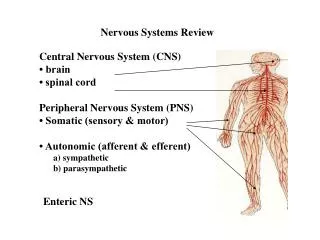
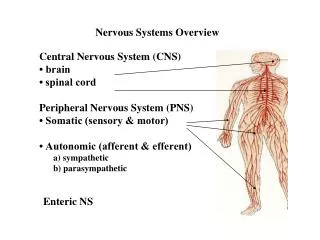
Nervous Systems Overview • Central Nervous System (CNS) • • brain • • spinal cord • Peripheral Nervous System (PNS) • • Somatic (sensory & motor) • • Autonomic (afferent & efferent) • a) sympathetic • b) parasympathetic Enteric NS
The Nervous Systems + Afferent nerves to CNS + Sensory nerves +
Neural Transmission at the Synapse Axon Hillock Retrograde messenger Autoreceptors Receptor or
Mid -sagittal Section of the Brain Pituitary Gland
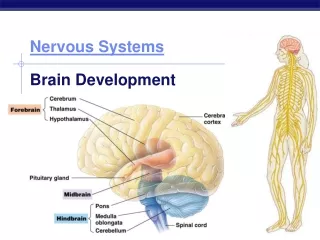
Brainstem Medulla: autonomic nuclei Pons: sleep (REM), wakefulness nuclei Midbrain (mesencephalon): dopamine (DA), norepinephrine (NE), serotonin (5-HT) nuclei Cerebellum: sensory-motor integration, classical conditioning memory Reticular Formation: sleep and waking
Diencephalon Thalamus: sensory-motor association intrinsic Hypothalamus: emotions (autonomic) hunger, thirst, sex, sleep reward, punishment Pituitary Gland
Telencephalon • Limbic System: amygdala, septum (subcortical), hippocampus (archicortical), cingulate gyrus (paleocortical); Kluver-Bucy, Papez-MacLean • Basal Ganglia: nucleus accumbens (Olds: intra-cranial self-stimulation), striatum (Parkinson’s) • Neocortex: frontal, parietal, temporal, occipital lobes