Nucleic acids
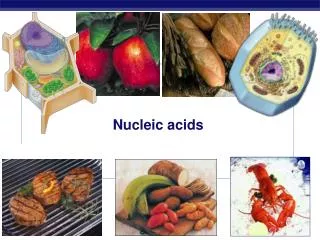
Nucleic acids, comprising DNA and RNA, are crucial macromolecules that serve as the primary information storage systems in biological organisms. DNA, with its double helix structure, contains genetic blueprints that direct cell functions and protein synthesis through transcription to RNA and translation to proteins. RNA, a single-stranded nucleic acid, plays various roles in coding, decoding, regulation, and expression of genes. Nucleotides, the building blocks of nucleic acids, consist of a nitrogenous base, a pentose sugar, and a phosphate group, forming polymers vital for life's biological processes.

Nucleic acids
E N D
Presentation Transcript
Nucleic Acids Informationstorage
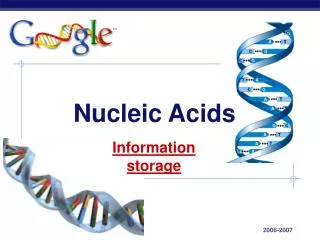
proteins DNA Nucleic Acids • Function: • genetic material • stores information • genes • blueprint for building proteins • DNA RNA proteins • transfers information • blueprint for new cells • blueprint for next generation
T G A C T A C A G G A T C
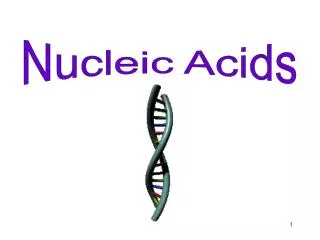
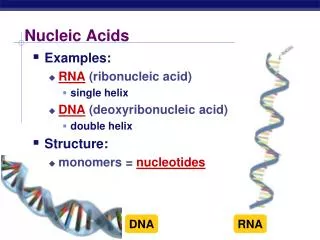
Nucleic Acids • Examples: • RNA (ribonucleic acid) • single helix • DNA (deoxyribonucleic acid) • double helix • Structure: • monomers = nucleotides DNA RNA
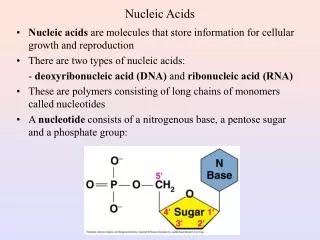
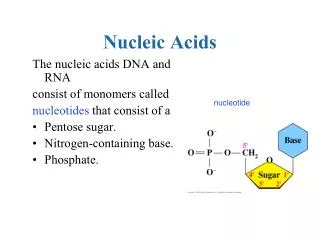
Nucleotides • 3 parts • nitrogen base (C-N ring) • pentose sugar (5C) • ribose in RNA • deoxyribose in DNA • phosphate(PO4)group Nitrogen baseI’m the A,T,C,G or Upart! Are nucleic acidscharged molecules?
Types of nucleotides Purine = AG Pure silver! • 2 types of nucleotides • different nitrogen bases • purines • double ring N base • adenine (A) • guanine (G) • pyrimidines • single ring N base • cytosine (C) • thymine (T) • uracil (U)
Nucleic polymer • Backbone • sugar to PO4 bond • phosphodiester bond • new base added to sugar of previous base • polymer grows in one direction • N bases hang off the sugar-phosphate backbone Dangling bases?Why is this important?
Pairing of nucleotides • Nucleotides bond between DNA strands • H bonds • purine :: pyrimidine • A :: T • 2 H bonds • G :: C • 3 H bonds Matching bases?Why is this important?
DNA molecule • Double helix • H bonds between bases join the 2 strands • A :: T • C :: G H bonds?Why is this important?
Copying DNA • Replication • 2 strands of DNA helix are complementary • have one, can build other • have one, can rebuild the whole Matching halves?Why is this a good system?
When does a cell copy DNA? • When in the life of a cell does DNA have to be copied? • cell reproduction • mitosis • gamete production • meiosis
DNA replication “It has not escaped our notice that the specific pairing we have postulated immediately suggests a possible copying mechanism for the genetic material.” James Watson Francis Crick 1953
1953 | 1962 Watson and Crick … and others…
1953 | 1962 Maurice Wilkins… and…
Interesting note… • Ratio of A-T::G-C affects stability of DNA molecule • 2 H bonds vs. 3 H bonds • biotech procedures • more G-C = need higher T° to separate strands • high T° organisms • many G-C • parasites • many A-T (don’t know why)
Another interesting note… • ATPAdenosine triphosphate • modified nucleotide • adenine (AMP) + Pi + Pi + +
Carbohydrates • Structure / monomer • monosaccharide • Function • energy • raw materials • energy storage • structural compounds • Examples • glucose, starch, cellulose, glycogen glycosidic bond
Lipids • Structure / building block • glycerol, fatty acid, cholesterol, H-C chains • Function • energy storage • membranes • hormones • Examples • fat, phospholipids, steroids ester bond (in a fat)
Proteins • Structure / monomer • amino acids • levels of structure • Function • enzymes u defense • transport u structure • signals u receptors • Examples • digestive enzymes, membrane channels, insulin hormone, actin peptide bond
Nucleic acids • Structure / monomer • nucleotide • Function • information storage & transfer • Examples • DNA, RNA phosphodiester bond