Evolution of the Sony Walkman: A Journey Through Time and Sound
The Sony Walkman has transformed the music listening experience since its introduction in 1979. Designed for outdoor use, this portable device allows users to enjoy high-quality audio while walking or cycling. Over the years, the Walkman has evolved through various innovative models, each enhancing design and sound quality. It caters to individual preferences, allowing listeners to enjoy music alone or share it with one other person. Discover the rich history of Walkman models and how Sony has navigated the competitive audio market while adapting to changing technology.

Evolution of the Sony Walkman: A Journey Through Time and Sound
E N D
Presentation Transcript
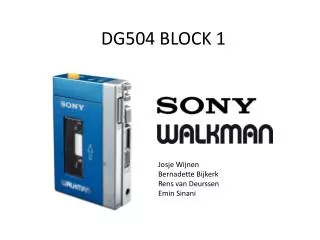
DG504 BLOCK 1 Josje WijnenBernadette BijkerkRens van Deurssen EminSinani
Sony Walkman • Concept description • A portable device to listen to high quality audio aimed for outdoor use. (Aimed for walking, cycling) • End user desire • Favourite music outdoor • High quality • Listening alone (or with 2 people) • Expressing yourself
18 Versions of Walkman 1. 1979 Name: Sony Walkman SRF 35-W Characteristics: Cassette based walkman • 1981 Name: Sony WM-1 Characteristics: lighter, supported metal tape. Attention to design and sound quality. • 1983 Name: WM-20 Characteristics: got AA batterythe cassette was placed horizontally, size is small. • 1984 Name: Sony discman D-50 Characteristics: Uses CDs.
Versions of Walkman • 1985 Name: WM-101 Characteristics: got a rechargeable battery. Had weight of 200gr. • 1989 Name: Sony GV-8 Video Walkman Characteristics: It played video 8 format videos. • 1990 Name: TCD-D3 Characteristics: used DAT-cassettes & lightweight • 1992 Name: NT-1 Characteristics: digital micro-recorder using ultra compact tapes.
Versions of Walkman 9. 1996 Name: MZ-E50 Characteristics: smallest and lightest walkman. 10. 1999 Name: D-E01 Characteristics: featured a skip-free playback mechanism. 11. 2001 Name: Sony Minidisc MZ-N1 Characteristics: plays Minidiscs: miniaturized CDs. Featured high-speed transfer music data from PC to Walkman. 12. 2003 Name: NW-MS70D Characteristics: featured Duo memory stick, 256MB flash.
Versions of Walkman • 2004 Name: Sony Walkman NW-HD1 Characteristics: 30 hours of playing music. • 2005 Name: NW-A3000 Characteristics: first Sony walkman which supported MP3 files. • 2005 Name: Sony Walkman XDR-M1 Characteristics: he could receive Digital Audio Broadcast • 2006 Name: Sony Walkman NW-HD3 Characteristics: hard disk based walkman.
Versions of Walkman • 2008 Name: Sony NW-A800 Characteristics: MP3 player combined with video. • 2008 Name: Sony Ericsson W900i Characteristics: MP3 integrated in mobile phones under the brand name Sony Ericsson
Competitors • Philips • JVC • Panasonic (alsocooperation) • Toshiba • Apple (iPod) • Sears • JC Penny • Radio Shack
MarketShare • 1970-1978 Sony loosesmarketshare (Toshiba & JVC improvedSony’stechnologies) • 1979-early ’80 Sony gotrealcompetitorslike Sears. Due to newinnovationslikeincreasing the sound quality Sony came back in the market • 1983 Walkman becomes hype and Sony’smarketshareincreases a lot • 1985 Cooperationwith Panasonic increasesmarketshareagain • 1992 Sony has 38,5% of the marketshare. Sony bought the American ColombianPictures and got 20% of the American markettoo. • 1993 Sony brought the Minidisc walkman. Sony stays in the market. Butnotthat long. • 1999 Fromthisyearotherbrandslike Apple walk into the market and gained a big marketsharebytheir MP3players. Sony’smarketshare is gone. • 2008 Nowadays Sony tries to gainmarketagainbylaunchingnew mobile phoneswith MP3 function.
Functions and sellingpoints • 1979 • Fitment of a stereo tape head • Removal of recording button and speaker • Hotline function • Double volume control • Multiple headphones • 1981 • All keys released when lid opened • Hotline on headphone • Simple stereo volume control • Attention to Design / Color / Styling • Plastic Belt Holder • Small • 1982 • Record TPS-L2 WM-2
Functions and sellingpoints WM-7 • 1983 • Pressed Metal Case • Logic buttons • Remote • Auto-reverse • Dolby B noise reduction • Led for tape direction and battery indicator • Hold Function • Play all kinds of cassettes • 1984 • Splash proof • In ear headphones WM-10 WM-F5
Functions and sellingpoints WM-36 • 1986 • AM/FM Tuner • A five band graphic equalizer • 1987 • Solar charging • Rechargeable batteries • 1988 • Alarm Clock • Radio Presets • Mega Bass: Bass Control WM-F107 WM-B39
Functions and sellingpoints • 1990 • My First Sony: child version • Loudspeaker • Volume limiter • 1995 • AMS: Automatic music search • Logic controlled • 1996 • Very long battery life WM-3000 WM-EX618