Circulatory System
The human circulatory system is a closed system that continuously transports blood, food, and oxygen to cells while removing waste. It consists of the heart, blood vessels (arteries, veins, and capillaries), and blood. The heart acts as a double pump, circulating deoxygenated blood to the lungs and oxygenated blood to the body. Blood vessels vary in structure, with arteries carrying blood away from the heart and veins returning it. Disorders such as aneurysms, varicose veins, and coronary artery disease can affect circulation, leading to serious health risks.

Circulatory System
E N D
Presentation Transcript
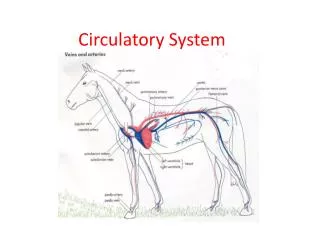
Circulatory System • Provides the force and channels for distribution of blood which carries food and oxygen to cells and removes wastes
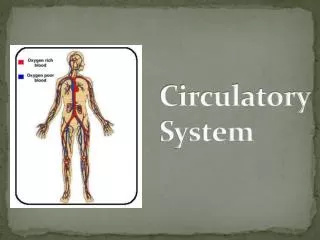
Circulation “The Double Pump” • Blood passes through the heart twice each time it completes a circuit • Right side of the heart receives deoxygenated blood from body tissues and pumps it to the lungs • Left side of the heart receives oxygenated blood from the lungs and pumps it to all body tissues
Human Circulatory System • Closed system of circulation in which blood is always enclosed in tubular blood vessels • Blood does not come in direct contact with body tissue cells • Body cells must come in close contact with blood to exchange materials, therefore, blood vessels are found in almost every part of the body • Human circulatory system is made up of the blood vessels, the blood, and the heart
Blood Vessels • Arteries • Thick walled tubes composed of elastic muscle tissue • Carries blood away from the heart • Aorta– principle artery protruding from the heart
Blood Vessels • Veins • Thin walled tubes • Carries blood back to the heart from body tissues • Vena Cava – principle vein going into the heart
Blood Vessels • Capillaries • Fine network of tubes surrounding body tissues • Composed of thin walls only one cell layer thick to allow for diffusion of materials quickly across the membrane • Oxygen and nutrients move from the capillaries into the body cells • Carbon Dioxide and other waste products move from the body cells into the capillaries
Blood Vessel Disorders Aneurysm • Bulging blood vessel that can rupture and cause a stroke, internal bleeding, and even death Varicose Veins • Valve failure resulting in backflow of blood • Causes enlargement of superficial veins in legs or rectum (hemorrhoids)
Blood • 70 kg person has ~ 5L of blood • Blood is a “fluid” tissue (individual cells working together for a common purpose)
Blood: The Transport Medium The importance of blood • Transport of gases (oxygen and carbon dioxide) • Transport of waste • Transport of nutrients • Fighting disease and infection • Blood clotting
Diseases and Disorders of the Circulatory System • Coronary Artery Disease • Coronary arteries provide blood to heart muscle tissue • Arteries can become partially blocked with plaque • Plaque is a build-up of fat, cholesterol, calcium and other substances that are found in blood • Symptoms – tired, dizzy, pain or burning sensation in arms or chest • Angiogram is used to diagnose this disease
Diseases and Disorders of the Circulatory System • Heart Attack • Arteries can become completely blocked with plaque or with a blood clot • Heart muscle cells no longer receive the oxygen and nutrients they need to function • Heart stops pumping and heart tissue starts to die • Symptoms – chest pain or pressure, shortness of breath, nausea, anxiety, sweating, dizziness • Blood test and electrocardiogram (ECG) are used to diagnose a heart attack • Heart attacks are very serious and life-threatening http://www.heartsite.com/html/cad.html
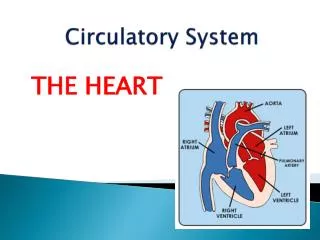
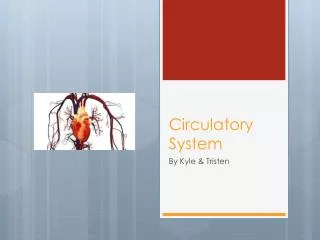
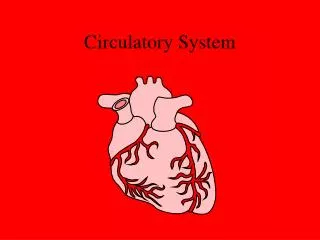
Summary of Heart Structure Superior Vena Cava Aorta Pulmonary Artery Right Atrium Left Atrium Right Ventricle Left Ventricle Inferior Vena Cava Septum