Functional Dissection of CA3-CA1 Learning Rule: Insights from Neural Plasticity
390 likes | 497 Vues
Explore the intricate CA3-CA1 synapse learning rule, examining potentiation and depression requirements, and behavioral mapping. Unravel the complexities of synaptic plasticity and cellular mechanisms underlying learning and memory. Investigate the separable processes of LTP and LTD at neural connections.


Functional Dissection of CA3-CA1 Learning Rule: Insights from Neural Plasticity
E N D
Presentation Transcript
Functional dissection of the CA3-CA1 learning rule Sam Wang Princeton University http://synapse.princeton.edu/~sam/Wang-STDP.ppt
Laboratory of Sam Wang Brain scaling and evolution: Mark Burish Damon Clark Kim Hatch Harrison Hao Yuan Kueh Jennifer Shultz Matt Wagers Krysta Wyatt Optical physiology and synaptic plasticity: Shari Gelber Daniel O’Connor Dmitry Sarkisov Shy Shoham Megan Sullivan Gayle Wittenberg
Too many learning rules! Abbott and Nelson, Nat. Neurosci.
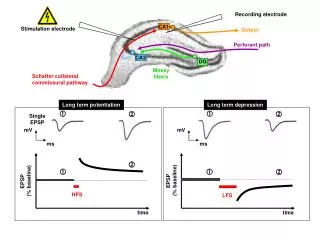
CA3-CA1 synapse of hippocampus Rich history of extracellular and single-cell recording The cell biology and plasticity literature is vast One synapse per connection Has AMPA, NMDA, mGluR,…
Questions at the CA3-CA1 synapse • Is timing between single spikes sufficient to describe the actual learning rule? • How different are the requirements for potentiation and depression? Are these full inverses of each other? • How might the learning rule map to behavior? • Can cell biology help clarify these issues conceptually?
At the CA3-CA1 synapse, pairing single APs gives… Nishiyama et al. 2000 Nature 408:584 80 pairings at 5 Hz Cesium pipet solution …LTP. Pike et al. 1999 Journal of Physiology 518:571 40 pairings at 5 Hz Four epochs (10 pairings each) at 10-s intervals …no change. Christie et al. 1996 Learning and Memory 3:160 900 pairings at 3 Hz Epochs (30-60 pairings each) at 5-s intervals …LTD.
At CA3-CA1 synapses, pairing of single spikes fails to induce potentiation Single pre+post APs 100 pairings with Dt=0-7 ms (pre before post) Pairing frequency 0.1-5 Hz
However… In Nishiyama et al. Cesium replaced Potassium in the intracellular pipette solution This will… -depolarize neuron -block A-type K channels in dendrite -broaden action potentials
Potassium Cesium Cs+ K+ pairings given at 5 Hz
Cs+ K+ …can bursts of APs emulate Cs+?
Dt Pairings must be given at high frequency
Observations on the LTP learning rule • Potentiation requires postsynaptic bursts • Pairings are effective at 5 Hz (near theta) …does depression have these requirements?
LTD occurs under many timing conditions All pairings given at 5 Hz
Requirement Theta Bursting LTP yes yes LTD no no
Conclusions so far • Potentiation and depression have different general induction requirements. • Potentiation: active exploration (causal, bursts, 5 Hz) • Depression: many conditions • During theta, the rule acts like a phase detector. • At other times, the rule is depression-only.
Why not explore parameter space exhaustively? …because it’s exhausting!
Uncaging in spatial patterns: High-throughput screening of neural responses Resolution: <1 micron 30,000 locations per second Shy Shoham
Subthreshold and spiking behavior for “natural” stimulation ensembles
Now play movie at http://synapse.princeton.edu/~sam/shoham-oconnor-movie.avi
The starting distribution of CA3-CA1 synapses >1 Hz >10 Hz >10 Hz
The CA3-CA1 learning rule Complex… …but dissectable?