Download
1 / 17
170 likes | 280 Vues
This training program, prepared by Environmental Health and Safety, outlines important information regarding the hazards associated with liquid nitrogen, including potential asphyxiation and severe frostbite from improper handling. It includes emergency procedures, container requirements, and necessary protective clothing. Key safety guidelines emphasize proper ventilation, the use of appropriate containers, and the importance of utilizing personal protective equipment at all times. This training ensures that personnel handling cryogenic materials are well-equipped to manage risks effectively.

E N D
Liquid Nitrogen and Cryogenics Training Program Prepared by: Environmental Health and Safety
Potential HazardsHealth: • Vapors may cause dizziness or asphyxiation without warning. • Vapors from liquefied gas are initially more dense than air and spread along ground. • Contact with gas or liquefied gas may cause burns, severe injury, and/or frostbite.
Public Safety • Immediately call emergency personnel in the event of a large spill or leak. 9-1-1 from campus phone or 438-8631 for ISUPD dispatcher • Isolate large spills or leaks for at least 100 meters in all directions. • Keep unauthorized personnel away. • Stay upwind. • Keep out of low areas. • Ventilate closed spaces before entering.
Container Requirements • Closed container with a loose fitting top that allows venting. • Use only vessels approved to contain liquid nitrogen. • Vessel must have carrying handles or be on wheels.
Potential HazardsExplosion: • Liquid Nitrogen must be transported and stored in an appropriate container containing pressure relief devices. • Otherwise, when the pressure builds up, • the stopper could be "rocketed out" • or worse, the container could explode
Appropriate Containers Examples of acceptable cryogenic Dewars:
Inappropriate Containers • DO NOT use open, un-insulated or glass containers!
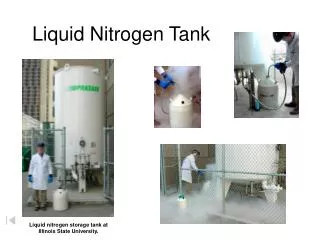
Liquid Nitrogen Tank • Located off loading dock at Science Lab Building • Key can be checked out at the Chemistry storeroom. • Only trained personnel should dispense Liquid Nitrogen. • Enter through South East gate. Valve Location
Liquid Nitrogen Tank • Do NOT touch any of the valves on the North side of the tank. • Do NOT enter through the North gate. DO NOT touch!
Protective Clothing • Always wear thermal protective clothing when handling refrigerated/cryogenic liquids or solids. • It is required you wear a full face shield over safety glasses, loose fitting gauntlet gloves, long sleeve shirts, full-length trousers without cuffs, and fully enclosed shoes.
Fill Hose • The liquid Nitrogen is released through this hose from the outside tank.
Fill Hose • The liquid Nitrogen is released through this hose from the large inside dewar.
Procedures:Step 1: Fill Hose • Insert and hold the fill hose into the appropriate container or into the funnel.
Procedures:Step 2: Open/Close Valve • Open valve slowly to begin filling. • Close valve tightly after filling. Valve Valve
Safe Handling • Always wear personal protective equipment while handling liquid nitrogen. • Always use Liquid Nitrogen in a well ventilated area. • Use a loose-fitting stopper or lid that allows venting of the boil off. • If using a funnel, use caution not to overfill the container.
Safe HandlingContinued • Only transport liquid nitrogen in the freight elevator with no other occupants present. • Only use containers that have been designed specifically for cryogenic liquids. • Do not store in a confined space. • Do not store at temperatures above 125°F.
References • DOT Emergency Response Guide • CAMEO Chemicals Datasheet • Praxair Liquid Nitrogen Safety Data Sheet