Notes: Subject and Theme
Explore the concept of theme in literature, a fundamental aspect that captures the deeper messages and insights about human experiences. We provide definitions for middle and high school students, explaining how themes differ from mere topics. Learn about universal themes that appear across various works and see how readers can interpret themes differently yet provide evidence from the text. Discover examples that illustrate the essence of themes, such as love, control through fear, and the impact of perception on reality.

Notes: Subject and Theme
E N D
Presentation Transcript
Notes: Subject and Theme English 1
Subject/Topic/Idea • Subject: the topic of a work of literature • Examples: love, war, racism, WWII, fruit, peace, etc.
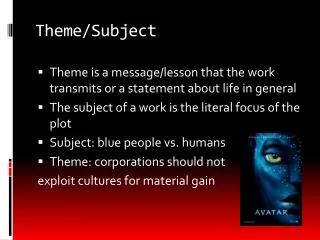
Theme • Middle school definition:a message or lesson of a work of literature • High school definition: a discovery of a truth about our own human experience expressed in a complete sentence
No two readers state a theme in exactly the same way All readers do not have to see the same theme in a story A reader does not have to agree with the theme of a story, but it is always able to be proved w/evidence from the text Examples: 1) Love is not always enough to make a relationship last. 2) Torture and fear of death can be used to control people. 3) Perception is reality. Theme
Universal Theme • Universal theme: a theme which occurs over and over again in many works of literature • Examples: • 1) Don’t judge a book by its cover. • 2) Love conquers all. • (these are clichés & are brief examples only; yours will be much more complex & thoughtful)
To sum up • A theme is an idea that has been placed into a complete sentence and expresses a proveable truth about the work. • It is different from a phrase or word; these are thematic ideas, but they are not THEMES.