
Endocrine System
E N D
Presentation Transcript
Endocrine System EQ: What are the functions of the glands that make up the endocrine system?
Function • Maintain Homeostasis (Balance) • Communicates and coordinates physiological responses
Hormones • Chemical messengers • Stimulate physiological responses in other cells • Target Cells • Tropic (Trophic) Hormones • Hormone whose target is another endocrine gland.
Hormone Production and Distribution • Production • Endocrine Glands • Gland: an organ specialized to produce secretions • Distribution • Relies on blood circulatory system • How does this compare to nervous system?
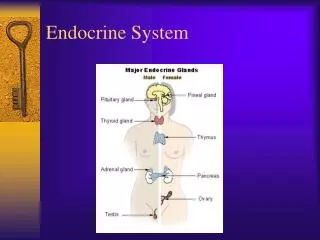
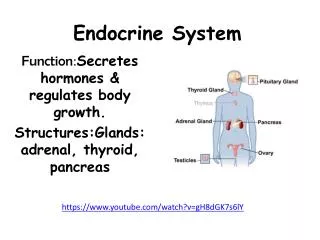
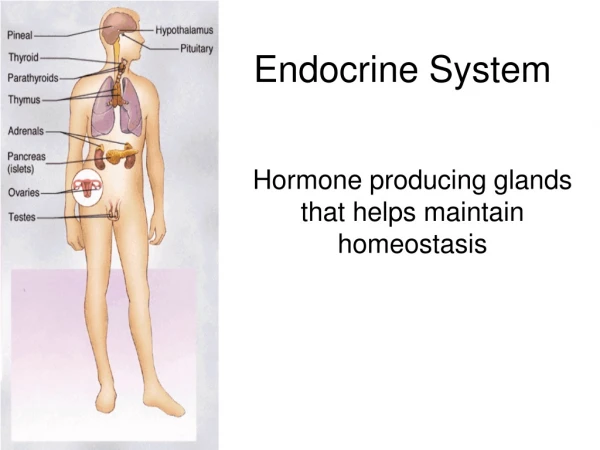
Hypothalamus Pituitary Thyroid Parathyroid Pancreas Adrenal Gonads Ovaries, Testes Endocrine Glands
Hypothalamus • Location- Base of brain case • Functions- Regulation of Primitive or Basal activities such as sex drive and water balance
Pituitary gland • Location- Sphenoid bone of the skull • Anterior Lobe • Produces Six hormones that Regulate • Reproduction, Growth, Activity of the Thyroid Gland • Posterior Lobe • No hormone production only storage of hypothalamic hormones
Thyroid • Largest endocrine gland • Location- Wrapped around anterior and lateral sides of Trachea, just below Larynx • Hormone- Thyroid Hormone • Function- Increases Metabolic Rate
Location- 2 glands one superior to each Kidney. Adrenal Glands
Stress and immune supression Sex steroids- sex hormones (Fight or Flight Response) Adrenal Glands
Location- Inferior and posterior to Stomach Secretion of Insulin- converts glucose to glycogen Function- Glucose Regulation Pancreas
Gonads • Male- Testes • Secrete Androgens such as Testosterone • Female- Ovary • Secrete Estrogen and Progesterone
Pineal Gland • Attached to upper part of thalamus • Secretes hormone Melatonin • Response to light conditions. • Acts upon “biological clock” or Circadian Rhythms
Thymus • Located posterior to the sternum, between the lungs • Secretes Thymosin, affects white blood cells and immunity
Hypothyroidism (Creatinism) Children: mental retardation, development abnormalities Adults: lethargy, obesity Hyperthyroidism (Graves’ Disease) Weight loss, sweating, nervousness, sleeplessness Goiter -----a hypertrophy of the thyroid gland resulting from iodine deficiency Disorders
Pituitary Dwarfism- Insufficient secretion of Growth Hormone Gigantism- Over-secretion of Growth Hormone Disorders
Disorders • Diabetes Mellitus- Disruption of Metabolism due to lack of insulin or lack of response to insulin. • Symptoms- Excessive Urine, Intense Thirst, and Ravenous Hunger • Type I- (Juvenile of Insulin Dependant) Destruction of Insulin Producing Cells • Type II- (Adult or Noninsulin Dependant) Target cells resistant to Insulin
LEFT SIDE ACTIVITY Draw a human body and label the following Hypothalamus, Pituitary, Thyroid, Parathyroid,Pancreas, Adrenal and, Gonads • Describe the function of each of the above