Download
1 / 11
120 likes | 239 Vues
This module, developed by the Tennessee Department of Education, focuses on enhancing educators' understanding of Science Research Simulation Tasks (RST). Participants will engage in a research simulation task, discuss connections to Common Core State Standards (CCSS) for literacy in science, and explore implications for teaching and learning. Key principles for effective collaboration and student-centered learning will be highlighted. The module aims to bridge gaps in educators' knowledge regarding key shifts in literacy standards, empowering them to better prepare students for college and career readiness.

E N D
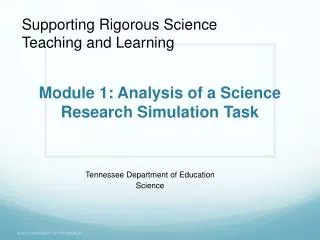
Supporting Rigorous Science Teaching and Learning Module 1: Analysis of a Science Research Simulation Task Tennessee Department of Education Science
Goals • Deepen understanding of Science Research Simulation Task (RST) by • engaging in a research simulation task; • analyzing and discussing Science RST connections with the Common Core State Standards (CCSS) for Literacy in Science reading and writing standards; and • discussing implications for teaching and learning in science. • Reflect on learning.
Norms for Working Together • Keep students at the center. • Be present and engaged. • Monitor air time and share your voice. • Challenge with respect. • Stay solutions oriented. • Risk productive struggle. • Balance urgency and patience.
“The Common Core standards represent considerable change from what states currently call for in their standards and in what they assess…[Furthermore,] they are different from what U.S. teachers report they are currently teaching.” Porter, McMaken, Hwang, and Yang Common Core State Standards: The New US Intended Curriculum Educational Researcher, 2011, 40: 103
Portrait of Students Who Meet the Standards • They demonstrate independence. • They build strong content knowledge. • They respond to the varying demands of audience, task, purpose, and discipline. • They comprehend as well as critique. • They value evidence. • They use technology and digital media strategically and capably. • They come to understand other perspectives and cultures.
Common Core State Standards (CCSS) Key Shifts for ELA & Literacy • Complexity: Regular practice with complex text and its academic language • Evidence: Reading, writing, and speaking grounded in evidence from text, both literary and informational • Knowledge: Building knowledge through content rich nonfiction What questions do you have about the key shifts? *Excerpted from A Strong State Role in Common Core State Standards Implementation: Rubric and Self-Assessment Tool, p. 6, Table 1, Key Instructional Shifts of the Common Core State Standards, by the Partnership of Readiness for College and Careers Transition & Implementation Institute, 2012, Washington, DC: Achieve.
Common Core State Standards (CCSS) for English Language Arts (ELA) & Literacy in History/Social Studies, Science, and Technical Subjects CCSS for ELA consist of • Reading • Literature • Informational Text • Foundational Skills • Writing • Arguments • Explanatory Text • Narratives • Speaking & Listening • Language CCSS for Literacy in Science consist of • Reading • Informational Text • Writing • Arguments • Explanatory Text Science content still comes from science standards.
College and Career Readiness Anchor Standards for Reading & Writing Reading (page 60) • Key Ideas and Details • Craft and Structure • Integration of Knowledge and Ideas • Range of Reading and Level of Text Complexity Writing (page 63) • Text Types and Purposes • Production and Distribution of Writing • Research to Build and Present Knowledge • Range of Writing
Science Research Simulation Task • You are going to engage in a Science Research Simulation Task (RST) similar to one students in your grade-band might encounter. • Engage in the task as an adult rather than a K-12 student. • You may not completely finish all tasks within the RST. Try to work through as much as possible within the next 20 minutes. • Please take the time to fully engage in the task. This task is important because it provides a common experience as we delve into the new literacy expectations.
Bridge To Practice (BTP) Assignment • The tasks that you have remaining should be completed as your BTP assignment before the next Professional Development Module. • Completion of these tasks is vital in understanding what the PARCC assessment has in store for our students. • The next module involves the un-packing analysis of these tasks along with implications for teaching and learning in Science. • Thank you for your time!