Understanding How a Bill Becomes Law: The Legislative Process Explained
90 likes | 213 Vues
Explore the fascinating journey of how a bill is transformed into law in this engaging video from the Senate. The legislative process involves multiple stages, including readings, committee studies, and the crucial Royal Assent. Learn about the roles of party discipline, free votes, private members' bills, and Orders in Council. Discover why some laws succeed while others fail, and delve into the democratic implications of this intricate system. Join us in understanding the complexities and importance of legislation in governance.


Understanding How a Bill Becomes Law: The Legislative Process Explained
E N D
Presentation Transcript
The Legislative Process • Let check out this thrilling video from the Senate to find out about the process: • Legislative process: http://www.youtube.com/watch?v=FoR14KLq_kg
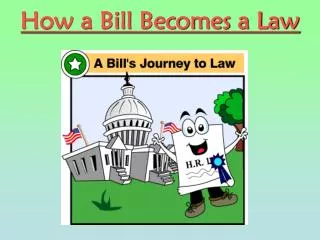
Bill Wants to Be a Law Second reading (principle of the bill is debated) First reading (the bill proposing a law is received and circulated) Committee stage: – members of public appear as witnesses to comment – committee members study the bill & make amendments Report stage (the committee report is considered by the whole house) Third reading(final approval of the bill) Senate: bill is either re-sent to the other house or is set aside for Royal Assent Congrats, Bill, you are a LAW Royal Assent: GG gives bill “royal assent”
The Big Questions • Why so many steps? • Which laws pass? • Which laws fail?
Things to Consider… Party Discipline • Party whip makes sure their party’s MP’s are in HofC for important votes • MP’s vote as a party block
Free Votes • MP’s are free to vote their conscience • Only happens when it suits the interest of the party
Private Members Bills Introduced by any non-Cabinet member of HofC or Senate Difficult to pass a law w/o lots of party support Example: http:/www.torontosun.com/2012/08/28/tory-trying-to-keep-definition-of-human-motion-alive
Orders in Council • Formulated in Cabinet & approved by GG • Used to make senate appointments, necessary changes to laws, and emergencies • A power used sparingly • Note: many appts are patronage appointments – rewards for loyal party members
The Big Questions: Is it democratic? What does the mean about the power of the PM?