
Light and Optics
E N D
Presentation Transcript
Section 1: Intro to Electromagnetic Waves • Intro Questions: • What is the difference between mechanical and electromagnetic waves? • Name as many types of electromagnetic waves you can • What is the speed of light and any other electromagnetic wave in space?
The Electromagnetic Wave • Characteristics: • Require no medium • Transverse waves of oscillating electromagnetic fields • Transverse waves move perpendicular to the direction the wave moves • The electric and magnetic fields are at right angles to each other • All electromagnetic waves travel at 3.0 x 10⁸ m/s Electric Field Direction of travel towards you Magnetic Field
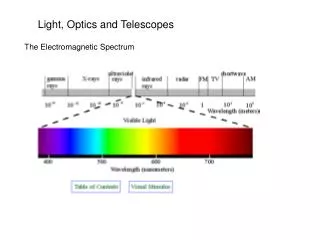
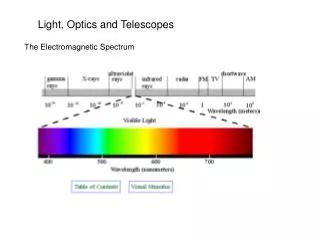
The Electromagnetic Spectrum Wavelength Decreases Frequency Increases Energy Increases 3.0 x 108 = λ • f V = λ • f More Penetration and Dangerous Velocity = 3.0 x 10⁸ m/s For All Electromagnetic Waves
Activity 1 • Label all the parts of the electromagnetic spectrum in order of increasing frequency. • Radio Waves, Microwaves, Infrared, Visible Light, Ultra Violet, X-rays, Gamma Rays • Label the trend lines as well
Activity 1 • Label all the parts of the electromagnetic spectrum in order of increasing frequency. • Radio Waves, Microwaves, Infrared, Visible Light, Ultra Violet, X-rays, Gamma Rays • Label the trend lines as well 4 Visible Light 3 Infrared 6 X-Rays 7 Gamma Rays 5 Ultra Violet 1 Radio waves 2 Microwaves Wavelength Decreases Frequency Increases Energy Increases More Penetration and Dangerous
V = λ • f Speed of light distance-time calculations • Velocity = 3.0 x 10⁸ m/s for all electromagnetic waves • If you see any of these you have an electromagnetic wave and v = 3.0 x 10⁸ m/s • Radio Waves, Microwaves, Infrared, Visible Light, Ultra Violet, X-rays, Gamma Rays
Example 1 The AM radio band extends from 5.4 x 10⁵ Hz to 1.7 x 10⁶ Hz. What are the longest and shortest wavelengths in this frequency range?
Example 1 The AM radio band extends from 5.4 x 10⁵ Hz to 1.7 x 10⁶ Hz. What are the longest and shortest wavelengths in this frequency range?
Example 2 What is the frequency of an electromagnetic wave if it has a wavelength of 1.0 km?
Example 2 What is the frequency of an electromagnetic wave if it has a wavelength of 1.0 km?
Example 3 How long does it take for light from the sun to reach Earth if the sun is 1.5 x 10¹¹ m away?
Example 3 How long does it take for light from the sun to reach Earth if the sun is 1.5 x 10¹¹ m away?
Intro • What are the primary colors of light? • List the colors of the rainbow in order • What do all the colors of the rainbow add up to?
Visible Light • Characteristics • “White” light is a combination of red, orange, yellow, green, cyan, blue, and violet • A prism can separate these colors out • By refraction of different wavelengths of color
Visible Light 700 nm 400 nm Red orange yellow green cyan blue violet • Red: • Longest Wavelength • Lowest Frequency • Least Energy • Violet: • Shortest Wavelength • Highest Frequency • Most Energy
Activity 2 • List the colors of the rainbow in order from lowest to highest frequency • Color this at home Highest Frequency Lowest Frequency ________ ________ ________ ________ ________ ________ ________ Visible Light
Activity 2 • List the colors of the rainbow in order from lowest to highest frequency • Color this at home Highest Frequency Lowest Frequency Red orange yellow green cyan blue violet Visible Light
Primary Colors • Red • Blue • Green Blue Red Green
Blue Red Magenta • Secondary Colors: Mixture of 2 Primary Colors • Magenta (Blue and Red) • Cyan (Blue and Green) • Yellow (Red and Green) • A mixture of all three primary colors produces white light Blue Blue Green Cyan Blue Red Green Red Yellow White Green
Primary Colors • Red • Blue • Green Blue Red Green
Since secondary colors are a mix of two primaries: • Mixing primary and secondary colors produces white light White Light = Primary Color + Secondary Color • White Light = Blue + Yellow • White Light = Green + Magenta • White Light = Red + Cyan Blue Red Green
Activity 3 • Color and label the color mixture diagram White Light = Primary Color + Secondary Color White Light= ___________+ ____________ White Light= ___________+ ____________ White Light= ___________+ ____________
Activity 3 • Color and label the color mixture diagram White Light = Primary Color + Secondary Color White Light = Blue + Yellow White Light = Green + Magenta White Light = Red + Cyan White
Red Blue Green Primary colors of light Primary pigments (ink) Magenta Cyan Yellow
are secondary pigments Primary colors add up to white light Red • Primary colors (light) • Red • Blue • Green • Primary pigments (ink) • Magenta • Yellow • Cyan Magenta Yellow Blue Green Cyan are secondary colors Primary pigments (ink) adds up to black Yellow Green Red Cyan Magenta Blue
Intro • Do section 3 of your worksheets as your intro today
Optics is the science that describes the behavior and properties of light and the interaction of light with matter.
Refraction- Bending of light as it travels from one medium to another. • Refraction occurs because lights velocity changes in another medium. • Light does not need a medium but it is affected by it.
Key items for refraction • Light travels from the object to the observers eyes • Light travels at different speed indifferent medium • Terms to know: • Normal line • Angle of incidence Θi • Angle of refraction Θr Normal Line Θr Slower Medium Θi
part of it is reflected and part is refracted • As light moves into a new medium, (a) Into slower medium light bends toward the normal line (b) Into faster medium light bends away from the normal line
Objects appear to be in a different position due to refraction • An object “appears” to be straight ahead • Light always travels from the object to the observers eyes, bending into the new medium Cats Perspective Fishes Perspective
Index of refraction (n)- the ratio of speed of light in a vacuum to speed of light in that substance. • Always greater than 1 because light in a vacuum is the fastest (n = 1.00 for a vacuum) • Has no unit n = index of refraction c = speed of light in a vacuum v = speed of light in medium
Example 4 • Tom, a watchmaker, is interested in an old timepiece that’s been brought in for a cleaning. If light travels at 1.90 x 10⁸ m/s in the crystal, what is the crystal’s index of refraction?
Example 4 • Tom, a watchmaker, is interested in an old timepiece that’s been brought in for a cleaning. If light travels at 1.90 x 10⁸ m/s in the crystal, what is the crystal’s index of refraction?
Example 5 • How fast does light travel in fluorite (n=1.434)?
Example 5 • How fast does light travel in fluorite (n=1.434)?
Snell's Law- a formula that describes the angle of incidence and angle of refraction (ni)(sin Θi) = (nr)(sin Θr) ni = index of refraction of first medium (incidence side) Θi= angle of incidence nr = index of refraction of second medium (refracted side) Θr= angle of refraction
(ni)(sin Θi) = (nr)(sin Θr) Can be rearranged to solve for ni Can be rearranged to solve for nr
(ni)(sin Θi) = (nr)(sin Θr) Can be rearranged to solve for Θi Can be rearranged to solve for Θr
Example 6 A light ray traveling through air (n=1.00) strikes a smooth, flat slab of crown glass (n=1.52) at an angle of 30.0° to the normal. • Find the angle of refraction • Draw a picture and label it
Example 6 • A light ray traveling through air (n=1.00) strikes a smooth, flat slab of crown glass (n=1.52) at an angle of 30.0° to the normal. Find the angle of refraction.
Example 7 Find the angle of refraction for a ray of light that enters a calm lake at an angle of 25° to the normal. (nair = 1.00 and nwater = 1.33)
Example 7 Find the angle of refraction for a ray of light that enters a calm lake at an angle of 25° to the normal. (nair = 1.00 and nwater = 1.33)
What happens when you increase the angle of incidence when going from a slow to a fast medium? • Remember: slow to fast bends away from the normal • What happens if you increase the angle of incidence beyond here? • Total internal reflection Θr nr = 1.00 (faster) ni = 1.33 (slower) Θi