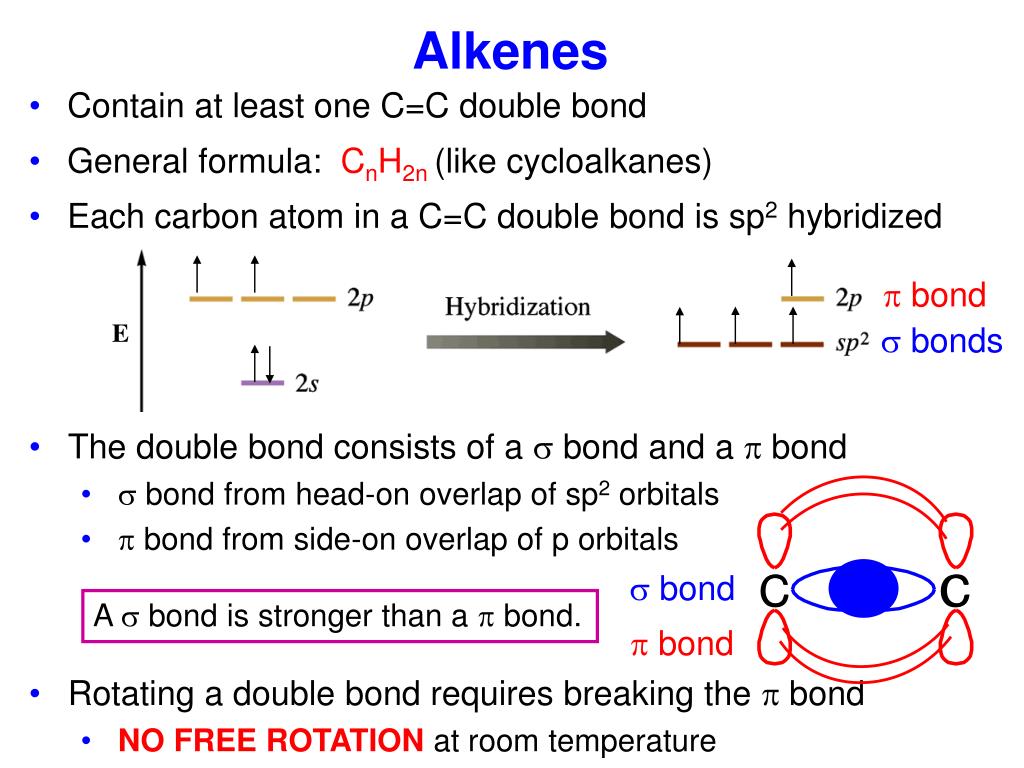
Alkenes E • Contain at least one C=C double bond • General formula: CnH2n(like cycloalkanes) • Each carbon atom in a C=C double bond is sp2 hybridized bond bonds • The double bond consists of a bond and a bond • bond from head-on overlap of sp2 orbitals • bond from side-on overlap of p orbitals bond A bond is stronger than a bond. bond • Rotating a double bond requires breaking the bond • NO FREE ROTATION at room temperature
Alkene Nomenclature (Naming) • Parent chain = longest chain that includes the double bond(s) • The double bonds have priority and must have the lowest number(s) possible • The first C atom in the C=C bond indicates the double bond’s location (or number in naming) • Name, number, & alphabetize substituents as usual • Replace –ane ending with –ene ending • Two double bonds: -diene; three double bonds: -triene • Put double bond number in front of entire root name (i.e. 2-pentene indicates the double bond starts on carbon 2) 7. Cyclic alkenes: number the atoms in the ring starting with the double bond 2-hexene 3-butyl-2,4-hexadiene
Naming Practice 2,4-hexadiene 4-ethyl-3,5-dimethyl-2-heptene 4-isopropyl-3,5-dimethyl-1,3,5-heptatriene 3,4-dimethyl-1,3-pentadiene
Cis-trans isomerism in alkenes • Substituents will stay on the same or opposite sides of the double bond (no C=C bond rotation) X cis- 2-butene (same side) 2-butene (opposite sides) trans- • For cis-trans isomerism, each C in the double bond must have 2 different substituents attached (i.e. a C and a H, etc.) • Determining cis or trans: follow the parent chain through the double bond cis cis-3-methyl-2-heptene
Cis/Trans Naming Practice trans,trans-2,4-hexadiene trans-4-ethyl-3,5-dimethyl-2-heptene No Cis or Trans No Cis or Trans Both CH3’s Both H’s Both H’s trans,trans-4-isopropyl-3,5-dimethyl-1,3,5-heptatriene 3,4-dimethyl-1,3-pentadiene
Important Common Names H C C H R 2 R Ethylene Propylene Vinyl (branch) i.e. polypropylene = milk jugs i.e. polyethylene = plastic bags Allyl (branch) i.e. diallyllysergamide = derivative of LSD i.e. polyvinyl chloride = PVC pipe
Arranging many double bonds • Cumulated C=C double bonds all in a row: C=C=C=C • Conjugated Single and double bonds alternate: −C=C−C=C−C=C− • Isolated >1 single bond between double bonds: −C=C−C−C=C−C−C=C− Lycopene 11 conjugated double bonds 2 isolated double bonds
Reactions of Alkenes + A-B • Alkanes – substitution reactions • R-H + A-B R-A + H-B • R = “residue”, a generic alkyl group • Alkenes – addition reactions bond is electron-rich Thermodynamics: Hrxn = bonds broken – bonds formed = ( bond + bond) – ( bond + bond) Exothermic reaction
Alkene Addition Reactions + A-B A-B H-F, H-Cl, H-Br, H-I H-OH Br-Br, Cl-Cl, F-F H-H Reaction Hydrohalogenation (addition of H-X, X = halogen) Hydration (addition of H2O) Addition of halogens Hydrogenation (addition of H2)
Markovnikov’s Rule • Consider the reaction C C + 1-chloropropane 2-chloropropane 1-propene • Two products are possible • Experimentally, only 2-chloropropane is formed • Markovnikov’s Rule: • The alkene carbon with the most H atoms gets the H • Hydrohalogenation (H-X), hydration (H2O) of alkenes Vladimir Markovnikov Why? Look at the reaction mechanism to find out...
Hydrohalogenation Predict the product of the following hydrohalogenation reaction + HBr Anti-Markovnikov Product Remember: Markovnikov’s rule says that the H (from HBr) will bond to the alkene C with the most H’s OR Markovnikov Product
Hydration Predict the product of the following hydration reaction + H2O Anti-Markovnikov Product OR Remember: Markovnikov’s rule says that the H (from H2O) will bond to the alkene C with the most H’s Markovnikov Product
Halogenation + Br2 Trans isomer + Br2 The Br’s will add to opposite sides of a RING (anti addition) The Br’s will be forced into a trans conformation ALWAYS
Hydrogenation • Occurs in the presence of a metal catalyst (like Pt) + H2/Pt cis isomer + H2/Pt Both H’s will add to the same side of a RING (syn addition) If branches are present, they will be forced into a cis conformation
Hydrogenation of alkenes + H2/Pt vegetable oils unsaturated saturated Contains NO double bonds Contains double bonds
Hydrohalogenation Determine any reactant(s) that could yield the given product of the following hydrohalogenation reaction + HBr 3-methyl-1-hexene Only possible reactant for this product + HBr trans-3-methyl-2-hexene Major product using M’s rule
Hydrohalogenation Determine any reactant(s) that could yield the given product of the following hydrohalogenation reaction + HBr All three reactants could give this product trans-3-methyl-2-hexene 2-ethyl-1-pentene trans-3-methyl-3-hexene
Halogenation Determine any reactant(s) that could yield the given product of the following halogenation reaction + Br2 trans-3,5-dimethyl-2-heptene Only one possible reactant in this case
Alkene Reaction Summary • Hydrohalogenation (+ HX) • Hydration (+ H2O) • Halogenation (+ X2) • Hydrogenation (H2/Pt) Markovnikov’s rule Cis/trans with rings
Polymerization of Alkenes • Polymer: a large molecule made by linking together small repeat units called monomers • Polymerization mechanism: radical chain reaction Monomer Polymer ethene (ethylene) polyethylene propene (propylene) polypropylene
Alkynes E • Contain at least one CC triple bond with sp-hybridized C atoms • Triple bond: one bond (sp orbitals), two bonds (p orbitals) • Naming: triple bond indicated by –yne ending ethyne (acetylene) 4-methyl-1-pentyne • Reactivity: same addition reactions as alkenes • Use 2 equivalents of addition reagent (i.e. + 2HCl) • Use Markovnikov’s rule in the same manner
Alkyne Naming Practice 2-methyl-3-hexyne 3,4-dimethyl-1-pentyne 3-methyl-1-pentyne 2,5-dimethyl-3-hexyne
Hydrohalogenation of Alkynes Predict the product of the following hydrohalogenation reaction ? + 2HBr 1-pentyne Break the reaction into two steps, adding 1 HBr each time to the multiple bond + HBr + HBr Final Product Markovnikov’s rule still applies…
Hydration of Alkynes Predict the product of the following hydration reaction ? + 2H2O 3,3-dimethyl-1-butyne Break the reaction into two steps, adding H2O each time to the multiple bond + H2O + H2O Markovnikov’s rule still applies… Final Product
Halogenation of Alkynes Predict the product of the following halogenation reaction ? + 2Br2 3,3-dimethyl-1-butyne Break the reaction into two steps, adding Br2 each time to the multiple bond + Br2 + Br2 Final Product
Hydrogenation of Alkynes Predict the product of the following hydrogenation reaction ? + 2H2 3,3-dimethyl-1-butyne This reaction will simply turn the alkyne to an alkene, and then to an alkane + H2 + H2 Final Product
Alkyne Reaction Practice + 2HCl → 1. 2. 3. 4. 5. + 2H2O → + 2Br2 → + 2H2 → + 2HCl → AND