Download
1 / 16
160 likes | 314 Vues
In this lesson, we explore key properties of special parallelograms, including rhombuses, rectangles, and squares. We will solve for missing variables in parallelograms, specifically examining the sides WX and ZY in parallelogram WXYZ, and using properties of rhombuses and rectangles to find values of x. We will also create a Venn diagram to represent the relationships among the properties of quadrilaterals. Understand the definitions, characteristics, and unique attributes that distinguish these shapes in geometry.

E N D
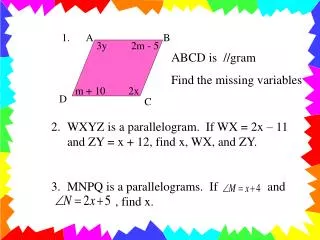
1. A B 3y 2m - 5 ABCD is //gram Find the missing variables m + 10 2x D C • WXYZ is a parallelogram. If WX = 2x – 11 and ZY = x + 12, find x, WX, and ZY. • MNPQ is a parallelograms. If and , find x.
Special Parallelograms
Special Parallelograms RHOMBUS RECTANGLE SQUARE
RHOMBUS FOUR CONGRUENT SIDES
A quadrilateral is a RHOMBUS if and only if it has four congruent sides
RECTANGLE FOUR RIGHT ANGLES
A quadrilateral is a RECTANGLE if and only if it has four right angles
SQUARE FOUR RIGHT ANGLES AND FOUR CONGRUENT SIDES
RHOMBUS Diagonals Bisect A Pair of Opposite Angles
RHOMBUS 90º Diagonals are Perpendicular
RECTANGLE Diagonals are Congruent
Let's make a Venn Diagram Relating all of the Properties of our quadrilaterals
QUADRILATERALS RHOMBUSES RECTANGLES Squares PARALLELOGRAMS
QUADRILATERALS 1. Polygon 2. 4 sides 1. Opposite Sides are congruent RHOMBUSES 1. Diagonals bisect angles RECTANGLES 2. Diagonals perp Squares 1. 4 rt. angles 3. 4 equal sides 2. Diagonals congruent 2. Opposite Angles are congruent 4. Diagonals Bisect 3. Opposite Sides are parallel 5. Consecutive angles are supplementary PARALLELOGRAMS
PQRS is a rhombus P Q S R