Download
1 / 17
170 likes | 300 Vues
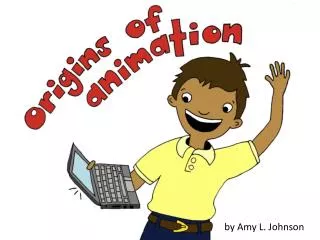
This comprehensive online unit designed by Amy L. Johnson takes learners through the fundamentals of animation, from traditional techniques to modern CGI. Featuring 7 engaging lessons, students will create three product-based outcomes culminating in a claymation project. Each lesson includes practical activities, resources, and assessment tools, leading students through the processes of designing, shooting, and editing their own claymation films. The entire unit is accessible online at http://originsofanimation.wikispaces.com.

E N D
General Overview • Full art unit designed to take learners from the beginnings of animation to current CGI. • 7 lessons with 3 product-based outcomes • Culminates in the publishing of a student-made claymation project • Entire unit is online at http://originsofanimation.wikispaces.com
Lesson Overview • Lesson 1: Thaumatropes • Lesson 2: Flip-Books • Lesson 3: Storyboards • Lesson 4: Character Design • Lesson 5: Backdrop Design • Lesson 6: Shooting Claymation • Lesson 7: Editing & Publishing Claymation
Foundation PPT • “Creating Movement: The Origins of Animation” is the foundation presentation • Presentation overviews all projects, gives examples, and defines various animation terms • Presentation has embedded animations and links to exemplar videos on YouTube.com
Thaumatropes You will need: • Two 3 x 5 in note-cards per student OR two 3 in diameter circles per student • pencils • markers • 2 rubber bands per student • “How To Make a Thaumatrope” worksheet
Flip-Books You will need: • 20-30 3 x 3 in sheets of paper per student • Pencils • Colored pencils • 1 small binder clip per student • “How To Make a Flip-Book” worksheet
Storyboards You will need: • Storyboard worksheet • Pencils • Story • Markers/colored pencils
Character Design You will need: • 1 brick of oil-based clay per character • 2 pipe cleaners per character • Storyboards • 5 x 7 in sketch paper • Pencils • Markers • Clay modeling tools • scissors
Backdrops You will need: • 18 x 24 in paper • Pencils • Markers • Tempera paint • Paintbrushes
Shooting You will need: • Digital cameras • Extra batteries • Books for “tripods” • Claymation characters • Backdrops • Masking tape • Pens/markers
Editing You will need: • Windows Movie Maker (WMM) • Computer • USB Drive • SD Card • SD Card-reader
Editing Cont’d Windows Movie Maker (WMM) • Unit relies on WMM instead of iMovie because most schools interface with PC as opposed to Mac • WMM is video editing software included in MS Windows Me, XP, Vista and 7 • It can be download for free: http://www.microsoft.com/windowsxp/downloads/updates/moviemaker2.mspx • Click-by-Click directions on how to move import pictures, begin a stop-motion movie, and editing in WMM are available on the wiki
Editing Cont’d Embedding Music • Students must find and download royalty free music for their videos • A great website for finding royalty free music is http://freeplaymusic.com • Directions on how to download and embed music into WMM are available on the wiki
Publishing • Completed student claymation movies can be uploaded to YouTube.com • Encourage the teacher to do all uploading • You will need to get a YouTube.com account (free) • Click-by-click directions on how to upload videos to YouTube.com can be found on the wiki
Assessment • The thaumatrope lesson, flip-book lesson, and story-board lesson, and backdrop lesson each have their own assessment • There is a longer, more comprehensive assessment for the shooting, editing, and publishing of the claymation video.
Questions? Amy.L.Johnson@Live.com