Understanding Coupled Linac Cells and Their Operating Modes
This lecture delves into the principles of coupling chains of linac cells, exploring the various modes present on the dispersion curve of coupled systems. It highlights the characteristics of different modes, the specific operating mode of Drift Tube Linacs, and the advantages and disadvantages of both π/2 modes and H-mode structures. Additionally, the discussion addresses energy efficiency in linac systems, the importance of contact between structure components, and the concept of shunt impedance as a crucial figure of merit for accelerating structures.

Understanding Coupled Linac Cells and Their Operating Modes
E N D
Presentation Transcript
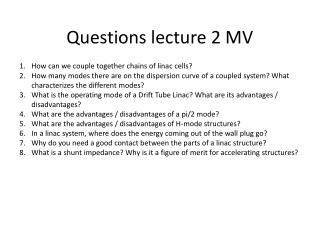
How can we couple together chains of linac cells? How many modes there are on the dispersion curve of a coupled system? What characterizes the different modes? What is the operating mode of a Drift Tube Linac? What are its advantages / disadvantages? What are the advantages / disadvantages of a pi/2 mode? What are the advantages / disadvantages of H-mode structures? In a linac system, where does the energy coming out of the wall plug go? Why do you need a good contact between the parts of a linac structure? What is a shunt impedance? Why is it a figure of merit for accelerating structures? Questions lecture 2 MV