Download
1 / 45
450 likes | 569 Vues
The critical investigation into Cockpit Task Management (CTM) reveals its significance in aviation safety. Pilots face multitasking challenges—aviating, navigating, communicating, and managing systems can lead to errors, as seen in the Everglades L-1011 accident. Training pilots to prioritize tasks based on urgency and importance is vital. The AgendaManager aims to assist pilots by maintaining updated task models, monitoring task progress, and suggesting necessary actions. This innovative approach employs advanced technology to improve decision-making and task management efficiency in the cockpit.

E N D
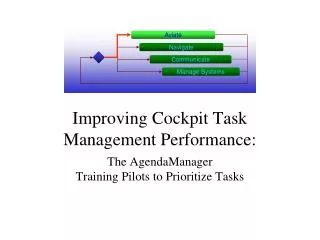
Aviate Navigate Communicate Manage Systems Improving Cockpit Task Management Performance: The AgendaManagerTraining Pilots to Prioritize Tasks
Observation: Cockpit Task Management Errors • Cockpit (flight deck) is a multitask environment • aviate • navigate • communicate • manage systems • Results of distraction, preoccupation • Everglades L-1011 accident • many incidents • Hypotheses: • flightcrew must manage as well as perform tasks: Cockpit Task Management (CTM) • CTM is a significant factor in flight safety
Preliminary Normative Theory of CTM • initiate tasks to achieve goals • assess status of all tasks • terminate completed and ‘obsolete’ tasks • prioritize remaining tasks based on • importance: • aviate • navigate • communicate • manage systems • urgency • other factors (?) • allocate resources (attend) to tasks in order of priority
Cockpit Task Management Research • CTM Errors in Aircraft Accidents (1991) • 80 CTM errors in 76 (23%) of 324 accidents • CTM Errors in Critical, In-Flight Incidents (1993) • 349 CTM errors in 231 (49%) of 470 incident reports • Part-Task Flight Simulator Study (1996) • CTM error rate increases with workload • ASRS Study of CTM and Automation (1998) • Task prioritization error rate higher in advanced technology reports • Findings: • CTM is a significant factor in flight safety • CTM can potentially be improved
Improving CTM Through Technology: The AgendaManager
Statement of Needs and Requirements Definition • CTM aid shall • maintain a current model of aircraft state and current cockpit tasks, • monitor task state and status, • compute task priority, • remind the flightcrew of all tasks that should be in progress, and • suggest that the flightcrew attend to tasks that do not show satisfactory progress. • leave the pilot in control
System Analysis • Generic, twin-engine transport aircraft • major subsystems • power plant • fuel system • electrical system • hydraulic system • adverse weather system • autoflight system • flight management system. • state variables of importance to pilot • specifications for simulator
Basic and Detailed Design of The AgendaManager • Object-Oriented Design • things & activities from IDEF0 models objects • Multi-Agent Approach • AMgt functions are complex, cognitive functions AI • AMgt is complex interplay of many entities DAI • System Agents • Actor Agents • Goal Agents • Function Agents • Agenda Agent • Agenda Manager Interface • Display Design • general display design guidelines alternative display designs • consistency with EICAS final display design
information flow AMgr display satisfactory functions Pilot unsatisfactory functions Verbex ASR conflicting goals reduce to 240 kt Goal & Function Agents maintain 070 deg G & F Agents Flightcrew Agent descend to 9,000 ft G & F Agents Aircraft Aircraft Agent reduce to 240 kt G & F Agents Autoflight Autoflight Agent maintain 070 deg G & F Agents descend to 8,000 ft G & F Agents extinguish L ENGINE FIRE G & F Agents L Engine L Engine Agent restore C HYD PRESS G & F Agents Hyd System Hyd System Agent correct FUEL BALANCE G & F Agents Fuel System Fuel System Agent System Models System Agents Goal & Function Agents AgendaManager Simulator AMgr Architecture and Function
AMgr Operation • simulator runs • pilot declares goals via ATC acknowledgements • System & Actor Agents instantiate Goal Agents • Goal Agents watch for goal conflicts • Function Agents assess function status • AgendaManager informs pilot via display
AgendaManager Display Design extinguish L engine fire not OK -> continuing descend to 7,000 ft A/F alt goal conflict maintain 070 deg slow to 240 kt fast -> accelerating correct fuel balance L heavy -> increasing
extremely important, urgent goals (highest priority) trend info aviate goals (high priority) extinguish L engine fire not OK -> continuing descend to 7,000 ft A/F alt goal conflict system goals (lower priority) maintain 070 deg slow to 240 kt fast -> accelerating correct fuel balance L heavy -> increasing gray = OK amber = not OK red = important/urgent not OK
Initial Conditions: altitude = 15,000 ft heading = 120 deg speed = 280 kt all systems normal maintain15,000 ft maintain 120 deg maintain 280 kt
ATC: “... descend and maintain 11,000 ft” pilot: “Roger, “... descend and maintain 11,000 ft” sets A/F altitude to 11,000 ft descent begins descend to 11,000 ft high -> descending maintain 120 deg maintain 280 kt
ATC: “... turn left heading 070” pilot: “Roger, “... turn left heading 070” begins turn levels off at 11,000 ft maintain 11,000 ft turn L to 070 deg right of -> turning L maintain 280 kt
pilot: rolls out on 070 deg AMgr: detects fuel imbalance & displays it maintain 11,000 ft maintain 070 deg maintain 280 kt correct fuel balance L heavy -> unbalancing
pilot: begins fuel crossfeed ATC: “... descend and maintain 9,000 ft; reduce speed to 240 kt” pilot: “Roger ... descend and maintain 9,000 ft; reduce speed to 240 kt” sets altitude to 9,000 ft, descent begins reduces throttles, aircraft slows descend to 9,000 ft high -> descending maintain 070 deg slow to 240 kt fast -> slowing correct fuel balance L heavy -> balancing
AMgr: detects left engine fire pilot: “... we have a problem ...” ATC: “... descend and maintain 7,000 ft” pilot: “Roger ... descend and maintain 7,000 ft” mis-sets altitude to 6,000 ft speed increases extinguish L engine fire not OK -> continuing descend to 7,000 ft A/F alt goal conflict maintain 070 deg slow to 240 kt fast -> accelerating correct fuel balance L heavy -> balancing
fire out speed controlled pilot: sets A/F to 7,000 ft forgets to secure crossfeed when fuel balanced maintain 7,000 ft maintain 070 deg maintain 240 kt correct fuel balance R heavy -> unbalancing
Test and Evaluation (1) • Objective: compare AMgt performance (AMgr vs EICAS) • Apparatus • flight simulator • AMgr • Subjects: 8 line pilots • Scenarios: • EUG to PDX • PDX to Eugene • Primary factor: monitoring and alerting condition • AMgr • EICAS
Test and Evaluation (2) • General Procedure • subject introduction • automatic Speech Recognition system training • flight training (using MCP) • subsystem training (fault correction) • EICAS/AMgr training • Trials • Scenario 1 (EICAS/AMgr) • experimenter/ATC controller gives clearances, induces faults, induces goal conflicts • subject acknowledges clearances, flies simulator, corrects faults, detects and resolves goal conflicts • Scenario 2 (AMgr/EICAS)
Conclusions • CTM is a significant factor in flight safety. • CTM can be facilitated (e.g., AMgr). • Future success of knowledge-based avionics depends on a systematic approach to development: • systematic identification of problems, needs, and opportunities • appropriate application of appropriate technology • evaluation of systems based on operationally relevant performance measures
Improving CTM Through Training: Training Pilots to Prioritize Tasks
ResearchMotivation and Objective • Is task prioritization trainable? • Evidence suggests that voluntary control of attention is a trainable skill • e.g., Gopher (1992) • Objective • Develop and evaluate a CTM training program to improve task prioritization performance.
Methodology • Participants • 12 General Aviation pilots, IFR rated, with at least 100 hrs “pilot-in-command” total time. • Recruited through flyers and word of mouth • Oregon State (Corvallis, Albany, Salem, Eugene, Portland) • Apparatus: Microsoft Flight Simulator 2000 • 3 monitors, Flight Yoke, Throttles, and Rudder Pedals • IFR conditions • Two flight scenarios
Experimental Groups • Control Group: No Training • Descriptive Group: CTM lecture • Multi-tasking • Attention • CTM • Task Prioritization errors • Accident/Incident examples • What to be aware of. • Prescriptive Group: • CTM lecture • “APE” procedure
APE:Assess Prioritize Execute • Let the APE help you • Assess the situation: • aircraft systems, environment, tasks, procedures • “What’s going on?” “What should I be doing?” • Prioritize your tasks: • Aviate: “Is my aircraft in control?” • Navigate: “Do I know where I am and where I’m going?” • Communicate: “Have I communicated or received important information?” • Manage systems: “Are my systems okay?” • Execute the high priority tasks Now. • Invoke the APE frequently. • Think out loud. A P E
Experimental Procedure • Initial briefing, informed consent • Initial 30-minute simulator training • Pre-training flight • CTM training (break for control group) • Additional 30-minute simulator training • Post-training flight (different scenario) • Post-experiment questionnaire
Dependent Measures • Task prioritization error rate • 19 Task prioritization challenges, e.g. • clearance near end of climb • “bust” altitude? (+/- 200 ft) • Prospective memory recall rate • 5 Memory recall challenges (prospective memory), e.g., • “report crossing SHONE [intersection]” • remember to report?
Data Collection • Flight Data Recorder • Videotape • Observation • Data reduction to: • task prioritization error rate • prospective memory recall rate
Prescriptive Descriptive Control Interaction Plot(task prioritization error rate)
Interaction Plot(prospective memory recall rate) Control Descriptive Prescriptive
Paired t-tests • Prescriptive training group improved • Task prioritization error rate • Prospective memory recall rate • Descriptive training group improved • Task prioritization error rate • Control group did not significantly improve
Discussion • Task Prioritization Error rate • Reduced, perhaps, due to (Prescriptive) CTM training. • Significant interaction and post-hoc tests support that hypothesis. • Prospective Memory Recall rate • Increased, perhaps, due to (Descriptive & Prescriptive) CTM training. • Significant interaction and post-hoc tests support that hypothesis.
Possible Interpretations • Results may have two interpretations: • CTM training did improve task prioritization performance. • CTM training did not improve task prioritization. • Floor effect • MSFS experience • Age • Research favors first interpretation • ANOVA results • t-tests • Potential for better control group performance was there. • Additional tests
Final Comments • CTM performance significant to flight safety • Results are encouraging • Evidence suggests that task prioritization is a trainable skill • Follow-up experiment underway to resolve ambiguities • If successful, would provide evidence that CTM training can reduce risk of CTM errors and subsequent accidents
The AMgr: a KBS The Cockpit Task Management Website http://flightdeck.ie.orst.edu/CTM/