Overview of Parvoviruses: Characteristics, Classification, and Prevalence Data
160 likes | 299 Vues
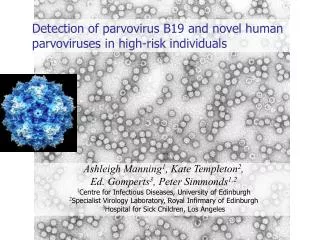
Parvoviruses are small, non-enveloped viruses with a genome of approximately 4-5.5 kb single-stranded DNA. This overview highlights the two subfamilies—Densovirinae (insects) and Parvovirinae (vertebrates)—the biology of Parvovirus B19, first identified in 1974, and its unique structural features. Emphasis is placed on the viral replication process, dependence on host cellular proteins, and the significance of transcriptional complexity. Furthermore, data on PARV4, including its prevalence in various populations, elucidates the virus's pathogenic potential and genetic variability.


Overview of Parvoviruses: Characteristics, Classification, and Prevalence Data
E N D
Presentation Transcript
Human Parvoviruses Kevin E Brown Immunisation and Diagnosis Unit Virus Reference Department Centre for Infections
Parvoviruses Small 22-24 nm non-enveloped 4 - 5.5 kb ss DNA genome with ITRs at 5’ and 3’ ends Encode no polymerase Dependant on cellular/other viral proteins for DNA replication 2 large ORF NS (or Rep) proteins VP (or Cap) proteins Classification Two subfamilies – host range Densovirinae – insects Parvovirinae – vertebrates Autonomous/dependant replication + or – strand packaging Identical or different 5’ and 3’ ITRs 1, 2 or 3 promoters Sequence pyhlogeny
Parvovirus B19 • First identified in 1974 (CPHL, London) • ~ 22 nm icosahedral virion • Linear single stranded DNA • ~ 5600 nucleotides • Long (383nt) terminal hairpin seq • Complex transcription map • Single promoter (p6) • 1 non-spliced non-structural protein • 2 capsid proteins (VP1 & VP2) -alt splicing • Small proteins of unknown function • VP2 self assembles to form VLP • Erythrotropic • Does not grow in standard tissue culture • Replicates in erythroid progenitors • Rare cell lines (UT7/Epo; KU812Ep6)
A6 V9 Phylogenetic tree of VP1u region Servant et al. J. Virol 2002
Prevalence of variant B19 in different groups * Only detected in those born before 1973
1st identified in a IVDU • Fever, arthralgia, meningism • Acute sample only • Lost to follow up • Closest sequence • Putative Erythroviruses • Chipmunk
Parv4 DNA • Typical parvovirus features • Incomplete hairpin sequence • Gap between NS and capsid • VP1 ~ 100 kDa • No 11 kDa or 7.5kDa ORFs
Prevalence of PARV4 virus using nested PCR Blood donors from Los Angeles area summer 2005 300 pools of 16 29 positives (9.6% or 0.6% if divided by 16). 200 single donations 4 positives (2%) Subjects with symptoms of acute viral infection or highly exposed (MSM, IDU) 16/195 subjects positive (85) 1 PARV5, PARV4 Increasing prevalence in symptomatic/exposed subjects may reflect pathogenic viral infection OR higher exposure to blood borne viruses (e.g. like GBV-C)
Genetic variation among PARV4 10 20 30 40 50 60 70 80 90 100 ---------+---------+---------+---------+---------+---------+---------+---------+---------+---------+ gttgatggccctgtggttagCACCCAGCATCAAGAAGCTTTGCAGACAAGAATAACCATGTTTCAGTTTCAGAGAATGGTTCCGGATGGCTTAGCTCCAC PARV4-Cutter pool-1991 ........y..................................G........................................................ Poolx16 24/29 ........y........................................................................................... Poolx16 2/29 ........y..................................R........................................................ Poolx16 1/29 ........y........................T.........G........................................................ Poolx16 1/29 ........y..................................G................................................R....... Poolx16 1/29 ........y..................................G........................................................ Neat 3/4 ........y..................................G.....................................T.................. Neat 1/4 ........y..................................G........................................................ Option 7/16 ........y........................................................................................... Option 3/16 ........y........................................................................................... Option 1/16 ........y..............................................T............................................ Option 1/16 ........y................R.................G........................................................ Option 1/16 ........y..................................G...R.................................................... Option 1/16 ........y.............................C....G........................................................ Option 1/16 ........y..............T........G......C..................................G........C...........C..T. Option 1/16 --......T..............T........G......C..................................G........C...........C..T. PARV5-Cutter-1991 110 120 130 140 150 160 ---------+---------+---------+---------+---------+---------+- TTCCTGAAGAGGAAGTGAGAAGCTTTTTTAAGCTAGgtgaacaggaactgaatatgaaagg PARV4-Cutter-1991 ............................................................. Poolx16 24/29 ............................................................. Poolx16 2/29 ............................................................. Poolx16 1/29 ............................................................. Poolx16 1/29 ............................................................. Poolx16 1/29 ............................................................. Neat 3/4 ............................................................. Neat 1/4 ............................................................. Option 7/15 ............................................................. Option 3/15 ...............................A............................. Option 1/15 ............................................................. Option 1/15 ............................................................. Option 1/15 ............................................................. Option 1/15 ............................................................. Option 1/15 .C....................T...........T.......................... Option 1/15 .C....................T...........T.......................... PARV5-Cutter-1991
Parv4 DNA VP2 expression • Bacteria • 60 kDa • Baculovirus • VLP • No HA • ELISA developed • Indirect format
Pooled NPA secretions • 48 samples • 38/48 pediatric patients • 378 NPA samples • Culture negative • 7/266 pediatric patients • 0/112 adult patients • 540 samples hospitalized peds • 3.1% pos • Increased in winter months • Closest sequence • Bovine parvovirus • CPV type 1 (MVC)
Human parvoviruses • Parvovirus B19 (B19V) – type member of Erythroviruses • 3 different genotypes now recognized • No evidence for different serotypes • Highly erythrotropic • Detection of DNA in blood and tissues for years following acute infection • No evidence of reactivation/integration • Parv4/5 is a new member of the Parvovidae • Sequences are uncommon in blood and blood products • No culture method available • VLP can be expressed • Do not resemble B19V • Do not HA • Parv4 Ab common in children/adults • Human bocavirus in respiratory secretions of children < 5 • Prevalence in other tissues/age groups • VLP can be expressed • Adeno-associated viruses – AAV2, 3, 5 are human viruses
Acknowledgements • Virus Discovery Group • Jun Lu • Ian Mills • Tri Nguyen • Susan Wong • Ning Zhi • Hematology Branch • Neal Young • Sachiko Kajigaya • Outside collaborations • Mavis Agbanje-McKenna • Sally Baylis • Eric Delwart • Erik Heegaard • Mei-Ying Yu • Health Protection Agency • Hazel Appleton