
Enhancing Sales Performance: Training and Motivation
E N D
Presentation Transcript
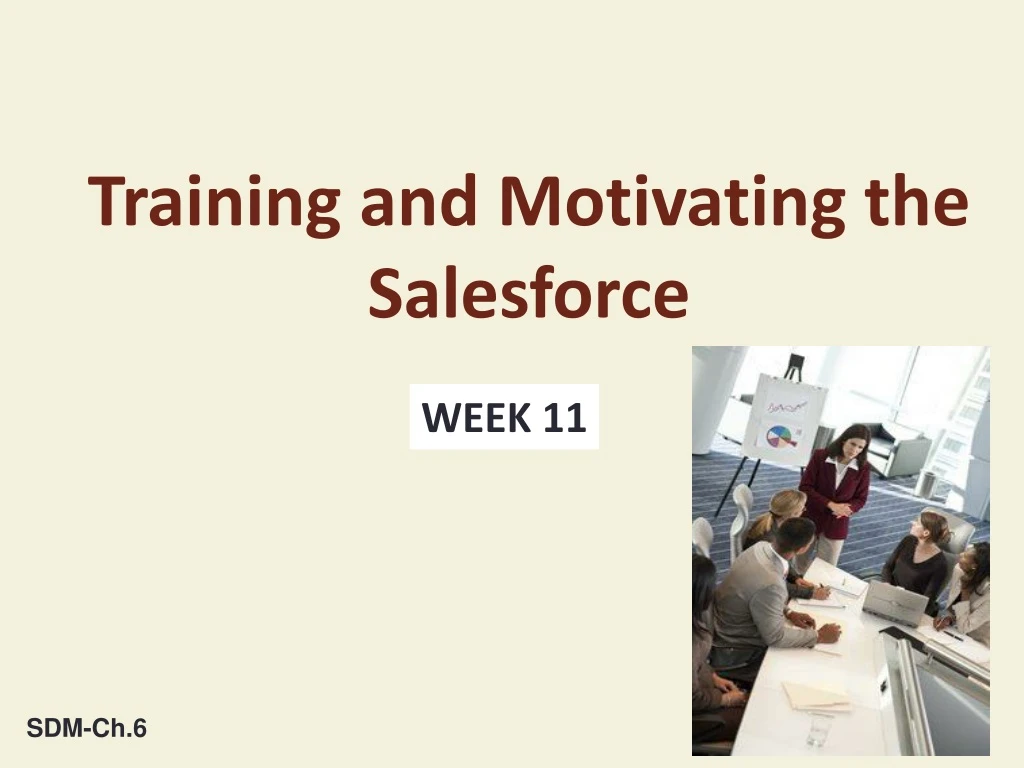
WEEK 11 TrainingandMotivatingthe Salesforce
Learning Objectives • To understand sales training process • Training method • To learn importance, • theories, and • tools of motivation
Sales Training • Proper training can prepare salespeople to meet with customer expectations • New salespeople spend a few weeks to several months in training • Companies view sales training important for protecting their investments in their salesforce • Sales Training Process consists of: • Assessing sales training needs • Designing and executing sales training programs • Evaluating and reinforcing sales training programs
Assessing Sales Training needs • Sales training needs are assessed both for • Newly hired sales trainees, and • Experienced / existing salespeople • Methods used for assessing training needs are: • First level sales managers’ observation • Survey of salesforce and field sales managers • Customer survey • Performance testing of salespersons • Job description statements • Salesforce audit (as a part of marketing audit)
Designing and Executing Sales Training Programme • For this, sales manager takes five decisions, called: ACMEE: Aim, Content, Methods, Execution, Evaluation • Examples of Aims / Objectives of sales training: • Increase sales, profits, or both • Increase sales productivity • Improve customer relations • Prepare new salespeople for assignment to territories
Content of Training Program • Content for new sales trainees is broader. It includes: • Company knowledge • Product knowledge • Customer knowledge • Competitor knowledge • Selling skills / sales techniques • Examples of specific content for experienced salespersons are: • New product/service/operation/software knowledge • Introduce change in sales organization • Negotiating skills • Content depends on the aims of training program
Sales Training Methods • Selection of suitable methods for a training program depends upon the topic and audience • Training methods are grouped into five categories: • Class room / Conference training • Behavioral learning / Simulations • Online training • Absorption training • On-the-job training • We shall briefly review the training methods
Class-Room / Conference Training • The training methods in this group are: (1) lecture, (2) demonstration, and (3) group discussion • Lecture • Used when more information is presented in a short time to a large number of participants • May lead to boredom due to less active participation • Demonstration • Used for giving product knowledge • Group discussion • Useful when participants include experienced and inexperienced salespersons • A panel discussion consists of a small group of people who discuss a specific topic
Behavioral Learning / Simulation • This group consists of three training methods: (1) role playing, (2) case-studies, and (3) business games • Role playing • Useful method for teaching sales technique / process • Typically, one trainee plays the role of a salesperson and another trainee acts as a buyer • Case studies • Beneficial for understanding consumer behavior, and building problem solving abilities • Case teaching includes open discussion, group discussion and presentation • Business games • Helpful in learning impact of decision making • Generates enthusiasm and competitive spirit
Online Training • It includes, (1) interactive multimedia training, (2) distance learning • It takes 50 percent less time and costs and more convenient than other training methods • Useful for getting basic knowledge like products and customers • Interactive media training is used for retraining salespeople who can repeat or skip material as desired • Distance learning is a personal training method, which is interactive
Absorption Training / Self Study • It includes supplying audio cassettes, product manuals, books, articles, and CD-ROMs to salespeople, who read (or absorb) these materials without feedback • Useful for introducing basic materials or strengthening previous training On-the-Job Training Most companies use this method as it places a sales trainee in arealistic sales situation • Typically, a junior salesperson is assigned to a senior salesperson for some period of time • In mentoring, a junior / new employee gets information, advise and support from mentors / experienced persons • Job rotation is used to prepare salespeople for management positions
Selecting Training Method • In addition to the topic and audience, selection of appropriate method depends on active / passive learning • People generally remember • 10% of what they read • 20% of what they hear • 30% of what they see • 50% of what they hear and see • 70% of what they say, and • 90% of what they say as they do a thing
Organizational Decisions for Sales Training • Organizational decisions, which are parts of designing sale training program, are: • Who will be the trainees? • Who will conduct the training? • When should the training take place? • How long should the training be? • Where should the training be done? • What will be the budgeted expenditure for the training?
Execution of Sales Training Programme • Usually sales trainer or sales training manager is responsible for entire process of sales training • Execution / implementation includes preparing time-table, arranging internal / external trainers, making travel arrangements of participants, arranging conference hall and teaching aids, and so on • A good practice to make a final check one / two days prior to start of training program • Obtain feedback from the sales trainees at the end of the program
Evaluation of Sales Training Program • It is done to improve training design and implementation, and to find if expenditure was worthwhile Framework for sales training evaluation:
Reinforce Sales Training • Behaviour of most salespeople would not change unless there is reinforcement to sales training • In many companies reinforcement or follow-up trainings are not done • Training methods used for reinforcement are: • Refresher training consists of continuous training to overcome deficiencies of experienced salespeople and retraining of salespeople whose job requirements have changed • Web-based or online methods to reinforce formal training sessions • Senior salespeople or first line sales managers coaching new salespersons
Motivating the Salesforce • Motivation is derived from Latin word “movere”, which means “to move” • Motivation is the effort the salesperson makes to complete various activities of the sales job • 10-15 percent salespeople are self-motivated • Majority of salespeople are not adequately motivated • Importance of motivating salespeople is recognized, because financial performance of the company depends upon the achievement of sales volume objective
Satisfaction Reward Performance Effort Motivation Motivational Theories • Motivation is first
Selecting a Mix of Motivational Tools • Sales manager should know each salesperson and understand his / her specific needs • For designing or selecting a mix of motivational tools, a compromise between differing needs of customers, salespeople, and the company management becomes necessary • Motivational tools are divided into: (1) financial, and (2) non-financial. These are shown in the next slide
Motivational Tools in a Motivational Mix • Financial compensation is the most widely used tool of motivation, but non-financialtoolsarealsoveryimportant!
Supervising Salespeople • Supervising is directing and controlling day-to-day activities of salespeople • It is a part of leadership • Sales managers use a combination of methods to supervise salespeople • Methods of supervision are classified into two categories – direct and indirect
Key Learnings • Sales training process consists of need assessment, designing, executing, evaluating, and reinforcing • Methods used for need assessment include observation, survey, performance testing, job description, and audit of salesforce • Designing sales training programme require five decisions, called “ACMEE”: Aims, Content, Methods, Execution, Evaluation • Execution of training programme includes preparing time-table, arranging trainers, travel booking, conference hall, teaching aids, etc. • Evaluation of training is done to improve design & implementation, and find if expenditure was worthwhile • Methods used for reinforcement include refresher training, web-based, and coaching salespeople
Key Learnings (Continued) • Motivation is the effort salesperson makes to perform various activities of sales job • Out of the various financial and non-financial tools of motivation, financial compensation is most widely used • 68 percent companies use combination compensation plan, and 32 percent use straight salary / commission plans • Leadership is necessary for a sales manager’s effectiveness • Leadership styles are transactional, transformational, and situational • Leadership skills include communication, problem-solving, and interpersonal • Supervising, a part of leadership, is directing & controlling day-to-day activities of salespeople