Structural Analysis and Design Optimization of High Pressure Vessel Components
210 likes | 360 Vues
This study presents a finite element (FE) analysis of high-pressure vessel components, focusing on the case body and multiplier parts. It includes a general view and vertical cross-section of the vessel, detailing the contact interaction zones under internal pressure. Utilizing a submodeling approach, 3D linear static analysis evaluates equivalent stress and design optimization by assessing six geometric variables to meet safety constraints. Experimental research further validates strain fields on the inner surfaces of key components, including new designs for hard-alloy inserts under external pressure.


Structural Analysis and Design Optimization of High Pressure Vessel Components
E N D
Presentation Transcript
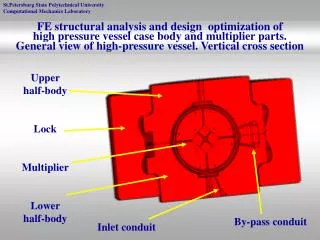
FE structural analysis and design optimization of high pressure vessel case body and multiplier parts. General view of high-pressure vessel. Vertical cross section Upper half-body Lock Multiplier Lower half-body By-pass conduit Inlet conduit
FE model of case body parts Contact interaction zones
Case body. Equivalent stress for analysis of 3D contact interaction of case body parts under internal pressure
Structural analysis for technological conduit zones. Submodeling method
3D linear static analysis. Equivalent stress Inlet conduit By-pass conduit
Design optimization of case body parts Design variables: Six geometric variables of the case body parts Constrains: max < 0.2/ksafety Objective function: Metal-intensity
Experimental research of strain fields. 12strain gaugeson the inner surface of the lock
3D solid model of multiplier Membrane Punch hard-alloy insert CapsuleGraphite
Equivalent stress for analysis of 3D contact interaction of punch and hard-alloy insert under external pressure
New design of hard-alloy insert. Analysis of utilization possibility
Equivalent stress for analysis of 3D contact interaction of punch and hard-alloy insert under external pressure. New design of hard-alloy insert