Three forms of quadratic function
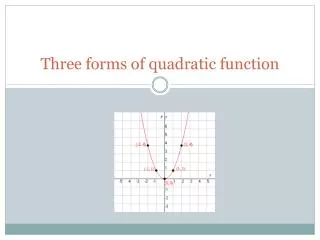
This guide explores the three forms of quadratic functions: Standard Form (F(x) = Ax² + Bx + C), Vertex Form (F(x) = a(x-h)² + k), and Intercept Form (F(x) = a(x-p)(x-q)). Learn how to determine the direction and width of the graph using the coefficient A, identify the vertex and y-intercept, and graph quadratics effectively. Discover how to find the axis of symmetry and plot critical points for accurate representation of the quadratic curve. Master these concepts for a comprehensive understanding of quadratic functions!

Three forms of quadratic function
E N D
Presentation Transcript
Standard form F(x)= Ax^2+Bx+C A tells you whether the graph opens up or down, and whether it is wide or narrow The vertex is (-b/2a, f(x) ) The y-intercept is C
Vertex form F(x)= a(x-h)^2+k A is the same as in standard form The vertex is (h , k)
Vertex cont. To graph Determine the vertex Plot it and draw the axis of symmetry, the equation of the AOS is x=h Find the coordinates of two other points Connect them and label
Intercept form F(x)= a(x-p)(x-q) First find the x and y intercepts x=p x=q y=apq 2. Plot the x-intercepts 3. Find the coordinates of the vertex (p+q/2, f(x))
Intercept cont. 4. plot the vertex and A.O.S x= p+q/2 5. Connect the points and label.