Understanding Chemical Equilibrium: Le Chatelier's Principle & Equilibrium Constants
Learn the fundamental concepts of chemical equilibrium, equilibrium constants, Le Chatelier's Principle, and the effects of catalysts, temperature, concentration, and volume on equilibrium reactions. Deal with stress in equilibrium systems and understand how to manipulate reactions toward desired products.


Understanding Chemical Equilibrium: Le Chatelier's Principle & Equilibrium Constants
E N D
Presentation Transcript
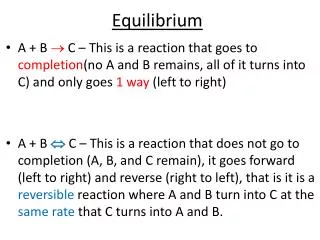
Equilibrium Chemical reaction in which reactants are forming as fast as products yet the net concentrations of each remains constant A + B C + D N2 + 3H2 2 NH3
Equilibrium Constant K aA + bB cC + dD K = [C]c [D]d [A]a [B]b Products over reactants
Equilibrium Constant K K > 1000 mostly products K < .001 mostly reactants K = .001 to 1000 equilibrium condition
Lechatlier’s Principle If stress is applied to a system at equilibrium, the system will adjust to relive the stress
Lechatlier’s Principle Possible stresses occur with Concentration, Volume and Temperature
Change in concentration PCl3 + Cl2 PCl5 At equilibrium, the molar concentrations are constant Add PCl5 the reaction will shift to form more PCl3 and Cl2 remove PCl5 the reaction will shift to form less PCl3 and Cl2 Add PCl3 or Cl2 more PCl5 will form Remove PCl3 and Cl2 more will form
Change in volume Reducing the volume or increasing the pressure causes the equilibrium to shift to the side of the equation with the fewest moles N2 g + 3H2 g 2NH3 g 4moles 2 moles H2 g + Br2 g 2HBr g 2moles 2moles
Temperature effects Exothermic Reactants products + Heat H2 + O2 H2O + 700 Calories Endothermic Heat + Reactants products CO2 + 2H2 + 90.7 Calories CH3OH
Catalyst effect A catalyst speeds up the rate at which equilibrium is achieved but does not change anything else – this occurs due to lowering the activation energy