Understanding Chemical Equilibrium: Reactions, Constants, and Calculations
This guide explains the concepts of chemical equilibrium, emphasizing the difference between irreversible and reversible reactions. It introduces the equilibrium constant (Kc) and its reliance on concentrations of reactants and products. The relationship between Kp and Kc is also discussed, including how temperature affects equilibrium and the method for calculating K. Additionally, it covers the reaction quotient (Q) for determining equilibrium status. Lastly, examples and calculations are provided for better comprehension.

Understanding Chemical Equilibrium: Reactions, Constants, and Calculations
E N D
Presentation Transcript
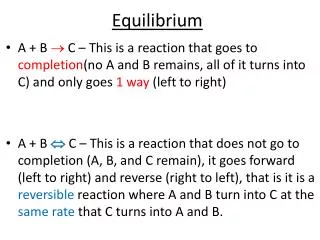
Equilibrium • A + B C – This is a reaction that goes to completion(no A and B remains, all of it turns into C) and only goes 1 way (left to right) • A + B C – This is a reaction that does not go to completion (A, B, and C remain), it goes forward (left to right) and reverse (right to left), that is it is a reversible reaction where A and B turn into C at the same rate that C turns into A and B.
Equilibrium Constant • Relates the concentrations of reactants to the concentrations of products • Equiliburm Constant – Kc – “c” stands for concentrations (molarity) aA + bB cC • Kc= [products]coefficients = [C]c____ [reactants]coefficients[A]a[B]b
Stuff about K • Include gases and aqueous solutions only • If all of the substances are gases, calculate Kp instead of Kc; relationship between Kp and Kc,Kp = Kc(RT)n • K is a function of temperature, even though it’s not shown in the equation • Only use equilibirum concentrations (NOT initial) • Kc reverse = 1/Kc forward (they are inverses of each other) • If you multiply the equation by a whole #, you raise K to that power • If a reaction occurs in a series of steps where you add the reactions to get the overall equation, multiply the individual K’s to get the overall K
Practice At a given temperature, K = 1.3 X 10⁻² for the reaction N2(g) + 3H2(g) 2NH3(g). Calculate K for the following reactions at this temperature. a. ½ N2(g) + 3/2H2(g) NH3(g) b. 2NH3(g) N2(g) + 3H2(g) c. NH3(g) 1/2 N2(g) + 3/2H2(g) d. 2N2(g) + 6H2(g) 4NH3(g)
Q – reaction quotient • Use to determine if you are at equilibrium or not • Calculate the same way you calculate K • Q = K – at equilibrium • Q < K – forward reaction needs to “go” • Q > K – reverse reaction needs to “go”
Percent ionization % = equilibrium concentration Initial concentration *100