Understanding Reversible Reactions and Equilibrium Constants in Chemistry
This guide delves into the principles of reversible reactions and chemical equilibrium, explaining the forward and reverse reactions' dynamics. It elaborates on how equilibrium is established when the rates of forward and reverse reactions are equal, even though reactant and product concentrations may differ. The guide covers the Law of Mass Action, the calculation of equilibrium constants (K), and how temperature influences K. It also addresses both homogeneous and heterogeneous equilibria, the Reaction Quotient (Q), and how to predict the direction of shifts towards equilibrium.

Understanding Reversible Reactions and Equilibrium Constants in Chemistry
E N D
Presentation Transcript
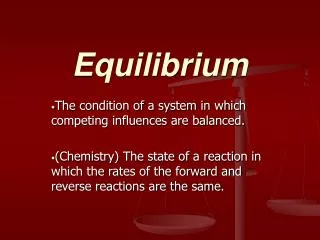
Reactions are reversible • A + B C + D ( forward) • C + D A + B (reverse) • Initially there is only A and B so only the forward reaction is possible • As C and D build up, the reverse reaction speeds up while the forward reaction slows down. • Eventually the rates are equal.
Forward Reaction Reaction Rate Equilibrium Reverse reaction Time
What is equal at Equilibrium? • Rates are equal. • Concentrations are not. • Rates are determined by concentrations and activation energy. • The concentrations of products and reactants do not change: • at equilibrium. • or if the reaction is verrrry slooooow.
Law of Mass Action • For any reaction • jA + kB lC + mD • K = [C]l[D]m [PRODUCTS]power [A]j[B]k [REACTANTS]power • K is called the equilibrium constant. • is how we indicate a reversible reaction
Playing with K • If we write the reaction in reverse, lC + mD jA + kB • Then the new equilibrium constant is K’ = [A]j[B]k = 1/K[C]l[D]m
Playing with K • If we multiply the equation by a constant (n), njA + nkB nlC + nmD • Then the equilibrium constant is K’ = [C]nl[D]nm ([C]l[D]m)n= Kn[A]nj[B]nk= ([A] j[B]k)n
The units for K • NONE! • BUT, you have to make sure you use the correct units throughout your calculation of K.
K is CONSTANT • At any specific temperature. • Temperature affects rate! • The equilibrium concentrations don’t have to be the same, only K. • Equilibrium position is a set of concentrations at equilibrium. • There are an unlimited number of K’s.
Equilibrium Constant One for each Temperature
Calculate K • N2 + 3H2 2NH3 • InitialAt Equilibrium [N2]0 =1.000 M [N2] = 0.921M [H2]0 =1.000 M [H2] = 0.763M [NH3]0 =0 M [NH3] = 0.157M
Calculate K • N2 + 3H2 2NH3 • InitialAt Equilibrium [N2]0 = 0 M [N2] = 0.399 M [H2]0 = 0 M [H2] = 1.197 M [NH3]0 = 1.000 M [NH3] = 0.203M • K is the same for a given reaction, no matter what the amount of starting materials!
Equilibrium and Pressure • Some reactions are gaseous. • Ideal Gas Law: PV = nRT • P = (n/V)RT • P = CRT, where C is a concentration in moles/liter (M). • C = M = P/RT
Equilibrium and Pressure • 2SO2(g) + O2(g) 2SO3(g) • KP = (PSO3)2 (PSO2)2 (PO2) • KC = [SO3]2 = (PSO3/RT)2[SO2]2 [O2] (PSO2/RT)2 (PO2/RT)
Equilibrium and Pressure • K =(PSO3/RT)2 (PSO2/RT)2 (PO2/RT) • K =(PSO3)2 (1/RT)2 (PSO2)2(PO2) (1/RT)3 • K=Kp(1/RT)2= Kp RT (1/RT)3
General Equation • jA + kB lC + mD • Kp= (PC)l (PD)m= (CCxRT)l (CDxRT)m (PA)j (PB)k (CAxRT)j(CBxRT)k • Kp=(CC)l (CD)m x (RT)l+m (CA)j(CB)k x (RT)j+k • Kp =K (RT)(l+m)-(j+k) = K (RT)Dn • Dn=(l+m)-(j+k)=Change in moles of gas
Homogeneous Equilibria • So far every example dealt with reactants and products where all were in the same phase. • We can use K in terms of either concentration or pressure. • Units depend on reaction.
Heterogeneous Equilibria • If the reaction involves pure solids or pure liquids, the concentration of the solid or the liquid doesn’t change. • As long as they are not used up we can leave them out of the equilibrium expression. • For example:
For Example • H2(g) + I2(s) 2HI(g) • K = [HI]2 [H2][I2] • But the concentration of I2(s)does not change, so it doesn’t affect K. • K= [HI]2 [H2]
Write the equilibrium constant for the heterogeneous reaction
The Reaction Quotient • Tells you the direction the reaction will go to reach equilibrium • Calculated the same as the equilibrium constant, but for a system not at equilibrium • Q = [Products]0coefficient [Reactants]0coefficient • Compare value to equilibrium constant
What Q tells us • If Q<K • Not enough products • Shift to right • If Q>K • Too many products • Shift to left • If Q=K system is at equilibrium
Example • for the reaction • 2NOCl(g) 2NO(g) + Cl2(g) • K = 1.55 x 10⁻⁵ M at 35ºC • In an experiment 0.10 mol NOCl, 0.0010 mol NO(g) and 0.00010 mol Cl2 are mixed in 2.0 L flask. • Which direction will the reaction proceed to reach equilibrium?
Solving Equilibrium Problems • Given the starting concentrations and one equilibrium concentration. • Use stoichiometry to figure out other concentrations and K. • Learn to create a table of initial and final conditions.
Consider the following reaction at 600ºC • 2SO2(g) + O2(g) 2SO3(g) • In a certain experiment 2.00 mol of SO2, 1.50 mol of O2 and 3.00 mol of SO3 were placed in a 1.00 L flask. At equilibrium 3.50 mol of SO3 were found to be present. Calculate • The equilibrium concentrations of O2 and SO2, K and KP
Consider the same reaction at 600ºC 2SO2(g) + O2(g) 2SO3(g) • In a different experiment .500 mol SO2 and .350 mol SO3 were placed in a 1.000 L container. When the system reaches equilibrium 0.045 mol of O2 are present. • Calculate the final concentrations of SO2 and SO3 and K
Type 1Problems with large K K > 100
What if you’re not given equilibrium concentration? • The size of K will determine what approach to take. • First let’s look at the case of a LARGE value of K ( >100). • Allows us to make simplifying assumptions.
Example • H2(g) + I2(g) 2HI(g) • K = 7.1 x 10² at 25ºC • Calculate the equilibrium concentrations if a 5.00 L container initially contains 15.8 g of H2 294 g I2 . • [H2]0 = (15.8g/2.02)/5.00 L = 1.56 M • [I2]0 = (294g/253.8)/5.00L = 0.232 M • [HI]0 = 0
Q= 0<K so more product will be formed. • Set up table of initial, final and change in concentrations. • Assumption since K is large- reaction will almost go to completion. • Stoichiometry tells us I2 is LR, it will be smallest at equilibrium let it be x
H2(g) I2(g) 2 HI(g) initial 1.56 M 0.232 M 0 Mchange final X • Choose X so it is small. • For I2 the change in X must be X-.232 M • Final must = initial + change
H2(g) I2(g) 2 HI(g) initial 1.56 M 0.232 M 0 Mchange X-0.232 M final X • Using to stoichiometry we can find • Change in H2 = X-0.232 M • Change in HI = -twice change in H2 • Change in HI = 0.464-2X
H2(g) I2(g) 2 HI(g) initial 1.56 M 0.232 M 0 Mchange X-0.232 M X-0.232 M 0.464-2X final X • Now we can determine the final concentrations by adding.
H2(g) I2(g) 2 HI(g) initial 1.56 M 0.232 M 0 Mchange X-0.232 M X-0.232 M 0.464-2X final 1.328+X X 0.464-2X • Now plug these values into the equilibrium expression • K = (0.464-2X)2 = 7.1 x 10² (1.328+X)(X)
Why we chose X • K = (0.464-2X)2 = 7.1 x 10² (1.328+X)(X) • Since X is going to be small, we can ignore it in relation to 0.464 and 1.328 • So we can rewrite the equation • 7.1 x 102 = (0.464)2 (1.328)(X) • Makes the algebra easy
H2(g) I2(g) 2 HI(g) initial 1.56 M 0.232 M 0 Mchange X-0.232 M X-0.232 M 0.464-2X final 1.328+X X 0.464-2X • When we solve for X we get 2.3 x 10⁻⁴ • So we can find the other concentrations • I2 = 2.3 x 10⁻⁴ M • H2 = 1.328 M • HI = 0.464 M
Checking the assumption • The rule of thumb is that if the value of X is less than 5% of the smallest concentration, our assumption was valid. • If not we would have had to use the quadratic equation • More on this later. • Our assumption was valid.
Practice • For the reaction Cl2 + O2 2ClO(g) K = 156 • In an experiment 0.100 mol ClO, 1.00 mol O2 and 0.0100 mol Cl2 are mixed in a 4.00 L flask. • If the reaction is not at equilibrium, which way will it shift? • Calculate the equilibrium concentrations.
At an elevated temperature, the reaction: has a value of Keq = 1.01 x 10³ . If 0.234 mol IBr is placed in a 1.00 L. flask and allowed to reach equilibrium, what is the equilibrium concentration in M. of I2?
Type 2Problems with small K K< .01
Process is the same • Set up table of initial, change, and final concentrations. • Choose X to be small. • For this case it will be a product. • For a small K the product concentration is small.
For example • For the reaction 2NOCl 2NO +Cl2 • K= 1.6 x 10⁻⁵ • If 1.20 mol NOCl, 0.45 mol of NO and 0.87 mol Cl2 are mixed in a 1 L container • What are the equilibrium concentrations • Q = [NO]2[Cl2] = (0.45)2(0.87) = 0.15 M [NOCl]2 (1.20)2
2NOCl 2NO + Cl2 Initial 1.20 0.45 0.87 Change Final • Choose X to be small • NO will be LR • Choose NO to be X
2NOCl 2NO + Cl2 Initial 1.20 0.45 0.87 Change Final X • Figure out change in NO • Change = final - initial • change = X-0.45
2NOCl 2NO + Cl2 Initial 1.20 0.45 0.87 Change X-.45 Final X • Now figure out the other changes • Use stoichiometry • Change in Cl2 is 1/2 change in NO • Change in NOCl is - change in NO
2NOCl 2NO + Cl2 Initial 1.20 0.45 0.87 Change 0.45-X X-.45 0.5X -.225 Final X • Now we can determine final concentrations • Add
2NOCl 2NO + Cl2 Initial 1.20 0.45 0.87 Change 0.45-X X-.45 0.5X -.225 Final 1.65-X X 0.5 X +0.645 • Now we can write equilibrium constant • K = (X)2(0.5X+0.645) (1.65-X)2 • Now we can test our assumption X is small ignore it in + and -
2NOCl 2NO + Cl2 Initial 1.20 0.45 0.87 Change 0.45-X X-.45 0.5X -.225 Final 1.65-X X 0.5 X +0.645 • K = (X)2(0.645) = 1.6 x 10⁻⁵ (1.65)2 • X= 8.2 x 10⁻³ • Figure out final concentrations
2NOCl 2NO + Cl2 Initial 1.20 0.45 0.87 Change 0.45-X X-.45 0.5X -.225 Final 1.65-X X 0.5 X +0.645 • [NOCl] = 1.64 • [Cl2] = 0.649 • Check assumptions • .0082/.649 = 1.2 % OKAY!!!