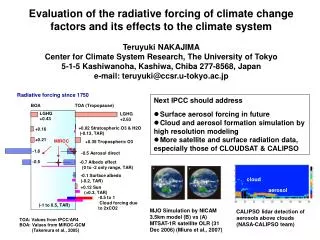
Radiative forcing since 1750
Evaluation of the radiative forcing of climate change factors and its effects to the climate system Teruyuki NAKAJIMA Center for Climate System Research, The University of Tokyo 5-1-5 Kashiwanoha, Kashiwa, Chiba 277-8568, Japan e-mail: teruyuki@ccsr.u-tokyo.ac.jp.

Radiative forcing since 1750
E N D
Presentation Transcript
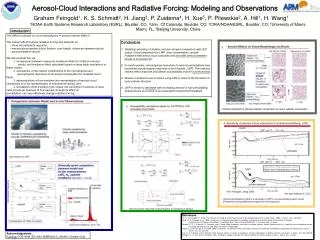
Evaluation of the radiative forcing of climate change factors and its effects to the climate system Teruyuki NAKAJIMA Center for Climate System Research, The University of Tokyo 5-1-5 Kashiwanoha, Kashiwa, Chiba 277-8568, Japan e-mail: teruyuki@ccsr.u-tokyo.ac.jp Radiative forcing since 1750 • Next IPCC should address • Surface aerosol forcing in future • Cloud and aerosol formation simulation by high resolution modeling • More satellite and surface radiation data, especially those of CLOUDSAT & CALIPSO BOA TOA (Tropopause) LGHG +0.43 LGHG +2.63 +0.02 Stratospheric O3 & H2O (-0.13, TAR) +0.16 +0.21 MIROC +0.35 Tropospheric O3 -1.6 -0.5 Aerosol direct -0.5 -0.7 Albedo effect (0 to -2 only range, TAR) -0.1 Surface albedo (-0.2, TAR) cloud +0.12 Sun (+0.3, TAR) aerosol -0.5 to 1 Cloud forcing due to 2xCO2 (-1 to 0.5, TAR) MJO Simulation by NICAM 3.5km model (B) vs (A) MTSAT-1R satellite OLR (31 Dec 2006) (Miura et al., 2007) CALIPSO lidar detection of aerosols above clouds (NASA-CALIPSO team) TOA: Values from IPCC/AR4 BOA: Values from MIROC-GCM (Takemura et al., 2005)