Download
1 / 7
70 likes | 195 Vues
This guide explores the usage of dashes and hyphens in English for clear communication. Learn how to use dashes to indicate interruptions, repetitions, and to set off additional information. Discover examples that demonstrate their role in enhancing clarity and meaning in sentences. Additionally, understand how hyphens connect words or clarify meanings, exemplified with phrases like "ice-cream" and "big-city project". Mastering these punctuation marks can improve your writing's fluidity and precision.

E N D
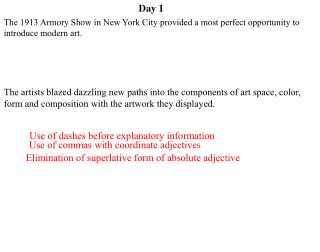
A dash showing interruption: "The girl is my -" "Sister," interrupted Miles. "She looks just like you."
A dash showing repetition: • "You-you monster!" cried the frightened woman. • "St-st-op!" stammered the boy.
In the same way commas and brackets can be used (to contain extra information): • When we get there - if we get there - I'll have something to say to him about his confounded map. • When we get there (if we get there) I'll have something to say to him about his confounded map. • When we get there, if we get there, I'll have something to say to him about his confounded map.
A dash before a final comment: • "Yes - I will do it," agreed Lucy. • Arthur did not answer, did not move, did not so much as bat an eyelid, but lay quietly in his bed - with a large knife protruding from his chest. • I just have to make one phone call to the police and it's all over - don't think I won't do it. • She got home, put the kettle on and sat down - then she remembered. • I'd love to go out with you to the dinner - when hell freezes over!
A hyphen links words: • ice-cream • topsy-turvy
A hyphen also makes the meaning of a sentence clear: • A big-city project. (A project on a big city not a big project on a city.)