Understanding AVL Tree Operations: Insertion, Deletion, and Balancing Techniques
This guide covers essential AVL tree operations, including finding, inserting, and deleting nodes while maintaining balance. The insertion involves first placing the node like in a standard binary search tree (BST) and then checking for height imbalances. Four cases of imbalance are discussed, along with the necessary rotations to restore balance. The deletion process is outlined, emphasizing both lazy deletion and standard BST methods followed by a balance check. Various examples illustrate the concepts, making it easier to grasp AVL tree mechanics.


Understanding AVL Tree Operations: Insertion, Deletion, and Balancing Techniques
E N D
Presentation Transcript
AVL Tree 2014.1.23 Iris Jiaonghong Shi
AVL tree operations • AVL find: • Same as BST find • AVL insert: • First BST insert, then check balance and potentially “fix” the AVL tree • Four different imbalance cases • AVL delete: • The “easy way” is lazy deletion • Otherwise, do the deletion as binary search tree and check balance.
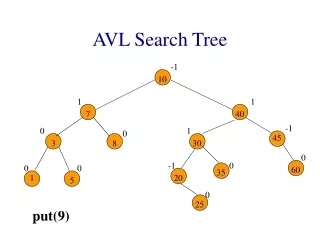
Insert, summarized • Insert as in a BST • Check back up path for imbalance, which will be 1 of 4 cases: • Node’s left-left grandchild is too tall • Node’s left-right grandchild is too tall • Node’s right-left grandchild is too tall • Node’s right-right grandchild is too tall • Only one case occurs because tree was balanced before insert • After the appropriate single or double rotation, the smallest-unbalanced subtree has the same height as before the insertion • So all ancestors are now balanced
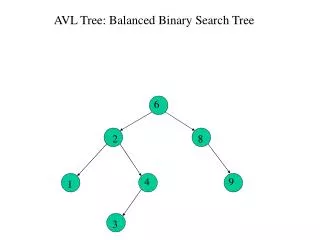
Example: Insert • Warm up: 2, 5, 6, 8, 9, 7 • Example in the book: • 3,2,1,4,5,6,7 • 16,15,14,13,12,11,10,8,9 • An avl applet to play with: • http://www.site.uottawa.ca/~stan/csi2514/applets/avl/BT.html
Node’s left-left grandchild is too tall:rotateWithLeftChild
Node’s right-left grandchild is too tall:doubleWithLeftChild
Example(Cont.) • Insert: • 3,2,1,4,5,6,7 • 16,15,14,13,12,11,10,8,9 • Delete( assume replace by leftMax) • 7,5
Q&A • Thank you!