Process Safety Management
The necessity of Process safety management is to prevent fatal accidents from occurring in a process plant affecting equipment and personnel in and around the plant. Unexpected release of toxic, reactive or flammable liquids or gases in industries leads to accidents which in turn creates the possibility of disaster. Using this approach, the process design, process technology, process changes, operational and maintenance activities and procedures, non-routine activities and procedures, emergency preparedness plans and procedures, training programs, https://ifluids.com/process-safety-management/

Process Safety Management
E N D
Presentation Transcript
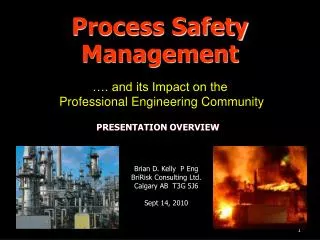
Process Safety Management The necessity of Process safety management is to prevent fatal accidents from occurring in a process plant affecting equipment and personnel in and around the plant. Unexpected release of toxic, reactive or flammable liquids or gases in industries leads to accidents which in turn creates the possibility of disaster. Using this approach, the process design, process technology, process changes, operational and maintenance activities and procedures, non-routine activities procedures, emergency preparedness plans and procedures, training programs, and other elements that affect the process are all considered in the evaluation. An effective Process safety management program requires a systematic approach to evaluating the whole process involving chemicals which are hazardous. Hence, the PSM elements stated by Occupational Safety and Health Administration (OSHA) are as follows 1. Employee participation OSHA requires employee participation to be followed as written, so employers should create formal plans. It is mandatory that employees - including operation and maintenance be involved in every aspect of the PSM programs. They must also participate in PSM related issue discussion.
2. Process safety information According to OSHA’s PSM mandates, “The employer shall complete a compilation of written process safety information before conducting any process safety hazard analysis required by the standard.” In other words, all workers should be able to access and understand the technical data regarding the HHC-related risks they face on the job. 3. Process hazard analysis (PHA) One of the most technical elements of PSM, Process Hazard Analysis requires that engineers and maintenance leaders analyze the consequences of safety failures. These analyses must be conducted in teams, and OSHA requires that each team must include one person who is “knowledgeable in the specific process hazard methodology being used.” 4. Operating procedures
There are plenty of potential chemical hazards following turnarounds and emergency shutdowns, which need to be regularly assessed and companies should have plans to keep everyone safe. 5. Training Workers involved in processes with hazardous chemicals need to be trained in an efficient and competent manner from a reliable source and also be well aware of safety procedures to be followed. The training should be a well-documented one. 6. Contractors All employees and contractors must be well informed with the risk they are exposed to in the workplace. They must be well trained and aware of all precaution and measures to be taken. 7. Pre-startup safety review OSHA expects employers to perform pre-startup safety reviews for both new and modified facilities. This rule applies even if the procedural changes only affect a single component or process.
8. Mechanical integrity Periodic, documented inspections are required for several systems, including: •Pressure vessels •Storage tanks •Piping systems •Ventilation systems The employers or contractors conducting these inspections must not only be officially trained, their testing procedures must follow “recognized and generally accepted good engineering practices,” according to OSHA. 9. Hot Work permit The employee must possess permit when exposed to high heat environment and working with heat. Training must be provided and state these documents as when and required. 10. Management of Change
In the process safety management standard, change includes all modifications to equipment, procedures, raw materials, and processing conditions other than "replacement in kind." If the operator finds any change in the operating parameters, a review and approval by a written management of change procedure to be followed. 11. Incident investigation This is usually done to avoid mishaps from recurring by learning from past experiences. The incidents OSHA expects employers to recognize and to investigate are the types of events that resulted in or could reasonably have resulted in a catastrophic release. These events are sometimes referred to as "near misses," meaning that a serious consequence did not occur, but could have happened. 12. Emergency planning and response Emergency preparedness need to be inculcated in all employers and always be alert of the sudden mishap which can lead to major accidents.
13. Compliance audits An audit is a technique to gather all information to verify compliance with standards. It is always beneficial to retain the recent audit reports for ready reference. 14. Trade secrets To enhance worker safety and safe working environment, the “trade secrets” helps employees know the work environment and the hazards they will be exposed to.The intent of PSM is to ensure that we perform our processes in a manner that is consistent with safety in all operations, engineering, and maintenance tasks that are conducted involving HHCs.
If you have decided to do Quantitative Risk Assessment (QRA) through DNV PHAST & SAFETI, you might be interested to get it from iFluids Engineering. iFluids Engineering is a Specialist Engineering Consultancy which specializes in various Risk & Safety Studies. It is also has genuine licensed software for major requirements in Oil & Gas and Petrochemical Industry. These include software from DNV PHAST, Pipenet, Olga, MAROS and a whole lot more as mentioned in Figure.1 Software with iFluids. Whenever you find yourself choosing between service provider for various specialized, just remember the that using latest software helps in a reliable and safe operations! And always verify the same directly. Learn more about Safeti software Contact our experts to learn more about DNV Safeti software and the services that iFluids Engineering provides
Figure.2 iFluids Process Safety Consulting Services Figure.3 iFluids Loss Prevention/Fire Safety Consulting Services
Figure.4 iFluids Functional Safety Consulting Services Figure.5 iFluids Specialized Studies
Disclaimer Disclaimer: All information and content contained in this article are provided solely for general information and reference purposes. TM information, Images & any copyrighted material inadvertently published or depicted belong to rightful owner and iFluids doesn’t claim to be its own. To know more or to send inquiry, Please call +91 8939 530143 WhatsApp +91 90254 00631 Email us: info@iFluids.com Or Click here to submit your inquiry online