Download

1 / 16
190 likes | 643 Vues
5/16/2012. CS326A

E N D
1. 5/17/2012 CS326A #6 1 Khatib: Real-time Obstacle Avoidance for Manipulators and Mobile Robots Jeffrey Yu Frequently, presenters must deliver material of a technical nature to an audience unfamiliar with the topic or vocabulary. The material may be complex or heavy with detail. To present technical material effectively, use the following guidelines from Dale Carnegie Training®.
Consider the amount of time available and prepare to organize your material. Narrow your topic. Divide your presentation into clear segments. Follow a logical progression. Maintain your focus throughout. Close the presentation with a summary, repetition of the key steps, or a logical conclusion.
Keep your audience in mind at all times. For example, be sure data is clear and information is relevant. Keep the level of detail and vocabulary appropriate for the audience. Use visuals to support key points or steps. Keep alert to the needs of your listeners, and you will have a more receptive audience.Frequently, presenters must deliver material of a technical nature to an audience unfamiliar with the topic or vocabulary. The material may be complex or heavy with detail. To present technical material effectively, use the following guidelines from Dale Carnegie Training®.
Consider the amount of time available and prepare to organize your material. Narrow your topic. Divide your presentation into clear segments. Follow a logical progression. Maintain your focus throughout. Close the presentation with a summary, repetition of the key steps, or a logical conclusion.
Keep your audience in mind at all times. For example, be sure data is clear and information is relevant. Keep the level of detail and vocabulary appropriate for the audience. Use visuals to support key points or steps. Keep alert to the needs of your listeners, and you will have a more receptive audience.
2. 5/17/2012 CS326A #6 2 Plan Review the motion problem
Show how previous approaches are similar
Show how the potential field approach is different
Describe details of the potential field approach
Summarize strengths and weaknesses
3. 5/17/2012 CS326A #6 3 Review: Motion Planning Problem Move a robot from a start position to an end position
Avoid obstacles along the way
Complete the task in a reasonable amount of time
Previous approaches: roadmap, cell decomposition, probabilistic roadmap In your opening, establish the relevancy of the topic to the audience. Give a brief preview of the presentation and establish value for the listeners. Take into account your audience’s interest and expertise in the topic when choosing your vocabulary, examples, and illustrations. Focus on the importance of the topic to your audience, and you will have more attentive listeners.In your opening, establish the relevancy of the topic to the audience. Give a brief preview of the presentation and establish value for the listeners. Take into account your audience’s interest and expertise in the topic when choosing your vocabulary, examples, and illustrations. Focus on the importance of the topic to your audience, and you will have more attentive listeners.
4. 5/17/2012 CS326A #6 4 Previous Approaches: Common Characteristics Find a valid path to the goal
Transform valid path into forces of motion
Apply forces to the robot
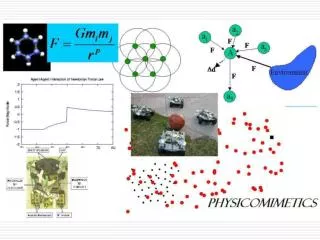
5. 5/17/2012 CS326A #6 5 Potential Field Approach Design a force to guide the robot towards the goal
Design forces to guide the robot away from obstacles
Apply the total force to the robot
6. 5/17/2012 CS326A #6 6 Example Combination of forces move steer the robot around a corner
7. 5/17/2012 CS326A #6 7 Goal Force: Design Criteria Move the robot towards the goal state
Bring the robot to rest at the goal state
Stay within robot safety and operational limits
8. 5/17/2012 CS326A #6 8 Goal Force #1 Basic spring-like force
Stable at the goal
Weakness: cyclic motion away from the goal
9. 5/17/2012 CS326A #6 9 Goal Force #2 Drag term brings the robot to rest
Weakness: long distances produce high acceleration and high-velocity motion
10. 5/17/2012 CS326A #6 10 Goal Force #3 (Final) Based on goal force #2
Produces straight-line, velocity-limited movement toward the goal
Motion perturbed near obstacles
11. 5/17/2012 CS326A #6 11 Obstacle Force: Design Criteria Steer robots away from an obstacle’s surface
Influence is negligible away from an obstacle’s surface
Two methods: analytic obstacle equations and shortest distance to an obstacle
12. 5/17/2012 CS326A #6 12 Obstacle Forces: Analytic Equations Function f(x) = 0 describes obstacle surface
Influence starts at f(x)=x0, approaches infinity at f(x)=0
No distance calculation needed
13. 5/17/2012 CS326A #6 13 Obstacle Forces: Shortest Distance Produces motion away from the closest point of danger
Real-time sensing possible
14. 5/17/2012 CS326A #6 14 Strengths Calculations done in operational space: avoid translation to and from configuration space
Calculations done in control domain: no conversion from intermediate path representation to command forces
Less upfront effort expended planning a possibly obsolete path
15. 5/17/2012 CS326A #6 15 Weaknesses Failure due possible even if a valid path exists
Workarounds:
Random walks
Roadmap connecting local minima
Motion attempted even if no valid path exists
Failure modes are observable to bystanders
16. 5/17/2012 CS326A #6 16 Other Topics Manipulator optimizations
End-effector decoupling parameters can be computed at a lower rate than the end-effector force vector
Applications
Khatib et al 1984: PUMA 560 with machine intelligence Corp vision module
Khatib, Burdick, and Armstrong 1985: real-time end-effector motion with active force control
17. 5/17/2012 CS326A #6 17 Summary: Potential Field Methods Artificial forces guide robot motion
Sacrifices reliability for speed Determine the best close for your audience and your presentation. Close with a summary; offer options; recommend a strategy; suggest a plan; set a goal. Keep your focus throughout your presentation, and you will more likely achieve your purpose.Determine the best close for your audience and your presentation. Close with a summary; offer options; recommend a strategy; suggest a plan; set a goal. Keep your focus throughout your presentation, and you will more likely achieve your purpose.