Theoretical Models of Collapse in Stellar Evolution: Insights and Methods
This document examines the collapse phase in stellar evolution. It discusses foundational theories surrounding star formation, focusing on the dynamics of gravitational collapse and the significance of various methods, including analytical, semi-analytical, and numerical approaches. Key topics include initial and boundary conditions, sensitivity to gridding, and mass accretion rates. Notable models and theories from significant contributions by scholars such as Shu, Larson, and Penston are summarized. The emphasis is placed on understanding the complexity and computational techniques required for modeling stellar collapse effectively.

Theoretical Models of Collapse in Stellar Evolution: Insights and Methods
E N D
Presentation Transcript
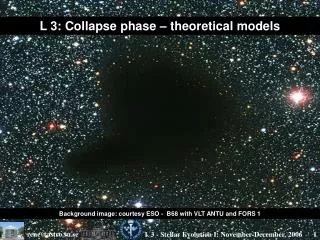
L 3: Collapse phase – theoretical models Background image: courtesy ESO - B68 with VLT ANTU and FORS 1 L 3 - Stellar Evolution I: November-December, 2006
L 3: Collapse phase – theoretical models The Formation of Stars Chapters: 9, 10, 12 Background image: courtesy ESO - B68 with VLT ANTU and FORS 1 L 3 - Stellar Evolution I: November-December, 2006
L 3: Collapse phase – theoretical models Barnard 68 considered a pre-collapse/collapse candidate Background image: courtesy ESO - B68 with VLT ANTU and FORS 1 L 3 - Stellar Evolution I: November-December, 2006
L 3: Collapse phase – theoretical models If you discuss methods and techniques of collapse calculations: consider sensitivity to gridding, boundary conditions; access to a standard code? (run it) Background image: courtesy ESO - B68 with VLT ANTU and FORS 1 L 3 - Stellar Evolution I: November-December, 2006
Time scales: low mass star formation L 3 - Stellar Evolution I: November-December, 2006
Generic types of theories of collapse analytical semi-analytical numerical L 3 - Stellar Evolution I: November-December, 2006
Jeans (1927) MNRAS 87, 720 On Liquid Stars Joel Tholine (1982) Hydrodynamic Collapse Fundamental Cosmic Physics Vol. 8, pp. 1-82 L 3 - Stellar Evolution I: November-December, 2006
Early Work Basic Insights L 3 - Stellar Evolution I: November-December, 2006
density x10 x 2 time L 3 - Stellar Evolution I: November-December, 2006
Self-similarity solutions Isothermal spherical collapse Penston 1969, MNRAS 144, 425 Larson 1969, MNRAS 145, 271 Shu 1977, ApJ 214, 488 Hunter 1977, ApJ 218, 834 L 3 - Stellar Evolution I: November-December, 2006
Mass Definition Continuity Equation Momentum equation eos L 3 - Stellar Evolution I: November-December, 2006
Similarity Variable L 3 - Stellar Evolution I: November-December, 2006
Palla & Stahler call this Eq the isothermal Lane-Emden equation LE derived for polytropes ( P = k r n ), e.g.fully convective stars: n=3/2 (=1+1/m) L 3 - Stellar Evolution I: November-December, 2006
density velocity LP = Larson, Penston H = Hunter EW = Expansion Wave (Shu) L 3 - Stellar Evolution I: November-December, 2006
density velocity LP = Larson, Penston H = Hunter EW = Expansion Wave (Shu) supersonic L 3 - Stellar Evolution I: November-December, 2006
centrally condensed Bonnor 1956 MNRAS 116, 351 flat distribution Shu 1977 extreme case L 3 - Stellar Evolution I: November-December, 2006
Inside-out collapse (Shu 1977) Mass accretion rate a constant of the cloud Mass accretion time scale L 3 - Stellar Evolution I: November-December, 2006
Foster & Chevalier 1993 Numerical simulations of non-singular isothermal spheres Like Hunter 1977: 1 solution has Shu’s EW as 1 limit models resemble LP with infall v ~ - 3 cs (homologous inflow) Why Shu 1977 commonly used ? (in particular, dM/dt = constant) L 3 - Stellar Evolution I: November-December, 2006
Foster & Chevalier 1993, ApJ 416, 311 r -3/2 r -2 Initial & boundary conditions density (t = 0 at core formation; t ~ 2 tff) L 3 - Stellar Evolution I: November-December, 2006
Foster & Chevalier Cloud boundary xmax = 6.541 compressional luminosity: pre-core formation L 3 - Stellar Evolution I: November-December, 2006
Tscharnuter 1d models of 1 Mo collapse: 1st core formation 0.01 Mo Foster & Chevalier Cloud boundary xmax = 6.541 compressional luminosity: pre-core formation L 3 - Stellar Evolution I: November-December, 2006
Inside-out collapse (Shu 1977) Why Shu 1977 commonly used ? ...computational convenience ...small number of parameters L 3 - Stellar Evolution I: November-December, 2006
Gravitational collapse: Example inside-out (Shu 1977, ApJ 214, 488) ~ r p ~ r a p = -1.5 a = -0.5 p = -2 a= 0 not from Shu model Rinf = cstinf adapted from Hartstein & Liseau 1998, AA 332, 703 L 3 - Stellar Evolution I: November-December, 2006
predicted spectral line profiles of ground state ortho- and para-water (H2O) for inside-out collapse [B 335] infall region unresolved at 557 GHz adapted from Hartstein & Liseau 1998, AA 332, 703 Herschel HIFI Sn/TA ~ 500 Jy/K and o/p = 3 assumed L 3 - Stellar Evolution I: November-December, 2006
Magnetised isothermal clouds Magnetic fields neglected in hydrodynamics of isothermal spheres: not important ?... Book Chapters 9 + 10 Examples: Krasnopolsky & Königl 2002 Self-similar collapse of rotating magnetic molecular cloud cores, ApJ 580, 987 Allen, Shu & Li 2003 Collapse of singular isothermal toroids, I. Nonrotating ApJ 599, 351 II. Rotation & magnetic braking ApJ 599, 363 L 3 - Stellar Evolution I: November-December, 2006
Allen et al: Development of pseudodisk Constant mass accretion rate L 3 - Stellar Evolution I: November-December, 2006
Anything missing ? L 3 - Stellar Evolution I: November-December, 2006
Isothermal eos No heating and cooling processes included Spherical, nonrotating, nonmagnetic, 1 Mo definition continuity momentum energy ! rad transfer ! Winkler & Newman 1980, ApJ 236, 201; ApJ 238, 311 L 3 - Stellar Evolution I: November-December, 2006
Stahler, Shu & Taam 1980, ApJ 241, 637; ApJ 242, 226 protostellar evolution during main accretion phase Pre-main-sequence evolution begins after collapse or main accretion phase L 3 - Stellar Evolution I: November-December, 2006
Stahler (and Palla & Stahler ch. 11.2): stellar birthline Deuterium burning acts as a thermostat 2H(p, g)3He Reaction rates (Harris et al. 1983, ARAA 21, 165) -> temperature sensitivity Assignment: anyone? Deuterium Burning Protostellar Pulsations L 3 - Stellar Evolution I: November-December, 2006
Protostar evolution of a single star Fragmentation during collapse ? L 3 - Stellar Evolution I: November-December, 2006
Analytically, Tohline (1982): fragmentation of isothermal or adiabatic spheres • Isothermal collapse (G = 1): • Perturbation analysis of pressure-free sphere -> fragmentation during collapse • No preferred wavelength -> perturbations of all sizes grow at the same rate Real clouds not pressure-free and adiabatic case more relevant... L 3 - Stellar Evolution I: November-December, 2006
2.Adiabatic collapse: L 3 - Stellar Evolution I: November-December, 2006
Numerically, Reid et al. 2002, ApJ 570, 231 See movie in L7 numerical simulations Rapid collapse Sheets: Burkert & Hartmann 2004 ApJ 616, 288 General discussion: Hennebelle et al. 2004, MNRAS 348, 687 L 3 - Stellar Evolution I: November-December, 2006
L 3: conclusions • analytical collapse solutions differ in results • one such solution has remained `successful´: • inside-out versus outside-in collapse • similarity technique applied also to magnetised • and rotating clouds • numerical simulations indicate otherwise, but • dM/dt = constant still preferred (?) • L 3: open questions • how realistic are the assumptions made (resulting • in e.g. supersonic/subsonic flow) ? • what is the `correct eos´ ? • how important is geometry ? Initial & boundary • conditions ? L 3 - Stellar Evolution I: November-December, 2006