Life substances
Carbon is fundamental to life, forming diverse compounds essential for organisms. With four electrons in its outer shell, carbon can create four covalent bonds, leading to a variety of structures and isomers. Natural elements combine to form all substances on Earth, and carbon's unique properties facilitate energy storage in carbohydrates, structural functions in proteins, and genetic information in nucleic acids. This essence of carbon underscores the complexity and variety found in biological molecules, highlighting its pivotal role in sustaining life.

Life substances
E N D
Presentation Transcript
Life substances The Role of Carbon in Organisms
??? • How many different words can you make from the letters: R T A E ?
??? • Think about the amount of words you could make from only 4 letters. Now explain how only 90 natural elements could form all of the different substances on Earth.
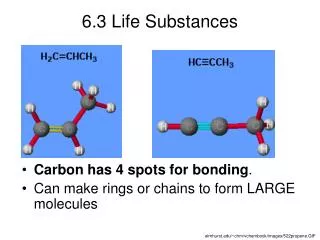
Structure of carbon • 4 electrons in its outer shell = 4 covalent bonds • Allows for different shapes of structures • Allows for diversity in carbon compounds
Structure of carbon • Isomers – compounds that have the same chemical formula, but differ in three dimensional shape. • Polymers of carbon are large molecules made from many smaller carbon molecule units (sugars starches)
Carbohydrates • Provide energy (esp. for nervous system) • C, H, O - 1:2:1 • Simple sugars = monosaccharides • Monosaccharides can link together to form a polysaccharide – starch
Lipids • Mostly carbon and hydrogen w/ very little oxygen • Fats, oils, steroids • Glycerol “backbone” w/ fatty acids attached = glyceride • Functions: energy storage, insulation, protective coverings; major component in membranes
Proteins • Made of C, H, O, N, and sometime S • Monomer = amino acid (20 common ones) • Combinations of amino acids can make thousands of different 3-D proteins
Proteins • Amino acids are linked together through dehydration synthesis creating a peptide bond • Enzyme is a protein catalyst; it is used to speed up a reaction, usually by lowering its activation energy, but is not used up in the reaction
Nucleic Acids • Complex molecule used to store hereditary info • Monomers = nucleotide = sugar, nitrogenous base, phosphate group • Made up of C, H, N, P, and O
Nucleic Acids • Found in DNA and RNA – named for the sugar found on the nucleotides • DNA is the gene sequence found in all organisms • RNA is used in protein synthesis in various ways