Challenges in Modern Africa
80 likes | 229 Vues
The legacy of apartheid in South Africa, characterized by racial segregation and oppression, has significantly shaped contemporary Africa. The apartheid regime divided citizens into four racial groups and imposed severe societal restrictions. Although apartheid ended with the election of Nelson Mandela in 1994, the effects linger. Additionally, many African nations face challenges from one-party rule and military dictatorships, ongoing ethnic conflicts, and struggles for democracy. This text explores these multifaceted issues and their implications for Africa's future.


Challenges in Modern Africa
E N D
Presentation Transcript
Legacy of Apartheid: “apartness” • Policy in South Africa which divided people into four racial groups, White, Black, colored (mixed ancestry) & Asians. • Attempted to create a greater separation between nonwhites & whites while imposing harsh controls over nonwhites BY LAW! • Laws banned interracial marriages.
Legacy of Apartheid: “apartness” • Black South Africans were required to carry passes or identity books, could not vote, hold political office or work in certain jobs; were not citizens and could only live in impoverished areas. • Decades of protest against apartheid led to its end, and South Africans elected the country’s first black president – Nelson Mandela (as part of the African National congress, he had been in jail for more than 20 years for fighting apartheid)
One-Party Rule & Military dictatorships • After many African countries gained independence following WWII, strong leaders seized power and set-up one party rule or military dictatorships • These governments accepted bribes and ran the government for personal profit. • Although some of these regimes lasted for many years, others were toppled and replaced in military coups.
Examples: • Mobutu SeseSeko of the Congo • IdiAmin of Uganda • Robert Mugabe of Zimbabwe
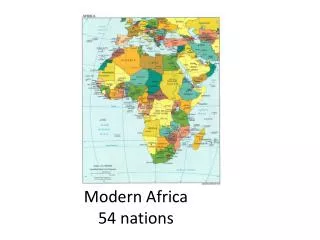
Ethnic Conflicts & Civil War • Africa’s ethnic diversity & rivalries, combined with country borders that were drawn without consideration of ethnic & tribal homelands, led to conflicts & civil wars in many countries • Rwanda experienced ethnic cleansing (genocide) in 1994; Sudan is still experiencing it today • Examples: Nigeria, Somalia, Rwanda, Sierra Leone, Sudan
Struggles with Democracy • Beginning in the early 1990’s, many African countries began to make progress toward democracy and overcome their history of dictatorship & conflict • Most still struggle to hold free elections and maintain stability • Examples: South Africa, Ghana, Kenya, Mali, Senegal
Today Africa faces many economic & environmental challenges, such as struggling economies, disease and desertification.