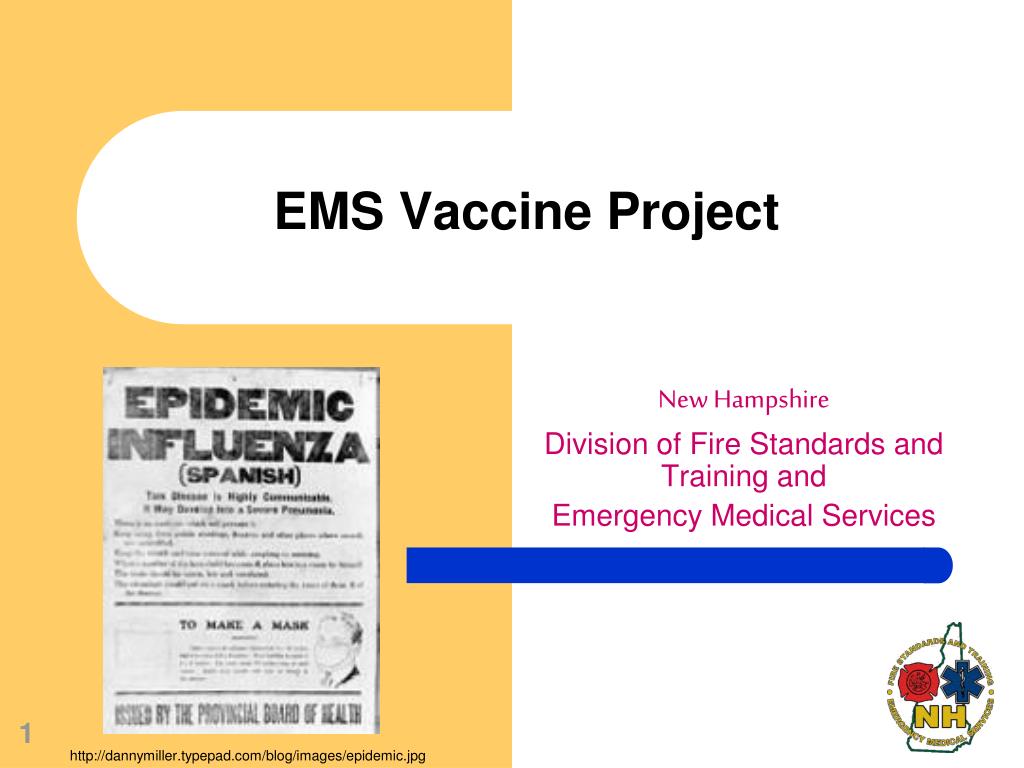
EMS Vaccine Project. New Hampshire Division of Fire Standards and Training and Emergency Medical Services. http://dannymiller.typepad.com/blog/images/epidemic.jpg. Acknowledgments. Developed under the CDC Preparedness Grant Dr. Joseph Sabato Paramedic Chuck Hemeon
Une image / un lien ci-dessous est fourni (tel quel) pour télécharger la présentation
Politique de téléchargement : le contenu du site vous est fourni TEL QUEL pour votre information et votre usage personnel ; il ne peut être vendu, concédé sous licence ni partagé sur d’autres sites sans l’accord de son auteur.Le contenu vous est fourni TEL QUEL, pour votre information et votre usage personnel uniquement.Téléchargez la présentation en cliquant sur ce lien.Lors du téléchargement, si vous ne parvenez pas à télécharger une présentation, l’éditeur a peut-être supprimé le fichier de son serveur.Pendant le téléchargement, si vous ne parvenez pas à obtenir une présentation, le fichier a peut-être été supprimé par l’éditeur.
F I N
Plus de contenu associé
Transcription de la présentation
EMS Vaccine Project New Hampshire Division of Fire Standards and Training and Emergency Medical Services http://dannymiller.typepad.com/blog/images/epidemic.jpg
Acknowledgments • Developed under the CDC Preparedness Grant • Dr. Joseph Sabato • Paramedic Chuck Hemeon • Paramedic Vicki Blanchard • Paramedic/RN Clay Odell • Bureau Chief Sue Prentiss
Acknowledgments • This EMS Vaccine Program has been partly funded under an Agreement with the State of NH, Dept. of Health & Human Services, by the US Dept. of HHS • the Office of the Assistant Secretary for Preparedness and Response - the Hospital Preparedness Program.
Why are we here? • Diseases of greatest concern • CDC Guidelines and Federal Laws • Federally required documentation • How to assist State Health Officials • Not here for lessons on IM injections
Influenza • “The Flu”: a highly contagious viral infection of the nose, throat and lungs • Influenza is an RNA virus • Type A & B • Respiratory symptoms, causing epidemics • Type C • Mild, do not cause symptoms
www.abc.net.au/health/library/influenza_ff.htm Type A • Hemagglutinin (H) • Neuraminidase (N) • These two proteins determine immunity, infection, severity and diagnosis of flu • Also infects horses, pigs, birds
Influenza Concerns • The influenza Type A viruses that are presently infecting humankind are: • A(H1N1) or "Spanish Flu“ • A(H1N1) or “Swine Flu” • A(H3N2)- or "Hong Kong Flu". • A(H1N2) a re-assortment of the above
Influenza Pandemic History • 1918 Spanish Flu • 1957 Asian Flu • 1968 Hong Kong Flu • 1997 Avian Flu • 2009 Swine Flu
1918 Spanish Flu A(H1N1) • Summer-Fall 1918 • AKA Spanish Flu • World War I • Influenza 1918 - 1919 • 20 million to 50 million deaths worldwide • 675,000 deaths in USA • Undiscovered virus at the time • Mass casualty in health facilities
1957 Asian Flu A(H2N2) • 1 – 2 million deaths worldwide • 70,000 USA deaths • Contraction rates greatest among school age • Death rates were highest among elderly • Science and technology advancement enabled vaccine
1968 Hong Kong Flu A(H2N2) • 700,000 deaths worldwide (34,000 USA) • Fewer people died because: • Improved medical care supported very ill • Antibiotics now available for secondary illnesses • Antigen N2 same as with 1957 Asian flu, severity probably reduced because people retained antibodies against N2 in their system from the 1957 pandemic
1997 Avian Influenza A(H5N1) • Avian (bird) influenza (flu) • Occurs naturally among birds • Infection can occur in humans • Most human infection result from contact with infected poultry or surfaces contaminated with secretion/excretions from infected birds • Very rarely spread from one ill person to another
Bird Flu (Avian Flu)1997 - 2009 • Slaughter of chickens occurred to removed source of infection to humans • World Health Organization (WHO) keeps surveillance on the Avian Flu • www.who.int/en/ for the most up to date information • Since June 2, 2009: 433 cases with 262 deaths from Avian Flu
Influenza Vaccine • Vaccine comes in two forms • inactivated virus for intramuscular administration • Live, antennuated virus for intranasal administration
Manufactured in eggs Takes six months to manufacture adequate vaccine Patient’s allergic to eggs should not receive the vaccine. Manufactured in eggs
Influenza Vaccine • Most effective if given within 2-4 months of illness • 90% effective in preventing illness in the healthy • 50-60% effective at preventing hospitalization in elderly • 80% effective at preventing death
Principals Vaccination • Active immunity produced by vaccine • Immunity similar to natural infection but without risk of disease
Live Attenuated Vaccine • Pathogen grown in animal or tissue culture under conditions that make it less virulent. • Nasal Spray Form
Influenza Clinical Features • Incubation period 2 days (range 1-5 days) • Severity of illness depends on prior experience with related variants • Abrupt onset of fever, myalgia, sore throat, nonproductive cough, headache
Healthcare Flu Vaccination • Historic rates of 34% for healthcare workers • Leading cause of occupational illness and risk of spread to patients • In pandemic planning we need to increase
Protection for yourself & your EMS crew • Infection control policies & procedures • Proper respiratory protection • N-95 or HEPA filter mask • Fit-tested • Hand-hygiene policies • Cleaning of ambulance, stretcher and equipment
Influenza Vaccine Indications • Children > 6 month to 5 years • Pregnant women • Adults greater then 50 years of age • Healthcare workers • Patients with history of chronic diseases • Patient with immunocompromise
Influenza Vaccine Contraindications • Influenza vaccine is not approved for children < 6 months of age • Allergy to eggs, vaccine or thimerosal • Moderate to severe acute illness with fever • Previous adverse reaction • History of Guillain-Barre syndrome within 6 weeks of previous influenza vaccines
Influenza Vaccine (Injection)Side effects • The viruses in the flu shot are killed (inactive), so you CANNOT get the flu from the flu shot (CDC) • Soreness, redness or swelling where the shot was given • Fever (low grade) • Malaise
Influenza Vaccine Live Attenuated (Nasal-Spray) Side Effects • Per the CDC “The viruses in the nasal-spray vaccine are weakened and do not cause severe symptoms often associated with influenza illness. (In clinical studies, transmission of vaccine viruses to close contacts has occurred only rarely.) • Children: runny nose, headache, vomiting, malaise, fever • Adults: runny nose, headache, sore throat, cough
Pneumococcal Pneumonia • Common but serious pulmonary infection • The gram-positive, spherical bacteria, Streptococcus pneumoniae • Elderly, infants, cancer patients, AIDS patients, post-operative, alcoholics and diabetics at highest risk • CDC states the only way to prevent is with pneumococcal vaccine
An Ounce of Prevention • During the past decade many strains of pneumococcus have become resistant to antibiotics • Vaccination prevents contracting the disease
Polysaccharide Vaccines • Made from the sugar coating of the bacteria • Mediated by antibodies • Exposing the person to only part of the bacterium elicits a protective active immune response
Pneumococcal Polysaccharide Vaccine • The polysaccharide coating doesn’t mutate or change very often • There are only 23 subtypes • Vaccination lasts about 10 years • Reduces complications from pneumonia
Pneumococcal Vaccine Dose • 0.5ml intramuscular injection in the deltoid with a 1 -11/2 inch 22-25 gauge needle • Children receive a series of 4 shots with a different vaccine • Children with special needs should be referred to their pediatrician or medical specialist
Severe Adult Respiratory Syndrome (SARS) • Newly identified acute viral respiratory syndrome • Caused by a novel coronavirus (not Corona beer) • Corona means crown-like (under microscope the SAR-CoV looks crown-like) • 2002 – 2003 Epidemic involving 26 countries with 8098 cases and 774 death.
Required forms/documents • Its Federal Law • Screening Questionnaire • Do I Need a Vaccine Today? • Vaccine Information Sheets (VIS) • Vaccine Administration Record • Skills Checklist for Immunization
Vaccine Administration Procedure • Reference Appendix CDC Immunization Guide • CDCs “Pink Book” Epidemiology and Prevention of Vaccine-Preventable Diseases