CPU Scheduling
CPU Scheduling. Basic Concepts Scheduling Criteria Scheduling Algorithms Multiple-Processor Scheduling Real-Time Scheduling. CPU Scheduler. Selects from among the processes in memory that are ready to execute, and allocates the CPU to one of them. When does kernel get to choose?

CPU Scheduling
E N D
Presentation Transcript
CPU Scheduling Basic Concepts Scheduling Criteria Scheduling Algorithms Multiple-Processor Scheduling Real-Time Scheduling
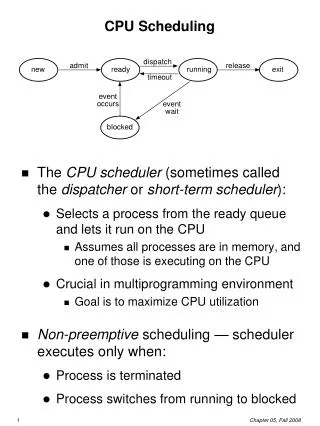
CPU Scheduler • Selects from among the processes in memory that are ready to execute, and allocates the CPU to one of them. • When does kernel get to choose? • when a running thread blocks • when a running thread terminates • when a running thread is preempted • possibly, when a waiting thread moves to ready list. • possibly, on any entry to the kernel
Dispatcher • Dispatcher module gives control of the CPU to the process selected by the short-term scheduler; this involves: • switching context • switching to user mode • jumping to the proper location in the user program to restart that program • Dispatch latency – time it takes for the dispatcher to stop one process and start another running.
CPU bound vs. I/O bound Process • Bursts of CPU usage alternate with periods of I/O wait • a CPU-bound process • an I/O bound process
Possible Goals of Scheduling • Maximize throughput • number of processes completed per unit time • Minimize turnaround time • how long does my process take to execute? • Minimize response time • amount of time until thread sees some result • Fairness • give each process a fair share of CPU • Predictability • avoid quality degradation in multimedia systems These goals conflict! Which goals to optimize depends on system.
P1 P2 P3 0 24 27 30 First-Come, First-Served (FCFS) Scheduling ProcessBurst Time P1 24 P2 3 P3 3 • Suppose that the processes arrive in the order: P1 , P2 , P3 The Gantt Chart for the schedule is: • Waiting time for P1 = 0; P2 = 24; P3 = 27 • Average waiting time: (0 + 24 + 27)/3 = 17
FCFS Scheduling (Cont.) P2 P3 P1 0 3 6 30 Suppose that the processes arrive in the order P2 , P3 , P1 . • The Gantt chart for the schedule is: • Waiting time for P1 = 6;P2 = 0; P3 = 3 • Average waiting time: (6 + 0 + 3)/3 = 3 • Much better than previous case. • Convoy effect short process behind long process
Shortest-Job-First (SJR) Scheduling • Associate with each process the length of its next CPU burst. Use these lengths to schedule the process with the shortest time. • Two schemes: • nonpreemptive – once CPU given to the process it cannot be preempted until completes its CPU burst. • preemptive – if a new process arrives with CPU burst length less than remaining time of current executing process, preempt. This scheme is know as the shortest-Remaining-Time-First (SRTF). • SJF is optimal – gives minimum average waiting time for a given set of processes.
P1 P3 P2 P4 0 3 7 8 12 16 Example of Non-Preemptive SJF Process Arrival TimeBurst Time P1 0.0 7 P2 2.0 4 P3 4.0 1 P4 5.0 4 • SJF (non-preemptive) • Average waiting time = (0 + 6 + 3 + 7)/4 - 4
P1 P2 P3 P2 P4 P1 11 16 0 2 4 5 7 Example of Preemptive SJF Process Arrival TimeBurst Time P1 0.0 7 P2 2.0 4 P3 4.0 1 P4 5.0 4 • SJF (preemptive) • Average waiting time = (9 + 1 + 0 +2)/4 - 3
Priority Scheduling • A priority number (integer) is associated with each process • The CPU is allocated to the process with the highest priority (smallest integer highest priority). • Preemptive • nonpreemptive • SJF is a priority scheduling where priority is the predicted next CPU burst time. • Problem Starvation – low priority processes may never execute. • Solution Aging – as time progresses increase the priority of the process.
Round Robin (RR) • Each process gets a small unit of CPU time (time quantum), usually 10-100 milliseconds. After this time has elapsed, the process is preempted and added to the end of the ready queue. • If there are n processes in the ready queue and the time quantum is q, then each process gets 1/n of the CPU time in chunks of at most q time units at once. No process waits more than (n-1)q time units. • Performance • q large FIFO • q small q must be large with respect to context switch, otherwise overhead is too high.
P1 P2 P3 P4 P1 P3 P4 P1 P3 P3 0 20 37 57 77 97 117 121 134 154 162 Example of RR with Time Quantum = 20 ProcessBurst Time P1 53 P2 17 P3 68 P4 24 • The Gantt chart is: • Typically, higher average turnaround than SJF, but better response.
Multilevel Queue • Ready queue is partitioned into separate queues:foreground (interactive)background (batch) • Each queue has its own scheduling algorithm, foreground – RRbackground – FCFS • Scheduling must be done between the queues. • Fixed priority scheduling; (i.e., serve all from foreground then from background). Possibility of starvation. • Time slice – each queue gets a certain amount of CPU time which it can schedule amongst its processes; i.e., 80% to foreground in RR 20% to background in FCFS
Multilevel Feedback Queue • A process can move between the various queues; aging can be implemented this way. • Multilevel-feedback-queue scheduler defined by the following parameters: • number of queues • scheduling algorithms for each queue • method used to determine when to upgrade a process • method used to determine when to demote a process • method used to determine which queue a process will enter when that process needs service
Example of Multilevel Feedback Queue • Three queues: • Q0 – time quantum 8 milliseconds • Q1 – time quantum 16 milliseconds • Q2 – FCFS • Scheduling • A new job enters queue Q0which is servedFCFS. When it gains CPU, job receives 8 milliseconds. If it does not finish in 8 milliseconds, job is moved to queue Q1. • At Q1 job is again served FCFS and receives 16 additional milliseconds. If it still does not complete, it is preempted and moved to queue Q2.
Multiple-Processor Scheduling • CPU scheduling more complex when multiple CPUs are available. • Homogeneous processors within a multiprocessor. • Load sharing • Asymmetric multiprocessing – only one processor accesses the system data structures, alleviating the need for data sharing.
Real-Time Scheduling • Hard real-time systems • must execute process in specific time, or reject it; known as resource reservation. • require different kind of OS. • Soft real-time computing • less restrictive – critical threads get priority. • must have priority scheduling • need: dispatch latency to be small • hard if no preemption in system call • may need to make kernel preemptible • need to avoid priority inversion
Scheduling in Real-Time Systems Schedulable real-time system • Given • m periodic events • event i occurs within period Pi and requires Ci seconds • Then the load can only be handled if
Thread Scheduling (1) Possible scheduling of user-level threads • 50-msec process quantum • threads run 5 msec/CPU burst
Thread Scheduling (2) Possible scheduling of kernel-level threads • 50-msec process quantum • threads run 5 msec/CPU burst