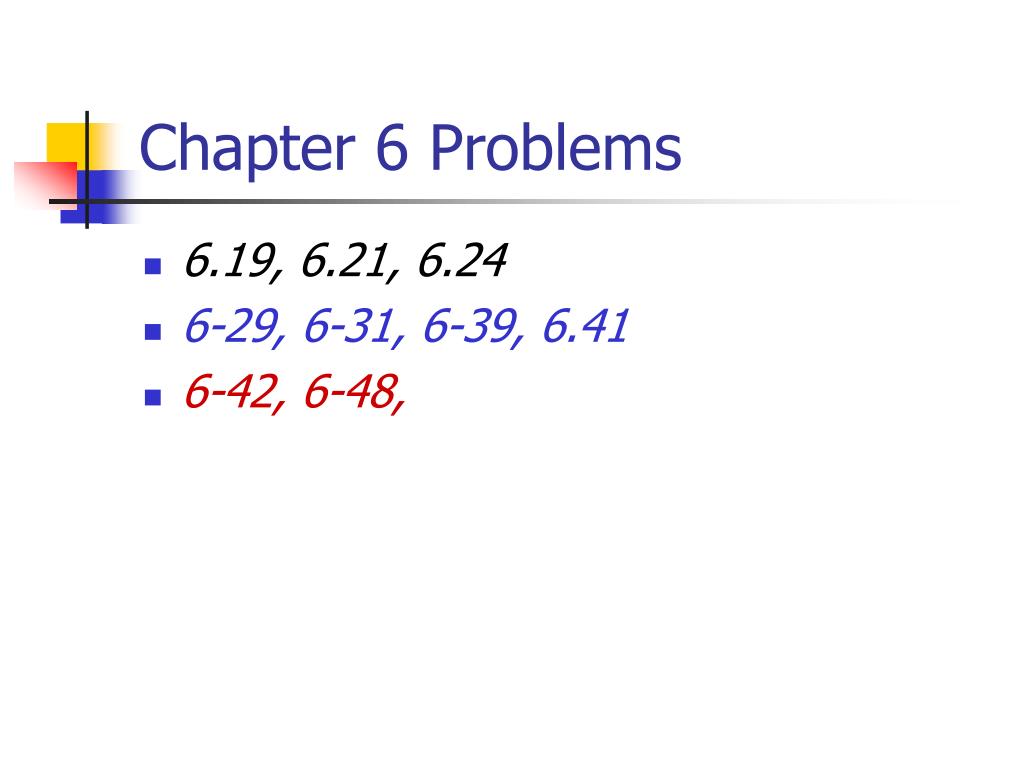
Chapter 6 Problems. 6.19, 6.21, 6.24 6-29, 6-31, 6-39, 6.41 6-42, 6-48,. 6-19. A solution contains 0.0500 M Ca 2+ and 0.0300 M Ag + . Can 99% of Ca 2+ be precipitated by sulfate without precipitating Ag + ? What will be the concentration of Ca 2+ when Ag 2 SO 4 begins to precipitate?.
Une image / un lien ci-dessous est fourni (tel quel) pour télécharger la présentation
Politique de téléchargement : le contenu du site vous est fourni TEL QUEL pour votre information et votre usage personnel ; il ne peut être vendu, concédé sous licence ni partagé sur d’autres sites sans l’accord de son auteur.Le contenu vous est fourni TEL QUEL, pour votre information et votre usage personnel uniquement.Téléchargez la présentation en cliquant sur ce lien.Lors du téléchargement, si vous ne parvenez pas à télécharger une présentation, l’éditeur a peut-être supprimé le fichier de son serveur.Pendant le téléchargement, si vous ne parvenez pas à obtenir une présentation, le fichier a peut-être été supprimé par l’éditeur.
6-19. • A solution contains 0.0500 M Ca2+ and 0.0300 M Ag+. Can 99% of Ca2+ be precipitated by sulfate without precipitating Ag+? What will be the concentration of Ca2+ when Ag2SO4 begins to precipitate?
6-19. • A solution contains 0.0500 M Ca2+ and 0.0300 M Ag+. Can 99% of Ca2+ be precipitated by sulfate without precipitating Ag+? What will be the concentration of Ca2+ when Ag2SO4 begins to precipitate? Ca2+ at equilibrium CaSO4 Ca2+ + SO42- Ksp= 2.4 x 10-5 = [0.000500][SO42-] CaSO4 Ca2+ + SO42- Ksp= 2.4 x 10-5 = [Ca2+][SO42-] [SO42-] = 0.048 M Sep. is NOT feasible Q>K Ag2SO4 2Ag+ + SO42- Ksp = 1.5 x 10⁻⁵ Q = [Ag+]2[SO42-] Q = [0.03]2[0.000500] Q = 4.3 x 10⁻⁵
6-19. • A solution contains 0.0500 M Ca2+ and 0.0300 M Ag+. Can 99% of Ca2+ be precipitated by sulfate without precipitating Ag+? What will be the concentration of Ca2+ when Ag2SO4 begins to precipitate? Ag2SO4 2Ag+ + SO42- Ksp = 1.5 x 10⁻⁵ K/[Ag2+]2 = [SO42-] 1.5 x 10⁻⁵/[0.0300]2 = [SO42-] 1.67 x 10-2= [SO42-] Find Ca2+ CaSO4 Ca2+ + SO42- Ksp= 2.4 x 10-5 = [Ca2+][1.67 x 10⁻²] [Ca2+] = 0.0014 M About 2.8 % remains in solution
6.21 • If a solution containing 0.10 M Cl-, Br-, I- and Cr2O42- is treated with Ag+, in what order will the anions precipitate? AgCl Ag+ + Cl- Ksp = 1.8 x 10-10=[Ag][Cl] AgBr Ag+ + Br- Ksp = 5.0 x 10-13=[Ag][Br] AgI Ag+ + I- Ksp = 8.3 x 10-17=[Ag][I] Ag2CrO4 2Ag+ + CrO4-Ksp = 1.2 x 10-12=[Ag]2[Cl] AgCl Ag+ + Cl- Ksp = 1.8 x 10-10=[Ag][0.1] AgBr Ag+ + Br- Ksp = 5.0 x 10-13=[Ag][0.1] AgI Ag+ + I- Ksp = 8.3 x 10-17=[Ag][0.1] Ag2CrO4 2Ag+ + CrO4-Ksp = 1.2 x 10-12=[Ag]2[0.1] 1.8 x 10-9=[Ag] 5.0 x 10-12=[Ag] 8.3 x 10-16=[Ag] 3.5 x 10-6=[Ag] SOLVE for Ag+ required at equilibrium
6-24. SnCl2(aq) • The cumulative formation constant for SnCl2(aq) in 1.0 M NaNO3 is b2=12. Find the concentration of SnCl2 for a solution in which the concentration of Sn2+ and Cl- are both somehow fixed at 0.20 M. Sn2+ (aq) + 2Cl-(aq) SnCl2 (aq) b2=12 b2=12
Complex Formation complex ions (also called coordination ions) Lewis Acids and Bases acid => electron pair acceptor (metal) base => electron pair donor (ligand)
Overall constants are designated with b This one is b2 Effects of Complex Ion Formation on Solubility Consider the addition of I- to a solution of Pb+2 ions
Strong Bronsted-Lowry Acid • A strong Bronsted-Lowry Acid is one that donates all of its acidic protons to water molecules in aqueous solution. (Water is base – electron donor or the proton acceptor). • HCl as example
Strong Bronsted-Lowry Base • Accepts protons from water molecules to form an amount of hydroxide ion, OH-, equivalent to the amount of base added. • Example: NH2- (the amide ion)
Question • Can you think of a salt that when dissolved in water is not an acid nor a base? • Can you think of a salt that when dissolved in water IS an acid or base?
Weak Bronsted-Lowry acid • One that DOES not donate all of its acidic protons to water molecules in aqueous solution. • Example? • Use of double arrows! Said to reach equilibrium.
Weak Bronsted-Lowry base • Does NOT accept an amount of protons equivalent to the amount of base added, so the hydroxide ion in a weak base solution is not equivalent to the concentration of base added. • example: NH3
Example • What is the concentration of OH- in a solution of water that is 1.0 x 10⁻³ M in [H+] (@ 25 oC)? “From now on, assume the temperature to be 25oC unless otherwise stated.” Kw = [H+][OH-] 1 x 10-14 = [1 x 10⁻³][OH-] 1 x 10-11 = [OH-]
Is there such a thing as Pure Water? • In most labs the answer is NO • Why? • A century ago, Kohlrausch and his students found it required to 42 consecutive distillations to reduce the conductivity to a limiting value. CO2 + H2O HCO3- + H+
Kb NH3 + H2O NH4+ + OH- Ka NH4+ + H2O NH3 + H3O+ H2O + H2O OH- + H3O+ Relation between Ka and Kb • Consider Ammonia and its conjugate acid.
Example The Ka for acetic acid is 1.75 x 10⁻⁵. Find Kb for its conjugate base. Kw = Ka x Kb
Example • Calculate the hydroxide ion concentration in a 0.0100 M sodium hypochlorite solution. OCl- + H2O HOCl + OH- The acid dissociation constant = 3.0 x 10⁻⁸
8-1 Effect of Ionic Strength on Solubility of Salts • Consider a saturated solution of Hg2(IO3)2 in ‘pure water’. Calculate the concentration of mercurous ions. Hg2(IO3)2(s)D Hg22+ + 2IO3- Ksp=1.3x10⁻¹⁸ some - - -x +x +2x some-x +x +2x I C E A seemingly strange effect is observed when a salt such as KNO3 is added. As more KNO3 is added to the solution, more solid dissolves until [Hg22+] increases to 1.0 x 10⁻⁶ M. Why?
Increased solubility • Why? • Complex Ion? • No • Hg22+ and IO3- do not form complexes with K+ or NO3-. • How else?
The Explanation • Consider Hg22+ and theIO3- Electrostatic attraction - 2+
The Explanation • Consider Hg22+ and theIO3- Electrostatic attraction - 2+ Hg2(IO3)2(s) The Precipitate!!
The Explanation • Consider Hg22+ and theIO3- NO3- K+ K+ NO3- NO3- NO3- K+ - K+ 2+ NO3- NO3- NO3- NO3- K+ K+ NO3- NO3- Hg22+ and IO3- can’t get CLOSE ENOUGH to form Crystal lattice Or at least it is a lot “Harder” to form crystal lattice
Alright, what do we mean by Ionic strength? • Ionic strength is dependent on the number of ions in solution and their charge. Ionic strength (m) = ½ (c1z12+ c2z22 + …) Or Ionic strength (m) = ½ S cizi2
Examples • Calculate the ionic strength of (a) 0.1 M solution of KNO3and (b) a 0.1 M solution of Na2SO4 (c) a mixture containing 0.1 M KNO3 and 0.1 M Na2SO4. (m) = ½ (c1z12+ c2z22 + …)
Relationship between activity and ionic strength Debye-Huckel Equation m = ionic strength of solution g = activity coefficient Z = Charge on the species x a = effective diameter of ion (nm) 2 comments • What happens to g when m approaches zero? • Most singly charged ions have an effective radius of about 0.3 nm Anyway … we generally don’t need to calculate g – can get it from a table