Download
1 / 22
220 likes | 332 Vues
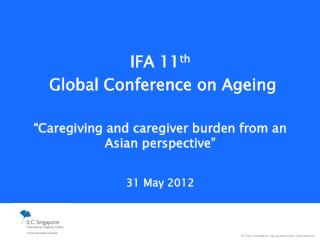
IFA 11 th Global Conference on Ageing “Caregiving and caregiver burden from an Asian perspective” 31 May 2012. A partnership between Other regional partner areas : India (GRAVIS) and Indonesia (CAS-UI, YEL and SCI) as part of the Health Working Group within HelpAge International network.

E N D
IFA 11th Global Conference on Ageing “Caregiving and caregiver burden from an Asian perspective” 31 May 2012
A partnership between Other regional partner areas : India (GRAVIS) and Indonesia (CAS-UI, YEL and SCI) as part of the Health Working Group within HelpAge International network
Self Care for Older Persons In Singapore: An Intervention Study(SCOPE) Susana Concordo Harding Director, ILC - Singapore A/P Angelique Chan Dept. of Sociology, NUS HSSR, Duke-NUS Prof David Matchar Director, Program in Health Services and Systems Research, Duke-NUS
Outline of Presentation Aims Hypothesis Overview of Study Design Barriers Faced in Providing Healthcare to OP in Singapore Study Timeline Inclusion Criteria Recruitment : Bukit Merah and Ang Mo Kio areas Research Design with Randomization
Outline of Presentation • The Intervention • Approach • Training Curriculum • Measures • Indicators of Success to be Measured • Progress so far
Aims • Evaluate a self-care intervention program aimed at enhancing the ability of mildly disabled and healthy older persons in Singapore to care for themselves • Evaluate the effectiveness of training health partners and community health trainers (CHTs) located within Senior Activity Centres (SACs) in Singapore to support the self-care capacity development amongst older persons in the locale
Hypotheses Self-care training will build the capacity of older persons for self-care as measured by improvements in functional status, quality of life, knowledge, attitudes, and preferences, and health care seeking behavior. Self care training will enhance a supportive attitudeamong older persons Self care training will increase knowledge of CHTs. Self care training will improve the control of chronic diseases (diabetes, hypertension, COPD).
Overview of Study Design • Randomized Controlled Trial (RCT) • 18 months • Intervention runs from baseline to 6 months • Questionnaire and biomarker collection at baseline, 8 months, and 18 months • 2 Arms • Intervention Arm • Control Arm(usual care)
Barriers Faced in the Providing Healthcare to Older Adults in Singapore
Study Timeline INTERVENTION FOLLOW-UP RECRUITMENT Baseline 18 mo. 8 mo. Training sessions Weekly support group sessions Randomization • Pre-intervention assessment: • Baseline questionnaire • Biomarker collection • Distribution of event diaries • Questionnaire • Biomarker collection • Questionnaire • Biomarker collection
Sample (N = 400 intervention group = 200, control group = 200) Inclusion Criteria
SAC Recruitment: Ang Mo Kio and Bukit Merah 2 different areas to control for socio-economic factors
The Intervention • Subjects receive 2 hour long training sessions for 7 months • Meet with CHT to develop health plan • Training sessions include: • Health promotion • Disease prevention • Health seeking behavior • Chronic disease management • Anti-stigmatization • Subjects will receive 24 two-hour weekly group-support sessions after the intervention period
Approach “UNDERSTAND” something new “VALUE” something new “DO” something new
Training Curriculum Basic Core Program: • Session 1: Successful Aging and the SCOPE Program • Session 2: My Life & Health Goals / Wishes • Session 3: Getting to Know Our Bodies • Session 4: Caring for Ourselves • Session 5: Common Chronic Diseases • Session 6: Common Community Health Problems • Session 7: My Health Baseline • Session 8: Health Monitoring, Goals & Plans • Session 9: Dealing with Stress • Session 10: Reframing Emotions • Session 11: Keeping the Mind Active • Session 12: Being Positive in One’s Life • Session 13: Two Models of Medicine • Session 14: Getting Good Medical Care
Training Curriculum Lifestyle Core Program: • Session 1: Ingredients of a Healthy Diet • Session 2: Eating Out & Cooking at Home • Session 3: Sensible Eating and Shopping for Food • Session 4: On Having an Eating Plan • Session 5: Keeping Fit • Session 6: Types of Exercises • Session 7: Creating a Personal Exercise Plan • Session 8: Living With Diabetes • Session 9: Living with Hypertension • Session 10: Medication Management • Session 11: Self-Care as a Personal Responsibility • Session 12: Family Dynamics • Session 13: How to Get What We Need • Session 14: Looking Ahead After the SCOPE Program
Training Curriculum – Health Partner • Session 1: Ageism & The Myths of Ageing • Session 2: Understanding Health Partnering • Session 3: The Dynamics of Health Partnering • Session 4: Effective Health Partnering and Coaching • Session 5: Communication Styles & Dynamics • Session 6: On Being an Active Listener • Session 7: Motivation and Older People • Session 8: The Partnering Sessions • Session 9: Living with Diabetes • Session 10: Living with Hypertension • Session 11: Nutrition and Healthy Eating • Session 12: Physical Activity and Exercise • Session 13: Getting Good Medical Care • Session 14: Getting What We Need
Progress so far (1) • Started June 2011 • Number of participants Intervention: 165 Control: 217 Total of 382 Older Person • Community Health Trainer A total of 20 community health trainer with diverse background in nursing, social work and training have completed SCOPE Program’s Training of Trainer in April 2012.
Progress so far (2) • SCOPE modules Three different sets of SCOPE modules have been developed. Each is targeted for the different education levels of the older persons. • Training Intervention Training intervention will start on the 2nd week of June 2012 and the 28 sessions will run up to December 2012. • SCOPE in Youtube http://www.youtube.com/watch?v=OfTWjvSnyI0