Download
1 / 20
200 likes | 326 Vues
Advent, meaning "arrival," marks the beginning of the Church's liturgical year. It invites us to reflect on Christ's first coming in the manger while anticipating His glorious return. This spiritual season emphasizes preparation and repentance, marked by the color violet as a sign of longing and renewal. Key elements of Advent include the Advent wreath, biblical readings, hymns that capture the emotional essence of waiting, and the reminders of prayer through incense. Join this journey of hope and joy as we await the coming of our Savior.

E N D
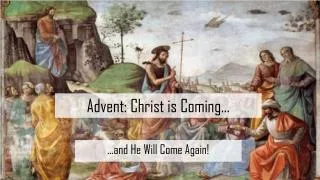
Advent: Christ is Coming… …and He Will Come Again!
Happy New Year! • The Church moves through a series of spiritual seasons throughout its Liturgical Year • Advent (from the Latin for “arrive”) begins the year • Looks back to Christ’s first coming in the manger • Looks ahead to His second coming in glory
Sights • Color = One of the first indicators of season • Violet-Usually signifies mourning or penance • Advent is not a penitential season like Lent, but it is one of spiritual preparation, and repentance is a theme in the readings • Rose is used on the Third Sunday of Advent • Advent wreath usually present
Sounds • Hymns help us experience the emotional “color” of the season: • Longing (“O Come, O Come Emmanuel”) • Joy (“The King of Glory Comes”) • Renewal (“On Jordan’s Bank”)
Smells • Incense: Signifies our prayer rising up to God • See: • Revelation 5:8 “…with golden bowls full of incense, which are the prayers of the saints.” • Revelation 8:4 “and the smoke of the incense rose with the prayers of the saints from the hand of the angel before God.”
The Word • Most important distinguishing mark of the season: Biblical Readings • The Liturgy has two parts: • the proclamation of the saving acts of God (Liturgy of the Word) • The making present of those mysteries in the celebration of the Sacrament (Liturgy of the Eucharist)
Incarnational Faith • Our worship is Incarnational-it engages our whole being • Body & Soul • Mind & Heart • Time & Space • Because of Creation and Redemption • God created everything for His praise and man’s use • Christ’s saving acts embrace all created reality
You Have Put on Christ • Baptism makes us part of the Mystical Body of Christ • Christ is the Head of His Body (the Church) • Where the Head goes, the Body will follow • The Liturgical Calendar helps us (members of the Body) share in the mysteries of Christ’s earthly life
The Day of the Sun • Sunday is the original feast day • Christ rose on Sunday • Appeared to disciples on Sundays • Justin Martyr wrote in 155 AD that Christians worshipped “on the day we call the day of the Sun” (CCC 1345) • Church calendar counts by Sundays (Four in Advent) • Advent wreath embodies liturgical perspective on time
Last Thing’s First • Readings for 1st Sunday of Advent • OT: Speaks longingly of the Lord’s coming and setting people and things aright • NT: Exhortations from St. Paul to live as good Christians ought • Gospel: Prophecy of Christ’s Second Coming
People of Advent: Isaiah • Isaiah is the most quoted book in the NT • Often called “the fifth Gospel” because it prophecies so much about the Messiah • 2 main parts of the book: • Chapters 1-39: some bright spots, but doom for Israel • Ch. 40-66: Restoration promised The Prophet Isaiah, by Raphael, St. Agostino, Rome
Second to None • Readings for the 2nd Sunday of Advent: • OT: The consolation that the Lord brings to His people • NT: Exhortation to love, harmony, or preparedness • Gospel: The ministry of John the Baptist Alexandre Cabanel, John the Baptist
Three to Get Ready • Readings for the 3rd Sunday of Advent (Gaudete Sunday): • OT: Rejoicing/encouragement • NT: Rejoice & Patience • Gospel: The Message of St. John the Baptist • Jesus’ testimony to John • John’s identity: I am the Voice • Practical advice for repentance
People of Advent: The Baptist • Bridge figure in Salvation History • Last of the OT prophets • First to announce the coming of Christ in His public life • Jesus said there was no greater man born of woman & that he was “Elijah” • Preached repentance in preparation for the Messiah Icon of Elijah and St. John the Baptist
Four to Go! • Readings for the 4th Sunday of Advent: • OT: Birth of the Messiah prophesied (a virgin shall conceive…) • NT: The proclamation of “Jesus Christ” • Gospel: The Annunciation and birth of Christ
People of Advent: Mary • Solemnity of the Immaculate Conception always falls during Advent • Appropriate, because the reason she was conceived without sin was to make her a fit mother for the Son of God • Mary is our Model of Advent Patience, Preparation, and Rejoicing “Mary Comforts Eve” by Trappist Sisters of Mississippi Abbey
A Mass a Day Keeps the Devil Away • The weekday Mass readings during Advent are divided into three parts: • Week 1-2: Isaiah, lots of him • Week 2 (End)-3: The Baptist • Week 4: Events leading up to the birth of Christ
O My Goodness! • The Alleluia verses for December 17-23 are collectively known as the “O Antiphons” • Taken from the Antiphon before the Magnificat during Vespers (Evening Prayer) of the same days • All address Christ directly (O…) by one of His titles drawn from Scripture (e.g. O Root of Jesse)
Roots, Keys, and Springs, O My! • O Antiphons: • Dec. 17– O Wisdom • Dec. 18—O Lord • Dec. 19—O Root of Jesse • Dec. 20—O Key of David • Dec. 21—O Dayspring • Dec. 22—O King of the Nations • Dec. 23—O Emmanuel • These are enshrined in the hymn “O Come O Come Emmanuel”
“Look Busy” The Magnificat Advent Companionwww.magnificat.com Joseph Ratzinger, What it Means to be a Christian, (San Francisco: Ignatius Press, 2006). Joseph Ratzinger, Seek That Which is Above: Meditations Through the Year, (San Francisco: Ignatius Press, 2007). Benedict XVI, Jesus of Nazareth: The Infancy Narratives (New York: Image, 2012). Scott Hahn, Signs of Life: 40 Catholic Customs and their Biblical Roots, (New York: Doubleday, 2009).